Organisational culture assessment
A clear picture of your organisational culture and how it’s affecting the day to day - how your organisation really runs, and the few changes that would make the most difference.

Our organisational culture assessment is a clear read of how your organisation works day to day - the principles you actually run on, how the work really gets done, and what the environment around it encourages. We look at what really happens: how decisions get made, what gets rewarded, what gets let slide, whether people feel safe to speak up. Then we give you the few patterns that matter most - what’s strong and worth keeping, what’s getting in the way, and what your people would change.
“Culture” is easy to talk about but can be harder to pin down. That’s why we focus on the tangible over the conceptual:
- The principles that guide decision making, sense-making and priorities
- The practices across the organisation - how work gets done
- The environment around them - what makes working that way natural
75% of organisations say they struggle to build a high-performance culture (McKinsey, State of Organizations 2026). Much of the difficulty is that culture is hard to see clearly from the inside - which is exactly what an assessment gives you.
When a culture assessment helps
An assessment is most useful when you need to see the culture clearly before you act - whether something isn’t landing, something’s about to change, or you’ve set a direction and need to know it’s lived:
The situation | How an assessment helps |
|---|---|
Strategy and behaviour are pulling apart | Shows where the gap actually sits, so you work the real obstacle, not a guess. |
The engagement scores are telling you something | Goes underneath the numbers to what’s driving them, so you act on the cause, not the symptom. Read the culture assessment in a professional membership body. |
Change keeps stalling | Surfaces the habits absorbing each attempt, so the next one lands. |
You’re new in post | Gives you a fair, clear read of what you’ve actually inherited. |
Two teams or cultures are coming together | Reads both sides, and where they’ll grate, before a merger or restructure makes it urgent. |
You’ve set new values, or you’re refreshing them | Reads whether they’re actually lived - and what it would take to make them stick. |
What we look at
Every organisation has a version of itself it describes out loud: the principles it says guide decisions, the practices it says it works by, the environment it says people work in. We start there. Then we read how much of it holds up day to day. These five angles are how we look.
Take one of them. Say a principle: we always put customers first.
Is it true when you look at behaviour? If it isn’t, would someone feel safe saying so? When we get it wrong, do we learn and change? Does the principle get weighed when following it is expensive? And do the people who hold to it when it’s hard get noticed?
Five questions, five different answers, and five different things to do about it. We run that same pass across your principles, your practices and your environment.

Integrity
Whether what people actually do matches what you say you stand for. Behaviour under pressure is the evidence here - claims are easy to live when the week is going well.
We gather specific moments - a budget call, a difficult exit, a shortcut taken or refused - and read each against the claim it tests. The finding is a map of where word and deed sit close, and where the distance deserves attention.

Safety
Whether people can speak up when something doesn’t match what you’ve said - even when it’s difficult. Speaking up is the mechanism that keeps the rest of it honest.
We measure it properly, on Edmondson’s psychological-safety scale, and read the results by team and level rather than as one average. Safety is rarely uniform - knowing where it’s strong tells you as much as knowing where it’s thin.

Learning
Whether the organisation learns and adapts when it falls short of its own standards, rather than blaming and moving on. How a shortfall is handled is one of the clearest tests of a claim in practice.
We trace recent examples - a missed target, a mistake, a complaint - and follow what happened next. The pattern shows whether shortfalls turn into adjustments, and where a little more curiosity would compound.

Respect
How seriously your organisation takes its own claims. Not how people treat each other - whether the principles, practices and environment you describe are treated as load-bearing, or set aside when they’re inconvenient.
We look at recent decisions where the claim was at stake, and whether anyone brought it into the room. A principle that never gets cited when it’s costly is one the organisation has quietly agreed to disregard.

Recognition
Whether what gets rewarded, celebrated, and promoted actually reflects what you say you value. It’s the angle with the most concrete evidence - promotions, praise and pay all leave a trail.
We read that trail: recent promotions, who got celebrated for what, and what went unremarked. Where it lines up with what you’ve said you have proof to point to; where it doesn’t, you’ve found one of the strongest levers culture work has.
The five angles stay constant; how we read them, we shape around you - your principles, structure, roles, locations and operating model - so the picture fits your organisation, not a template.

Why these five angles
We read principles, practices and environment rather than culture in the abstract, because those are the parts you can actually see and change - how decisions get made, how the work gets done, what behaviour gets rewarded, what it’s like to work here on a normal Tuesday. Culture is the deeper story underneath; these three are where it shows up, and where change takes hold.
The five angles are the conditions that decide whether any of it gets lived. A principle, a practice or an environment can be well designed and still fail on any one of them - which is why we read all five rather than only the first. Integrity is the most direct: the fit between what you say and what people actually do.
These five are our lens, refined across many organisations. They’re deliberately about lived experience, not aspiration - what happens, not what’s intended.
How it works
We read all three the way they’re actually lived - through more than one lens, so the findings hold up:
- We measure it - a whole-organisation survey across the five angles. We show you where views differ - leadership versus the front line, team by team - not just the average. The disagreement is usually where the story is.
- We listen - interviews across a cross-section of people, not only leaders. We look at real, recent situations: what actually happened, and how that squares with what the values would predict.
- We watch, where it helps - time spent seeing how things really run.
- We ask what people would keep and change - what’s good here that you wouldn’t want to lose, and the one thing you’d change tomorrow if you could. Asked right across the organisation. Those answers are where a target culture starts.
- We make sense of it - drawing on twenty years of organisational-development work, we read the gap between what’s said and what’s lived, and bring you the patterns that matter.
The thinking behind the method
No single method captures all this on its own, so we use several and cross-check them. A survey tells you how people feel, but not why - and an average hides how differently teams can experience the same organisation. Interviews reach the why, but only from the people in the room. Watching how things run shows you what people actually do, rather than what they say. Used together, they triangulate: a finding has to show up in more than one before we treat it as real.
We interview across a cross-section, not just leaders, on purpose. The people at the top are often the least able to see the climate the front line lives in - and the gap between those two views is frequently the most useful thing we find.
Rather than asking people to rate abstractions, we look at real, recent situations - what actually happened, and how it squares with what the values would predict. It’s a recognised approach (the critical incident technique), and it surfaces the lived climate far better than a rating scale.
And we show you the spread, not just the average. None of this is one number: two organisations with the same overall score can be completely different places to work. Where people disagree - by team, by level, by how long they’ve been here - is where the real picture lives.
What you get
A working session, not a report filed and forgotten. We walk you through:

- The principles you actually run on - what really guides decisions here, written down, often for the first time.
- A clear picture of the practices and the environment - how the work really gets done, and what’s helping or getting in the way.
- The strengths worth keeping - in your people’s own words.
- The few things getting in the way, and why.
- The handful of changes that would make the most difference.
Where two things are both true and in tension - “we want people to take ownership” and “people don’t feel they have the authority to” - we show you both. That’s usually where the useful conversation starts.
How we hand it back - and what happens next
The assessment ends in a working session, not a document dropped in your inbox. We take you through what we found in person, so it lands as something you understand and can use, rather than a report read once and filed.
Some of the most useful findings come as pairs - two things that are both true and pulling against each other. We name those tensions rather than smoothing them into one tidy message, because the tension is usually the thing worth working on.
From there it’s your call. Sometimes the picture is enough and you carry it forward yourselves. Sometimes you want us alongside for the change that follows - a focused piece of work, or a fuller culture change programme. And if what you need turns out to be lighter than you feared, we’ll say so.
Focused now, or continuous over time
This is a focused, one-off deep read of your culture as it is right now. If what you want is the whole organisation tracked continuously - culture as one thread among eight - that’s States of Vitality, our organisational-health platform. Different job: depth now, versus the wider picture over time.
Common questions
How is this different from an engagement survey?
A survey tells you how people feel and gives you scores. This tells you why, and what to do about it. We read more than the numbers - interviews, observation and the gap between your stated values and what people actually experience - and go deep on culture specifically.
Who do you involve?
A cross-section, not just leaders - the survey goes to everyone, and we interview across levels, teams and tenure. The people inside a culture are often the least able to describe it, so the outside read, and the gaps between groups, are where the value is.
Can you assess our culture if we don’t have defined values?
Yes, and it’s often the more interesting starting point. We read the principles you actually run on, whether anyone wrote them down or not. If nothing is written down, what we find is the finding. If something is, the distance between the two is where the work starts.
How long does it take?
It’s usually weeks rather than months, but it depends on the size of your organisation and how complex the picture is. We build each assessment around you, and agree the timeline when we scope it.
How much does it cost?
There’s no standard price - we build each assessment around you, so the cost reflects the size of your organisation, the scope, and the depth you need. We scope it with you and give you a clear figure before you commit.
Is it confidential?
Yes. Survey responses are anonymous, interviews are confidential, and we report in groups and patterns, never in a way that identifies an individual.
Want to see your culture clearly? Talk to us about a culture assessment
Organisations we've worked with
We've assessed and worked with cultures across housing, charity, public sector and corporate settings. Every organisation is different, so every assessment is shaped around how yours actually works - but the common thread is the same: an honest picture, given straight, that leaves you better placed to act.

Two cultures becoming one - built around what customers and colleagues were both asking for
Two of London's largest housing associations becoming one - 66,000 homes, two distinct cultures, and the question of how to build something genuinely shared rather than one organisation absorbing the other.
Read case study →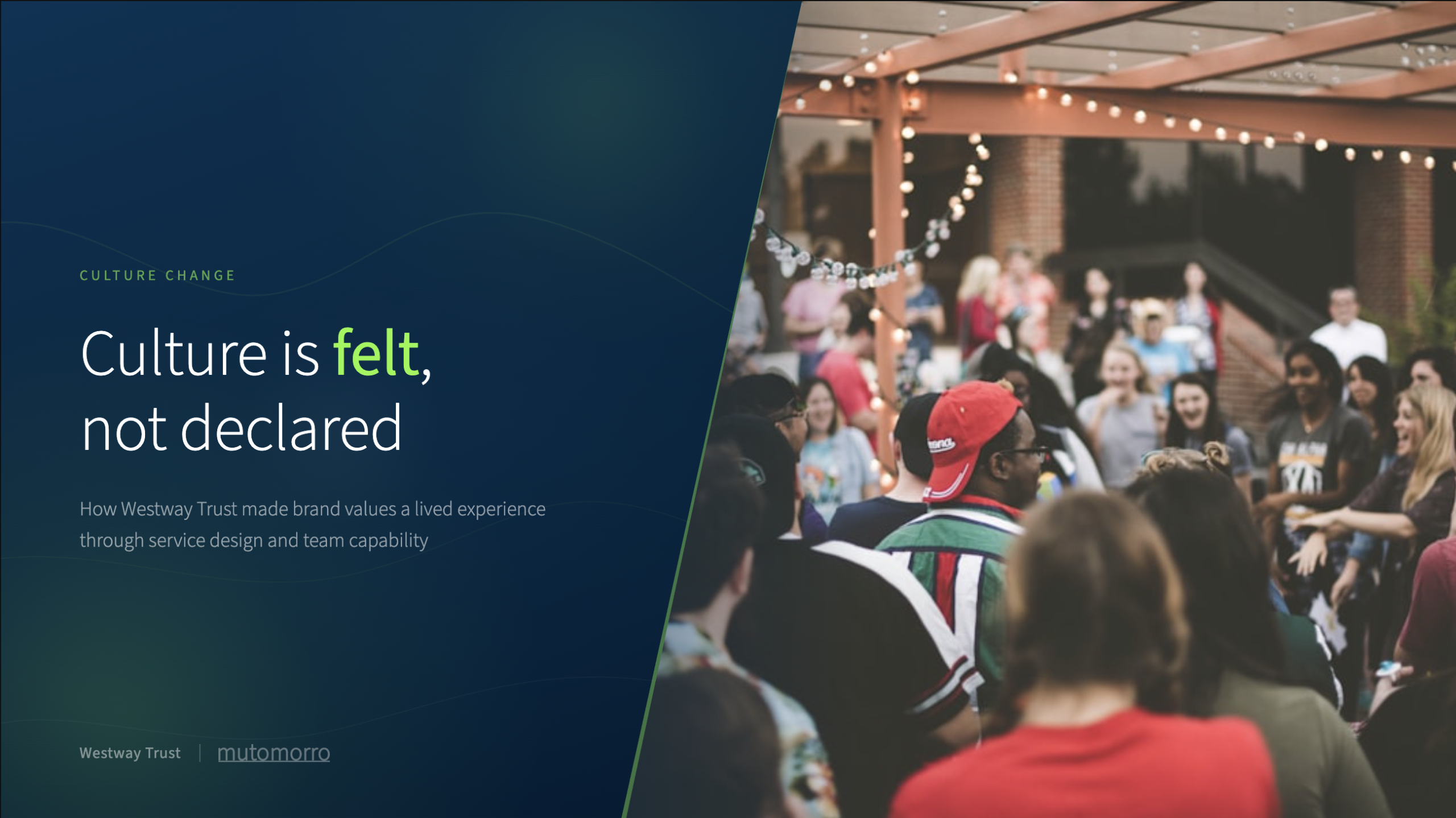
Culture change built on how services were delivered, not what was written on a wall
A community trust born from decades of activism, with brand values that felt bold on paper but hadn't yet changed how services were delivered or how teams worked day to day. Sports, housing and arts ran as different organisations to the person walking through the door.
Read case study →Strong cultures come from shared ways of working, common goals, and an environment that makes coming together easier than pulling apart. We work with leaders to cultivate exactly that - conditions where people can bring their best, find meaning in work, and translate culture into how work happens.
Target culture design gives you your target culture: the critical few behaviours your people will actually live, the traits worth keeping, and the redesigned signals - reward, recognition, promotion, leader modelling - that produce them, mapped from where you are today to where you are heading. We design it with your people, so the culture is genuinely theirs.
A Culture Change Programme is the governed set of workstreams that takes your Target Culture Design and makes it real across the organisation: the leadership signals, the everyday behaviours, the reward systems and the rituals that carry a culture, running day to day. We deliver it with your people, so the new culture is owned rather than imposed.
Keeping Culture Embedded keeps the culture you changed lived in everyday behaviour, and builds your own people's ability to tend it. Your leaders' attention, your champions network and your everyday routines carry the culture, so it stays the way things are done here. You run it, with an optional light rhythm from us as much or as little as you want.
The Cultural Web is a model for understanding and mapping organisational culture across six interconnected elements. It helps you see how stories, rituals, symbols, power structures, controls, and organisational structures shape the way things are done.
Edgar Schein's Culture Model explores organisational culture at three levels - visible artefacts, stated values, and the deeper underlying assumptions that really drive behaviour. It helps organisations get beneath the surface of what their culture actually is.
The Competing Values Framework is a model for understanding organisational culture by mapping it across two dimensions - flexibility versus stability, and internal versus external focus. It reveals which of four culture types your organisation leans towards.
The Iceberg Model is a systems thinking tool that helps you look beneath surface-level events to find the patterns, structures, and mental models driving them. It's a way of seeing the deeper causes behind what's happening in your organisation.
A practical guide to developing organisational culture. Cuts through the theory to explain what culture actually is, why most culture change programmes fail, and how to develop culture in a way that lasts - by working with your organisation as a living system, not a machine.
How to assess whether your organisation is genuinely ready for change - looking at the whole system, not just the surface. Covers what to examine, how to gather honest insight, and how to use what you find to build a change plan that works with your organisation rather than against it.
Silos between teams aren't the problem - they're a signal. What organisational silos reveal about the conditions shaping how your people work.
Most culture change efforts don't last. The pattern is remarkably consistent - and it points to something fundamental about how culture actually works.
A culture assessment is the first step in how we approach culture change. For the full picture - including how we co-design and embed change once you know where you stand - visit our main Culture Change page.