Competing Values Framework
The Competing Values Framework is a model for understanding organisational culture by mapping it across two dimensions - flexibility versus stability, and internal versus external focus. It reveals which of four culture types your organisation leans towards.
Get the free template
Every organisation has a culture, whether it was designed deliberately or grew by accident. The Competing Values Framework gives you a way to map that culture - not as a single label, but as a profile across four different orientations that pull against each other. It's one of the most widely used tools in organisational development for understanding where your culture sits today and where it might need to move.
What is the Competing Values Framework?
The Competing Values Framework (CVF) was developed by Robert Quinn and John Rohrbaugh in the early 1980s. They started with a simple question: what makes an organisation effective? When they analysed the different criteria people used to answer that question, they found something striking - the criteria weren't random. They clustered around two fundamental tensions.
The first tension is between flexibility and stability. Some organisations thrive by being adaptive, responsive, and open to change. Others thrive by being consistent, efficient, and well-controlled. Both work. They just work differently.
The second tension is between internal focus and external focus. Some organisations direct their energy inward - building their people, strengthening their teams, refining their processes. Others direct it outward - watching the market, chasing customers, outpacing competitors. Again, both work.
These two tensions create four distinct culture types. Quinn and Rohrbaugh called them "competing" values because they genuinely pull against each other. You can't maximise flexibility and stability at the same time. You can't give equal priority to internal development and external competition. Every organisation is navigating these tensions, whether consciously or not.
The CVF's real contribution isn't categorising organisations into boxes. It's revealing that effectiveness comes from how you navigate the tensions between them. The values compete - and that competition is something to be managed, not resolved.
That profile isn't a label you choose - it's produced by what your organisation actually rewards, focuses on, and repeats. Which is why you shift culture by changing those conditions, not by adopting a different quadrant.
Edgar Schein's Culture Model takes a complementary approach - where CVF maps cultural orientation across a framework, Schein looks at the layers beneath the surface: what an organisation says it values, what it visibly does, and the deeper assumptions driving behaviour.
The two axes
The CVF is built on two axes that cross to create four quadrants. Understanding the axes matters more than memorising the quadrants - they're the diagnostic engine.
Flexibility vs Stability
The vertical axis runs from Flexibility and Discretion at the top to Stability and Control at the bottom.
Organisations towards the top value adaptability, autonomy, and organic growth. Decision-making tends to be distributed. Change is welcomed. The risk is disorder - too much flexibility can mean nothing is predictable and everything is up for debate.
Organisations towards the bottom value efficiency, consistency, and formal processes. Decision-making tends to be structured. Stability is prized. The risk is rigidity - too much control can mean the organisation can't respond when circumstances shift.
Most organisations sit somewhere along this spectrum rather than at either extreme. The question isn't "which end is right?" but "where does our organisation currently sit, and is that serving us well?"
Internal vs External
The horizontal axis runs from Internal Focus and Integration on the left to External Focus and Differentiation on the right.
Organisations towards the left direct their energy inward. They invest in their people, build team cohesion, strengthen internal processes, and focus on how work gets done within the organisation. The risk is insularity - an internally focused organisation might build a brilliant culture that's completely disconnected from what its market needs.
Organisations towards the right direct their energy outward. They track competitors, pursue customers, seek market advantage, and focus on how the organisation positions itself in the world. The risk is hollowness - an externally focused organisation might win in the market while its internal culture frays.
What are the four culture types?
Where these two axes cross, they create four quadrants. Each represents a distinct cultural orientation with its own logic, leadership style, and definition of success.
Culture type | Orientation | Leadership style | Success means | Watch for |
|---|---|---|---|---|
Collaborate (Clan) | Flexible + internal | Facilitator and mentor | Engaged, well-developed people | Slow decisions; harmony over honest challenge |
Create (Adhocracy) | Flexible + external | Innovator and visionary | Breakthrough and new territory | Inconsistency; burnout from constant reinvention |
Control (Hierarchy) | Stable + internal | Coordinator and monitor | Reliable, efficient operations | Slow to innovate; less room for autonomy |
Compete (Market) | Stable + external | Hard-driving producer | Winning - targets and market share | Strained wellbeing; short-termism |
Collaborate (Clan)

Position: Flexible + Internal
Collaborate cultures feel like extended families. They value teamwork, participation, mentoring, and shared commitment. Leaders act as facilitators and mentors. Success is defined through people - their development, their engagement, their sense of belonging.
The leadership style is participative. Decisions happen through discussion and consensus. New team members are developed through coaching and mentoring rather than formal training alone.
Collaborate cultures tend to be strong at building loyalty and deep institutional knowledge. They can struggle with speed - when every decision needs consensus, the organisation can be slow to act. They can also become insular, prioritising harmony over honest challenge.
Create (Adhocracy)

Position: Flexible + External
Create cultures feel like laboratories or start-ups. They value innovation, experimentation, risk-taking, and staying ahead of what's coming. Leaders act as innovators and visionaries. Success is defined through breakthrough - new products, new approaches, new territory.
The leadership style is entrepreneurial. People are given room to experiment. Failure is treated as learning rather than cause for blame. The organisation watches the horizon and moves before others do.
Create cultures tend to be strong at innovation and speed-to-market. They can struggle with consistency - when everything is an experiment, it's hard to build reliable operations. They can also burn people out if the pace of reinvention never lets up.
Control (Hierarchy)

Position: Stable + Internal
Control cultures feel like well-run machines. They value efficiency, consistency, formal processes, and clear lines of authority. Leaders act as coordinators and monitors. Success is defined through reliability - things work, they work the same way every time, and they work efficiently.
The leadership style is structured. Roles are clearly defined. Processes are documented. There are right ways to do things, and people are expected to follow them. This isn't about bureaucracy for its own sake - it's about predictability and quality.
Control cultures tend to be strong at operational excellence and risk management. They can struggle with innovation - when processes are prized, new ideas can feel like threats rather than opportunities. They can also find it hard to attract people who want autonomy and creative freedom.
Compete (Market)

Position: Stable + External
Compete cultures feel like sports teams in a league. They value results, market share, goal achievement, and speed. Leaders act as competitors and hard-driving producers. Success is defined through winning - hitting targets, outperforming rivals, and delivering for customers.
The leadership style is results-oriented. Goals are clear and measurable. Performance is tracked. People are rewarded for what they deliver, not how they deliver it. The external market is the reference point for everything.
Compete cultures tend to be strong at execution and market responsiveness. They can struggle with internal wellbeing - when results are everything, people can feel like instruments rather than individuals. They can also miss long-term capability building because the focus stays on immediate outcomes.
The diagonal tensions
The most revealing dynamic in the CVF isn't within each quadrant - it's between the diagonal pairs.
Collaborate vs Compete. People vs results. Building internal community vs winning in the external market. Most organisations feel this tension daily. Investing in team development can feel like it slows execution. Pushing hard for results can feel like it undermines the culture.
Create vs Control. Innovation vs efficiency. Experimentation vs reliability. This tension shapes how organisations respond to change. The creative impulse wants to try new things. The control impulse wants to standardise what already works.
These tensions aren't problems to solve. They're dynamics to navigate - and different moments call for different balances. The McKinsey 7-S Model is useful alongside CVF here, because it helps you trace how a shift in cultural orientation ripples through strategy, structure, systems, and the other organisational elements.
How to use the Competing Values Framework
Map your current culture
Start by asking people across the organisation to describe how things actually work - not the aspirational values on the wall, but the lived reality. Where does decision-making authority sit? What gets rewarded? What gets people promoted? What stories do people tell about "how things work around here"?
The Cultural Web is a useful companion tool at this stage. It examines six specific areas - stories, rituals, symbols, power structures, organisational structures, and control systems - that together paint a detailed picture of culture in practice.
Plot your answers against the two axes. You'll likely find your organisation doesn't sit neatly in one quadrant - it has a profile that spans several, with one or two orientations dominant.
Map your desired culture
Then ask: given where we're heading strategically, what cultural orientation would serve us best? If you're about to enter a period of rapid change, you probably need more Create energy. If you're scaling and need reliable operations, you probably need more Control. If you're losing people and institutional knowledge, you might need more Collaborate.
The gap between current and desired is your culture change agenda.
Identify the tensions you need to manage
Look at the diagonal pairs. If your desired culture is stronger in Create but your current culture is strong in Control, you're asking the organisation to move from efficiency towards experimentation. That's not just a process change - it's a values shift, and it will feel uncomfortable.
Understanding which tensions are in play helps you anticipate where resistance will come from and what you'll need to support people through.
Use it to shape leadership development
Each quadrant implies different leadership capabilities. A leader who's brilliant in a Compete culture (driving results, setting targets, holding people accountable) might struggle in a Collaborate culture (facilitating dialogue, building consensus, developing others). CVF gives you a framework for identifying which leadership capabilities your organisation needs more of - and which it might be over-indexing on.
The Enacted Culture dimension of the EMERGENT framework explores this further - how culture isn't just what's written on the wall, but what's lived through daily decisions and leadership behaviour.
Example
A professional services firm notices their employee engagement scores have dropped steadily over two years, despite strong financial performance. Using CVF, they map their culture and find a heavy skew towards Compete - targets dominate every conversation, client wins are celebrated loudly, but internal mentoring has quietly disappeared and cross-team collaboration has dried up.
Their desired profile shows they need to strengthen Collaborate without losing their Compete edge. The tension is real: they can't simply dial down results-orientation without risking their market position.
Their response isn't to "become a Clan culture." It's more targeted: they reintroduce structured mentoring, create space for cross-team knowledge sharing, and adjust their promotion criteria to weight collaboration alongside billable performance. They're navigating the Collaborate-Compete tension, not resolving it.
Over 18 months, engagement scores recover while financial performance holds. The culture hasn't switched quadrants - it's developed a broader profile.
Limitations
It simplifies. Four quadrants can't capture everything about an organisation's culture. Subcultures within teams and departments may sit in completely different quadrants. The CVF maps the broad orientation, not the full complexity.
It's a snapshot. Culture shifts over time, and the CVF captures where you are now. An organisation in crisis might temporarily skew towards Control even if its underlying culture is more Create. Regular reassessment matters more than a single mapping.
Quadrant labels can stick. Once people hear "we're a Compete culture," it can become a self-fulfilling identity rather than a diagnostic finding. Emphasise that the CVF shows a profile across all four quadrants, not a single category.
It doesn't explain why. CVF tells you what your cultural orientation is, but not why it developed that way. For deeper cultural archaeology, pair it with Edgar Schein's Culture Model or the Iceberg Model to explore the underlying assumptions and systemic patterns beneath the surface.
Getting started
Start small. Pick one team or department and run a simple mapping exercise. Ask each team member to distribute 100 points across the four quadrants - how much of each orientation do they experience in their day-to-day work? Collect the responses, average them, and you'll have a rough cultural profile.
Then have a conversation about it. Where do people agree? Where do they see things differently? And most usefully: given what the team is trying to achieve over the next 12 months, is the current profile helping or getting in the way?
That conversation alone - even without formal assessment tools - often surfaces insights that have been felt but never named. The CVF gives people a shared language for talking about culture, which is often the most valuable thing a framework can do.
If you want to go further, Cameron and Quinn's Organizational Culture Assessment Instrument (OCAI) is the standard diagnostic built on the CVF. It provides a structured survey and scoring methodology for mapping cultural profiles at scale. Culture change consultancy often starts with exactly this kind of mapping - understanding where you are before deciding where to head.
So whichever profile emerges, treat it as a read on how your organisation currently works - and change the conditions that produce it, not the label on it.
We share thinking on organisational change and development on LinkedIn - practical ideas for people doing this work inside their own organisations.
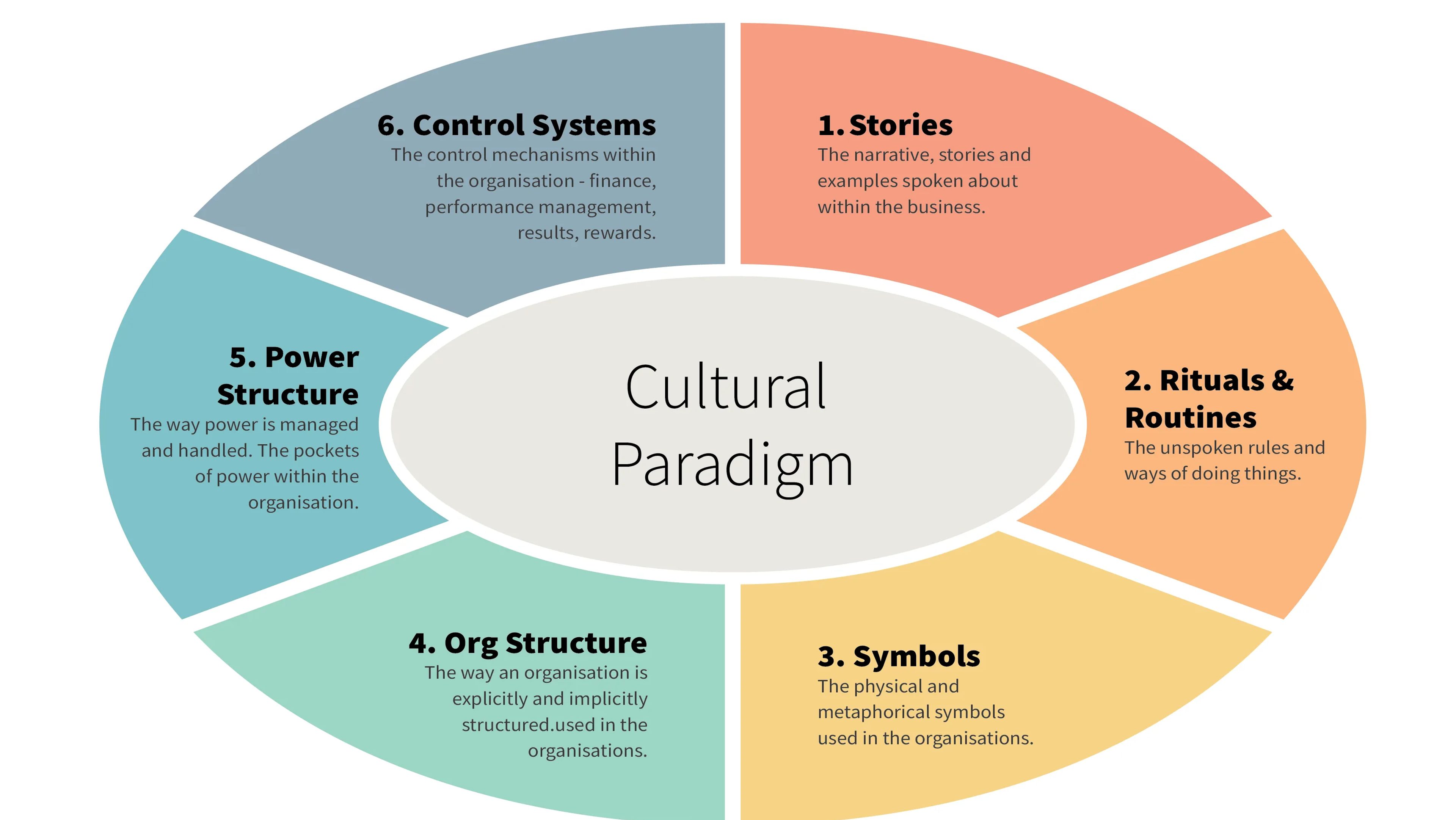
The Cultural Web is a model for understanding and mapping organisational culture across six interconnected elements. It helps you see how stories, rituals, symbols, power structures, controls, and organisational structures shape the way things are done.
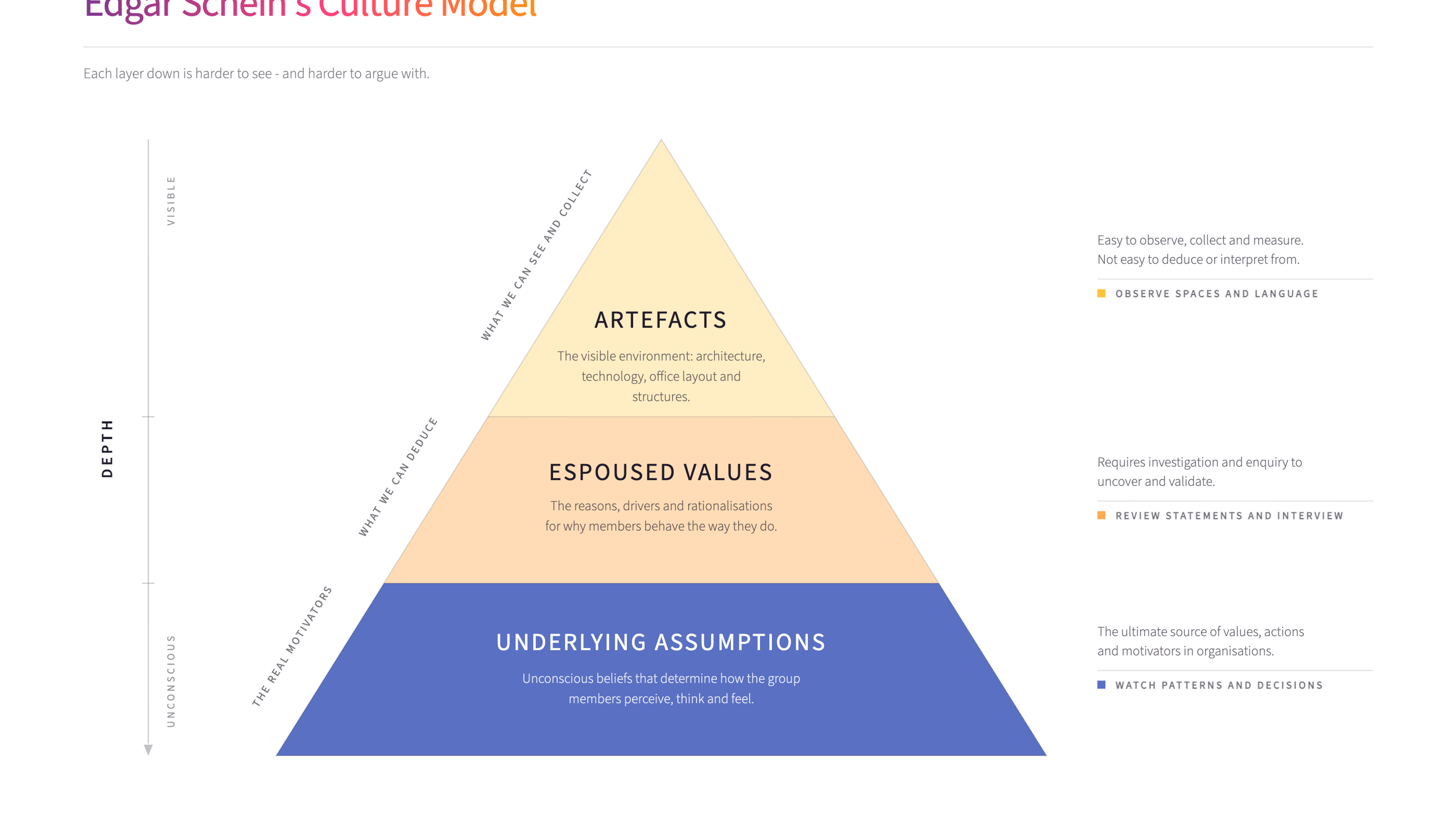
Edgar Schein's Culture Model explores organisational culture at three levels - visible artefacts, stated values, and the deeper underlying assumptions that really drive behaviour. It helps organisations get beneath the surface of what their culture actually is.
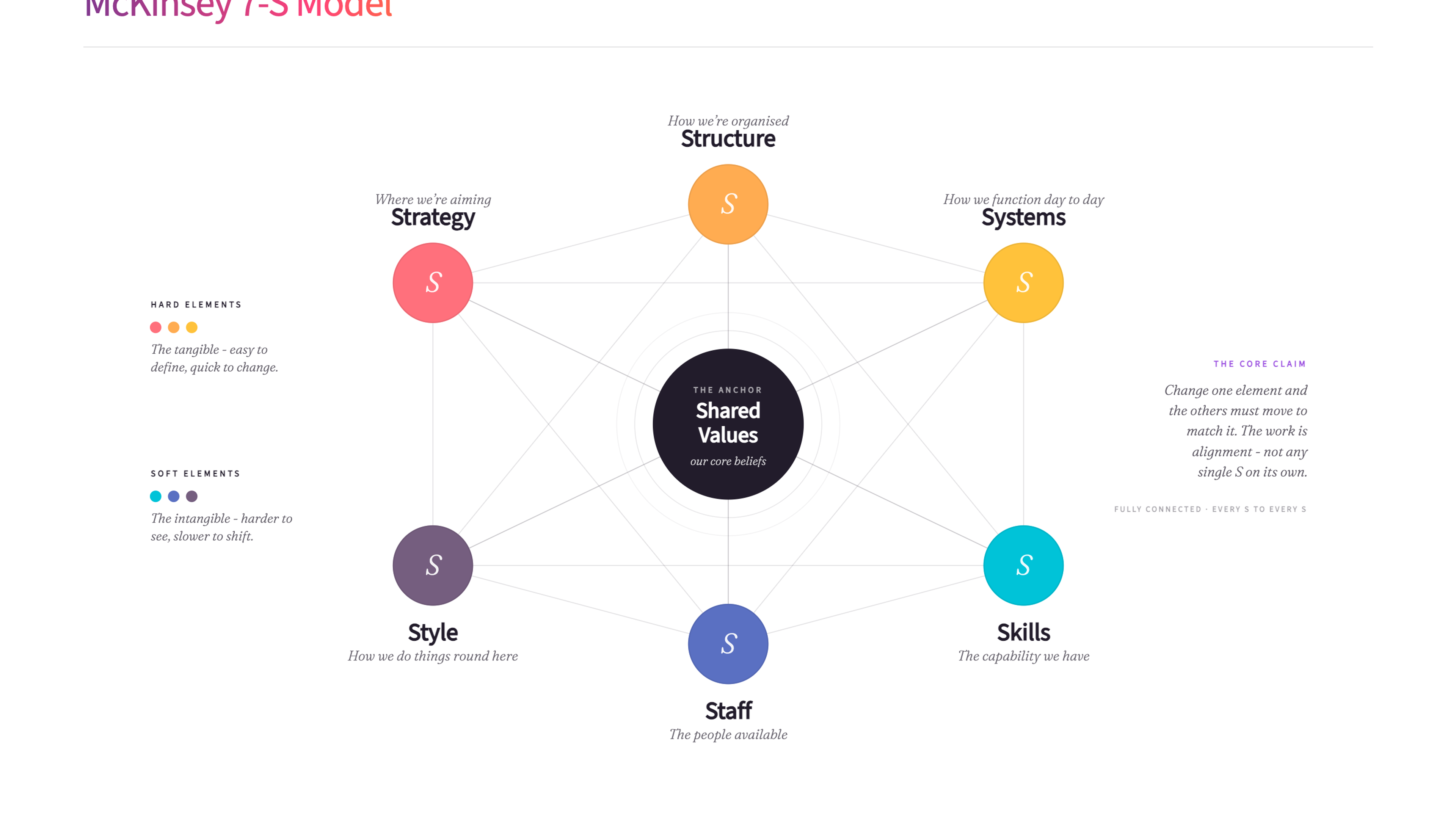
The McKinsey 7-S Model is a strategic framework that maps seven interconnected elements of an organisation - from strategy and structure to skills and shared values. It helps leaders understand how changing one part of the organisation affects everything else.
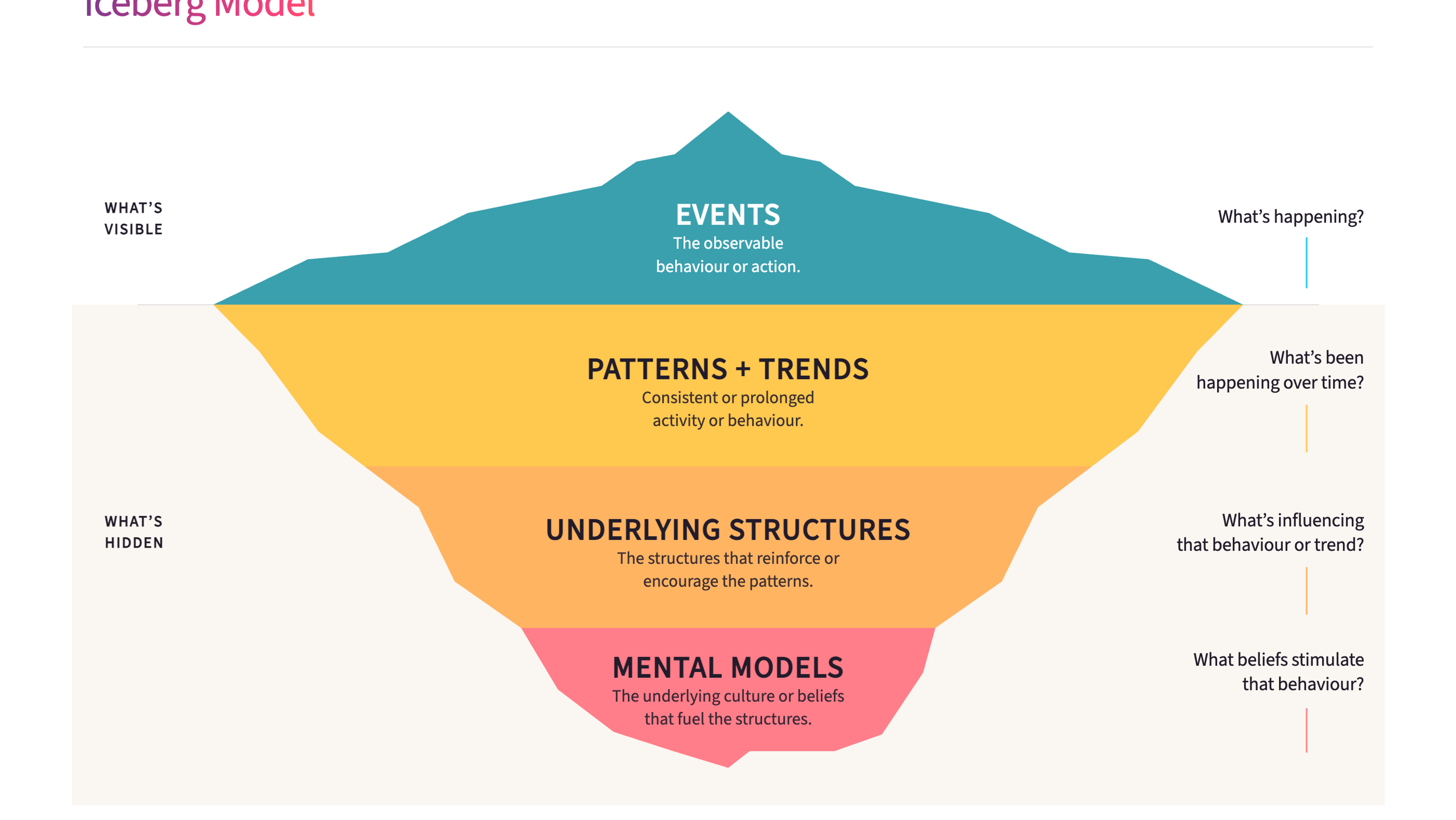
The Iceberg Model is a systems thinking tool that helps you look beneath surface-level events to find the patterns, structures, and mental models driving them. It's a way of seeing the deeper causes behind what's happening in your organisation.
A practical guide to developing organisational culture. Cuts through the theory to explain what culture actually is, why most culture change programmes fail, and how to develop culture in a way that lasts - by working with your organisation as a living system, not a machine.

The strategy is clear. So why does the organisation keep doing something different? The answer usually isn't about communication or buy-in. It's about the conditions nobody designed for.

Most culture change efforts don't last. The pattern is remarkably consistent - and it points to something fundamental about how culture actually works.
Which culture are you actually running?
A culture assessment reads the one you have - what's rewarded, what's tolerated, and where reality pulls against what you intend - and what to do about it.
James Freeman-Gray is the founder of Mutomorro. He's an organisational development practitioner who has spent over twenty years working with leaders across public, private and nonprofit sectors - helping organisations pull together around a common purpose, joined up in how they work. More about who we are and what it's like to work with us.
I use the Competing Values Framework when organisations are trying to figure out what kind of culture they want - not just what they want to change from. It's a good provocation tool because it shows that every culture choice has a trade-off. You can't be both highly innovative and highly controlled at the same time.
Last reviewed: June 2026
Ready to use Competing Values Framework?
Download the free template - includes practical guidance for workshops and team sessions.
Get the free template
Want to put these ideas into practice?
Whether you're navigating a merger, rethinking how you're structured, or trying to shift a culture that isn't working - underneath, it's the same job: getting the whole organisation pulling in the same direction. Start with a conversation.