Integration readiness assessment
A clear read of whether two organisations can genuinely become one - where they'll fit, where they'll grate, and what to settle first.

Our integration readiness assessment tells you whether two organisations can genuinely become one - how each side works, and where those ways of working meet. We look at what really decides a merger: how each side makes decisions, who holds the knowledge and relationships that matter, and whether the two leaderships agree on what the combined organisation is for. Then we give you what will decide it - where the common ground is, where the friction will be, and what to settle first.
The legal and financial fit gets examined hard before anyone commits. The human fit - how the two will actually work together - gets far less, because it's harder to put a number on. We read how each side behaves, not how it describes itself, whether you're weighing the merger or finishing one that stalled.
68% of organisations name cultural clashes as the single biggest challenge in a merger or acquisition - ahead of every operational and financial factor (Global PMI Partners, 2026). Culture is exactly what a readiness assessment reads, and the hardest thing to see clearly from inside your own side of the deal.
When an integration readiness assessment helps
An assessment earns its place wherever the human side of a merger is about to decide the outcome:
The situation | How an assessment helps |
|---|---|
You're weighing up a merger | Shows where the culture and people risk sits before you commit, while you can still shape the terms. |
A merger's agreed, integration ahead | Shows what you're bringing together before integration starts, so you plan for the hard parts. |
Merged on paper, not yet one | Reads why the two haven't come together, and what would finish the job. |
At risk of losing key people | Finds where the flight risk and concentrated knowledge sit, before the talent walks. |
An integration that's stalling | Names what's blocking it - trust, leadership, structure, pace - so the next push isn't into the same wall. |
You're new to leading the combined organisation | Shows what you've inherited from both sides, and where the join still needs work. |
What we look at
Most organisations come to us with a clear reason for the merger. We start there - what you want the combined organisation to be - and read how ready the two sides are to get there, through six angles:

Cultural fit
How each side makes decisions, treats people and gets work done, and where those ways sit together or pull apart. Neither culture is the wrong one - they're two working answers to two different histories.
We read both organisations the same way, side by side: how a decision gets made here, how it gets made there. The differences become a map of where integration needs deliberate design rather than goodwill - before they meet in live work.

Leadership alignment
Whether the two leaderships genuinely agree on what the combined organisation is for, or only appear to. The clearer the shared picture at the top, the less the rest of the integration has to improvise.
We interview across both leadership teams on the same questions, and compare the answers by side. The overlaps are your genuine common ground; the differences are integration decisions still waiting to be made.

Operating-model overlap
Where the two ways of running the same work fit, and where they collide. Every function that exists twice - finance, IT, service, sales - is currently running two answers to the same question.
We map the overlaps function by function and grade each: keep one, keep the other, build something new, or genuinely leave both. That turns integration from one giant merge into a sequence of specific, decidable calls.

Communication and trust
Whether the two sides talk straight and believe what they hear, or route around each other. Trust between merging organisations can absolutely be built - but only from an honest read of where it stands.
We listen on both sides for what's said openly, what's said carefully, and what's only said internally. That baseline shows where bridge-building is already working, and which specific relationships need deliberate attention first.

People and retention risk
Where the flight risk is real, and where key knowledge sits with too few people. Uncertainty peaks at exactly the moment your best people are most employable elsewhere.
We identify the people and knowledge the combined organisation most depends on, and read how each is experiencing the merger. You get a specific retention picture - who to reassure, what to secure, where to document - instead of a blanket bonus scheme.

Identity and belonging
Whether people on both sides can see themselves in the combined organisation. Names, teams and rituals sound like details until they decide who stays engaged through the transition.
We ask people on each side what they're proud of, what they fear losing, and what they'd want the new organisation to keep. The answers are raw material for an identity both sides recognise - rather than one side's identity with a new logo.
The six angles stay constant. How we read them, we shape around you - your reason for merging, and the two organisations behind it - so it fits this merger, not mergers in general.

Why these six angles
These six are where a merger is made or lost. The financial and legal fit gets examined hard before signing. The human fit - how two organisations work, lead and keep their people - is where the value is realised or lost afterwards, and the hardest part to see from your own side.
Cultural fit is the master signal. A culture clash is rarely about personalities: it's two sensible ways of working that were never designed to fit, meeting without anyone naming the difference. Leadership alignment decides whether a shared direction really exists, or just a shared announcement. Operating-model overlap is where two methods for the same job collide once the merger is real. Communication and trust decides whether problems get raised or sat on. People and retention risk is where the talent the deal was meant to secure can walk. And identity and belonging often tells you whether the two have truly become one.
These are about how each side behaves, not how it presents - refined across many organisations. Some may already be in your thinking about the deal; others are what let any merger take hold.
How it works
We read both organisations through more than one method, and on both sides, so the findings hold up:
- We watch - time on both sides seeing how each organisation really runs, and what the unwritten rules are.
- We measure - a structured read across the six angles, on both sides, reported by group so you see where views differ, not just the average.
- We listen - interviews across a cross-section of both sides, not only leaders, about real situations: what happened, and how it squares with the merger's goals.
- We notice - the patterns that will decide the integration, read with judgement from twenty years of organisational-development work.
The thinking behind the method
No single method captures how two organisations will fit, so we use several and cross-check them, on both sides. A structured read tells you where people stand, not why. Interviews reach the why, but only from the people in the room. Watching how each side runs shows what people actually do. Together they triangulate: a finding has to show up in more than one before we treat it as real.
We read both sides and the space between them, on purpose. Integration doesn't live inside either organisation - it lives in the fit, so that's where we look. And we interview a cross-section, not just leaders, because the people at the top of each side are often the least able to see the friction the front line already feels.
Rather than rate abstractions, people talk about real situations - what happened when the two sides had to work together - and how it squares with the merger's goals. That surfaces the lived fit far better than a rating scale.
And we show you the spread, not the average. Two mergers with the same readiness can be completely different prospects. Where people disagree, by side or by level, is where the real picture is.
What you get
A working read-out session, not a report filed and forgotten. You leave with:

- A clear read of how ready the two are to become one, for this merger - not mergers in general.
- The common ground already there, worth building on from each side - not just the risks.
- The few things most likely to cause friction - culture, leadership, people, structure - and where.
- The handful of moves that would most improve the odds - what to settle first.
Where two things are both true and pull against each other - "both sides want one organisation" and "each quietly assumes it'll be theirs" - we show you both. That's usually where the useful conversation starts.
How we hand it back - and what happens next
The assessment ends in a working session, not a document in your inbox. We take you through what we found - the common ground worth building on as much as the risks - so it lands as something you can act on.
Some of the most useful findings come in pairs - two true things pulling against each other. We name the tension rather than smoothing it over, because the tension between the two sides is usually the thing to work on.
From there it's your call. Sometimes the picture is enough and you take the integration forward yourselves; sometimes you want us alongside for what follows. And if the fit is better than you feared, we'll say so.
Focused now, or continuous over time
This is a focused, one-off read of where the two organisations stand now. If you'd rather track the combined organisation through a long integration - readiness as one of eight dimensions of health - that's States of Vitality, our organisational-health platform. Depth now, or the wider picture over time.
Common questions
How is this different from an engagement survey?
A survey reads one organisation. This reads two, and the fit between them - the part a merger actually turns on. We look across both sides, at how each really works and where those ways of working will meet, not just at how people feel.
Do you need access to both organisations?
Ideally, yes - the fit lives in the space between them, so we read both sides. Before a deal closes we can work with the side we have access to, and bring in the other once it's agreed.
Can you do this before the deal closes?
Yes, and it's often the most valuable time. Reading the human fit before you commit means you can still shape the terms, plan the integration, or walk away - while it's still a choice.
How long does it take?
It's usually weeks rather than months, but it depends on the size of the two organisations and how complex the picture is. We build each assessment around you, and agree the timeline when we scope it.
How much does it cost?
There's no standard price - we build each assessment around you, so the cost reflects the size of the two organisations, the scope, and the depth you need. We scope it with you and give you a clear figure before you commit.
Is it confidential?
Yes. Survey responses are anonymous, interviews are confidential, and we report in groups and patterns, never in a way that identifies an individual.
Organisations we've worked with
We've supported mergers and integrations across housing, charity and the public sector - bringing organisations together in ways that hold up beyond the structure chart. Every merger is different, so every readiness assessment is shaped around the two organisations in front of us - but the common thread is the same: an honest picture, given straight, that leaves you better placed to bring them together well.
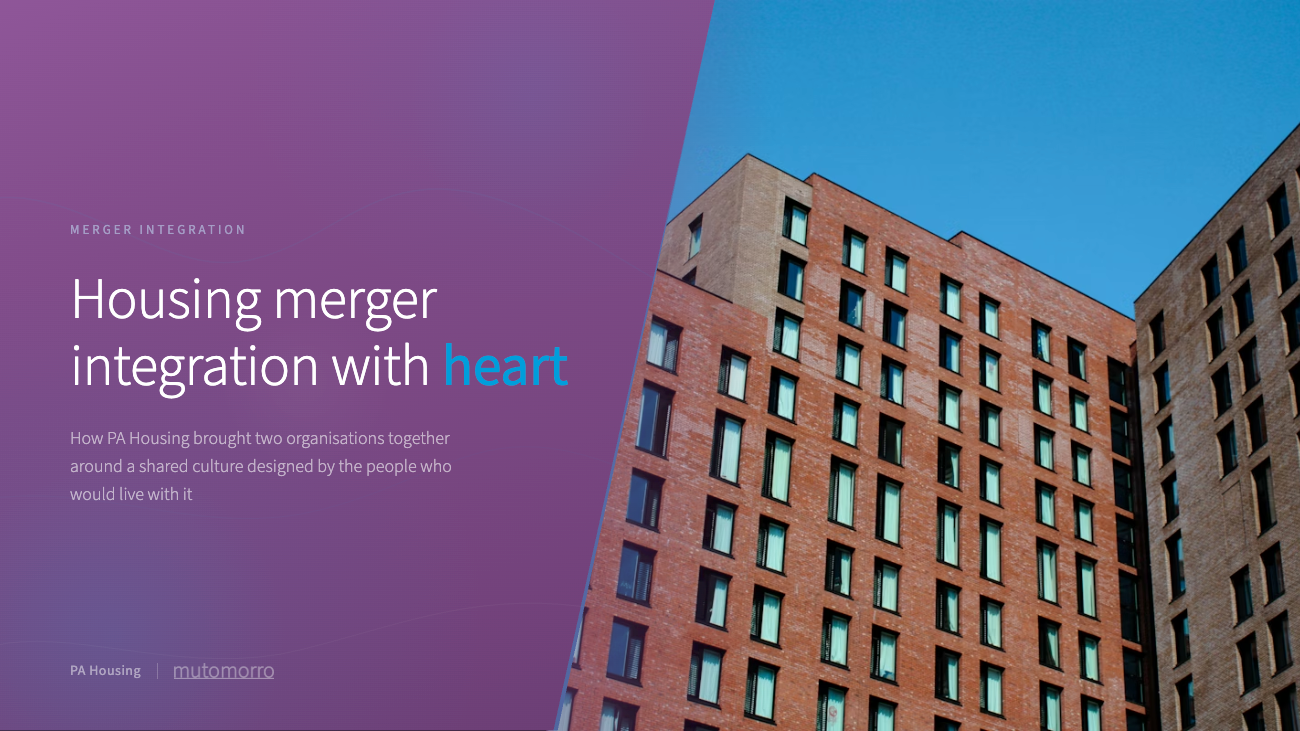
A merger that combined the best of both organisations, instead of one swallowing the other
Two housing associations merged on paper, but still operating as two organisations in practice - with the hard question of how to build a shared culture that neither had alone.
Read case study →
Bringing six departments together into one organisation customers could recognise
When a global payments company prepared for independence, the challenge wasn't rebranding - it was building organisational coherence across six departments that had never needed to work as one.
Read case study →Two ways of working. Two sets of habits. Two cultures. We help you design how they come together - because that's the part no integration plan covers.
Strong cultures come from shared ways of working, common goals, and an environment that makes coming together easier than pulling apart. We work with leaders to cultivate exactly that - conditions where people can bring their best, find meaning in work, and translate culture into how work happens.
Change takes root when the conditions inside your organisation support it - when people have genuine agency, feel safe to adapt, and understand why it matters.
The Cultural Web is a model for understanding and mapping organisational culture across six interconnected elements. It helps you see how stories, rituals, symbols, power structures, controls, and organisational structures shape the way things are done.
Edgar Schein's Culture Model explores organisational culture at three levels - visible artefacts, stated values, and the deeper underlying assumptions that really drive behaviour. It helps organisations get beneath the surface of what their culture actually is.
The Competing Values Framework is a model for understanding organisational culture by mapping it across two dimensions - flexibility versus stability, and internal versus external focus. It reveals which of four culture types your organisation leans towards.
The Mendelow Power-Interest Matrix is a stakeholder mapping tool that helps you work out who matters most during a change or project. It plots stakeholders by their level of power and interest so you can plan how to engage each group.
The Change Curve maps the emotional stages people move through during organisational change, from shock and denial through to acceptance and commitment. It helps leaders understand where people are in the process and what support they need.
A merger changes structures, systems and reporting lines. But whether two organisations genuinely become one depends on something integration plans rarely design for.
How to assess whether your organisation is genuinely ready for change - looking at the whole system, not just the surface. Covers what to examine, how to gather honest insight, and how to use what you find to build a change plan that works with your organisation rather than against it.
Change doesn't just affect what people do - it affects who they feel they are. Understanding the human experience of change helps leaders create conditions where people can adapt.
An integration readiness assessment is the first step in how we approach post-merger integration. For the full picture - including how we help you bring two organisations together once you know where you stand - visit our main Post-Merger Integration page.