Six Thinking Hats
Six Thinking Hats is Edward de Bono's framework for structured thinking and decision-making. It gives teams six different perspectives to work through - facts, feelings, caution, optimism, creativity, and process - so decisions are more balanced and thorough.
Get the free template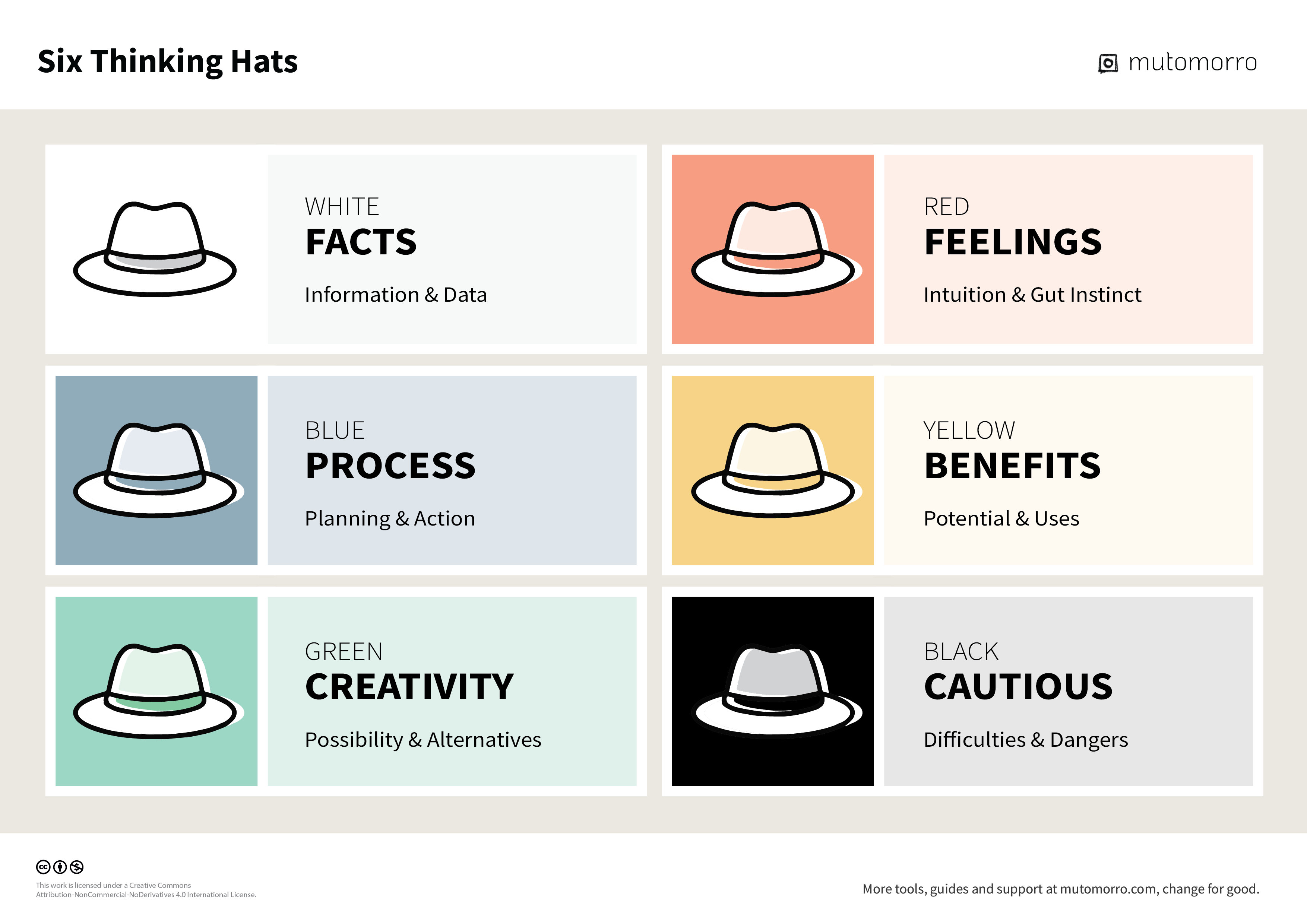
What are Edward De Bono's Six Thinking Hats?
Six Thinking Hats is a method for structured thinking and decision-making, built on parallel thinking: instead of debate - one side attacking while the other defends - everyone in the room thinks in the same mode at the same time, and the group works through six modes in turn. Each mode is a coloured hat: White for facts, Blue for process, Green for creativity, Red for feelings, Yellow for benefits and Black for caution. The method was created by Edward de Bono, the Maltese physician and psychologist who coined the term lateral thinking, and published in his 1985 book Six Thinking Hats. Its promise is simple: decisions get better when a group does one kind of thinking at a time, together, instead of all six at once, against each other.
This page gives you what you need to run the method for real: a free Six Thinking Hats template (PDF), each of the six hats with its diagram, key questions and watch-fors, a step-by-step guide to running a session, and a worked example of a leadership team using all six hats on a live decision.
How are the Six Thinking Hats used?
The heart of the method is one rule: everyone wears the same hat at the same time. Six Thinking Hats is parallel thinking, not role-play - you don't assign the Black Hat to your most sceptical colleague and let the meeting become a structured argument. The whole group looks at the problem through one mode, captures what that mode surfaces, then switches together. That single rule is what makes the method work: it separates the thinking from the thinker (it's much easier to raise a risk when everyone is hunting risks), gives quieter voices a structured way in, and stops the usual meeting pattern where facts, feelings, objections and ideas all collide at once and people hold back for fear of judgement.
The hats can be used in any order, and not every session needs all six - choosing the sequence is the Blue Hat's job, and there's a dependable default in the session guide below. A single hat also works on its own: "two minutes of Black Hat on this before we commit" is a perfectly good use of the method. And it works solo - a fast way to pressure-test a decision you're too close to.
The Six Thinking Hats
Here are the six hats - what each one does, the key questions it asks, and what to watch for when a group wears it.
1. White Hat - Facts
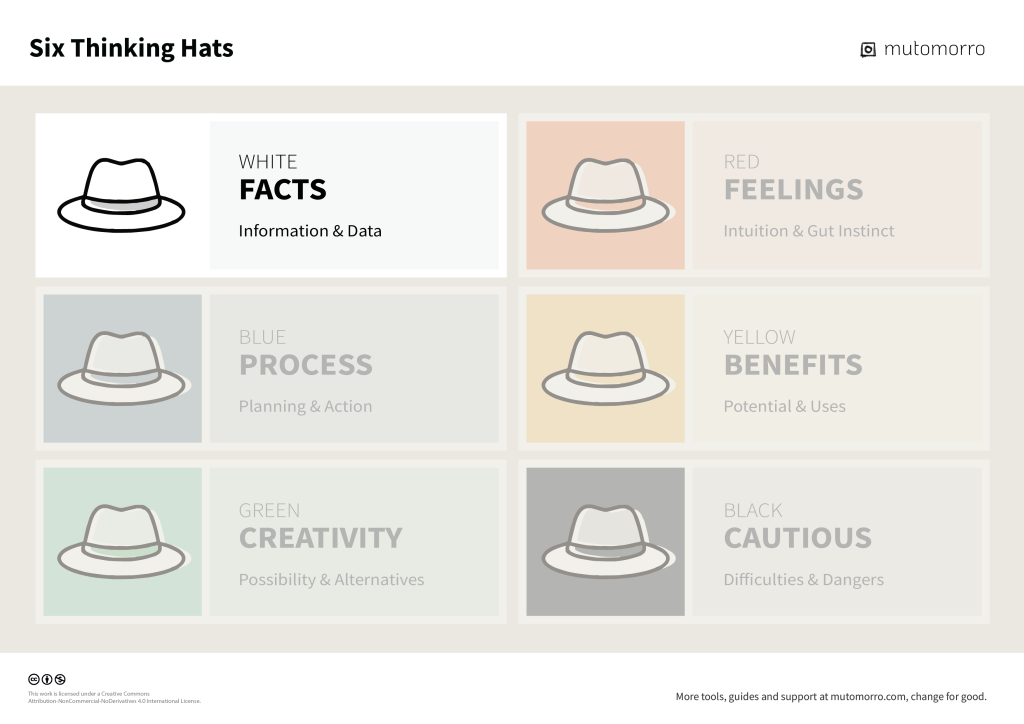
The White Hat is neutral, objective information: what we know, what we don't, and how we'd find out. No interpretations, no opinions - just the data, the evidence, and (just as importantly) the gaps in it. A PESTLE Analysis is a natural companion here, giving structure to the external facts.
Key questions: What do we know? What don't we know that we need to? How good is the evidence? How will we fill the gaps?
Watch for: opinions dressed as facts. "Everyone knows customers hate the current system" is a Red or Black Hat sentence in White Hat clothing. If it can't be sourced, name it as a belief and park it for the right hat.
2. Blue Hat - Process
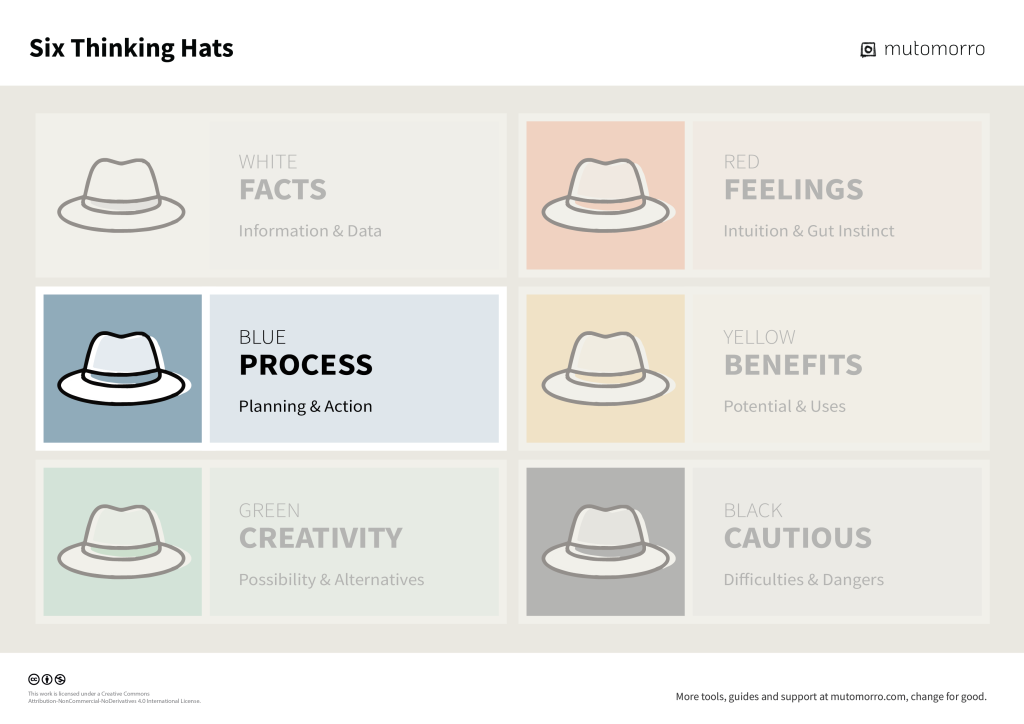
The Blue Hat manages the thinking itself - it's the hat the facilitator wears. It defines what the group is there to decide, chooses the sequence of hats, keeps everyone in the same hat at the same time, and closes the session with conclusions and next steps. Mid-session, it's the hat that notices the group has drifted and calls the switch.
Key questions: What are we actually trying to decide? Which hats, in which order, for how long? Where have we got to - and what happens next?
Watch for: nobody wearing it. A hats session without an active Blue Hat drifts back into ordinary discussion within minutes. And once the thinking has surfaced your options, a prioritisation tool like the Eisenhower Matrix can pick up where the Blue Hat closes.
3. Green Hat - Creativity
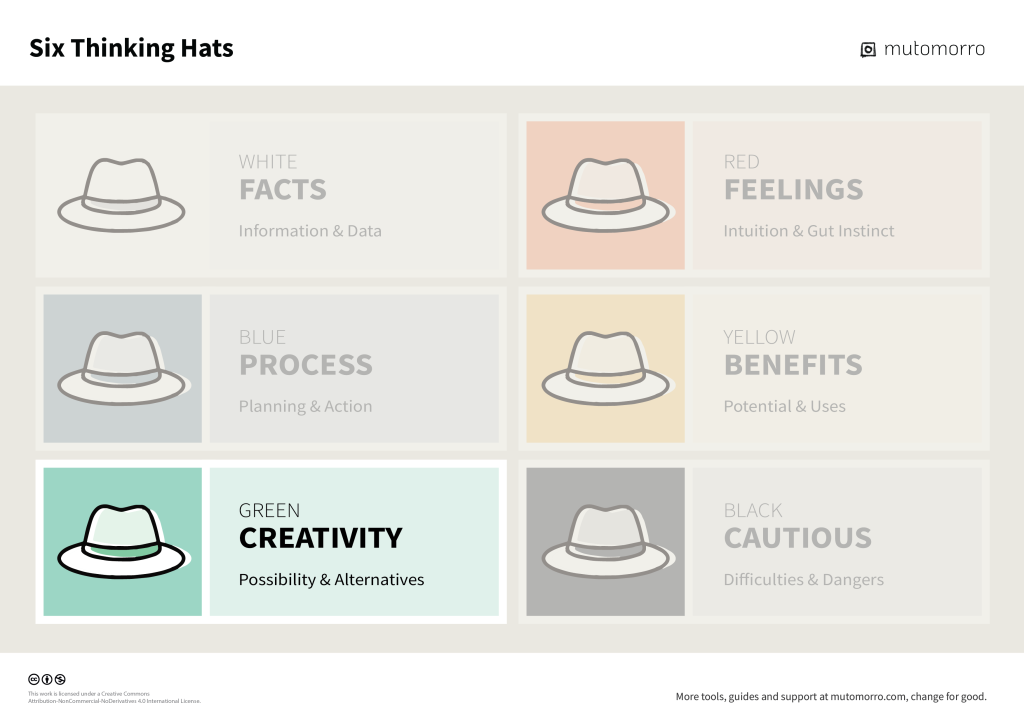
The Green Hat is creative effort: new ideas, alternatives, provocations and ways around obstacles. It deliberately suspends judgement - the point is to generate possibilities, not defend them - and it's at its most valuable straight after the Black Hat, designing a way around the problems caution has surfaced.
Key questions: What else could we do? What would this look like started from a blank page? How could we get around the Black Hat's biggest objection?
Watch for: evaluation creeping in. The instant an idea is met with "that won't work because", the group has changed hats without agreeing to. Capture the idea, keep generating, and save the judging for Yellow and Black.
4. Red Hat - Feelings
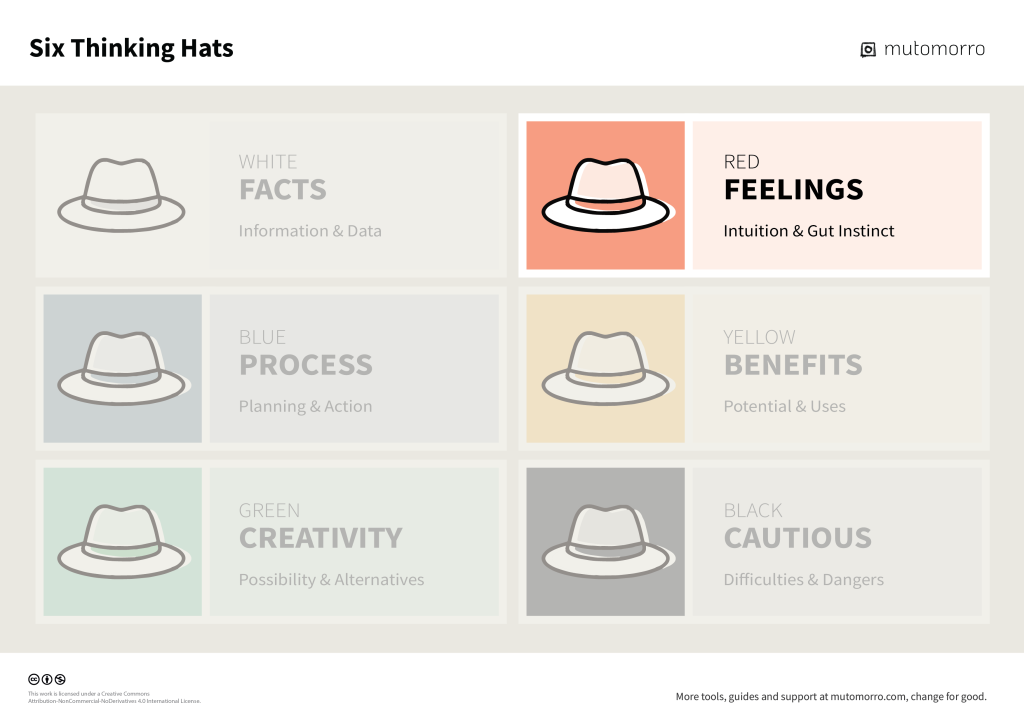
The Red Hat is feelings, hunches and intuition - offered as themselves, with no justification required. That's the hat's whole design: it gives emotion a legitimate, time-boxed place in the process, so it doesn't spend the rest of the meeting disguising itself as logic.
Key questions: What's your gut reaction, in a sentence or less? How do you honestly feel about this option right now?
Watch for: justification. The moment someone explains why they feel uneasy, they've left the Red Hat. First reactions only, kept brisk - thirty seconds of honest Red Hat from everyone is worth more than ten minutes of rationalised debate.
5. Yellow Hat - Benefits
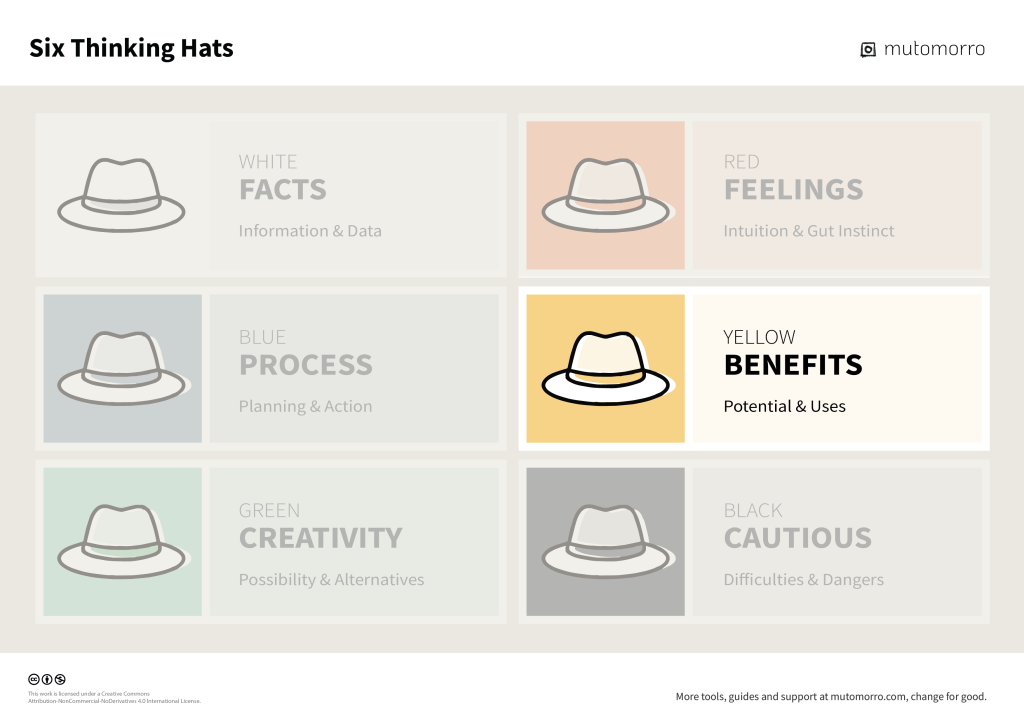
The Yellow Hat looks for value: benefits, opportunities and reasons the idea can work. It isn't cheerleading - Yellow Hat optimism has to be grounded in logic, saying who benefits, how, and under what conditions. For most professional groups it's the hardest hat to wear well, which is exactly why it's in the set.
Key questions: What's the value here, and to whom? What's the best realistic outcome? What would have to be true for this to work?
Watch for: thin, vague positivity. "It'll be great for morale" isn't Yellow Hat thinking until it can say why, and for whom. Push for grounded value, not hope.
6. Black Hat - Cautious
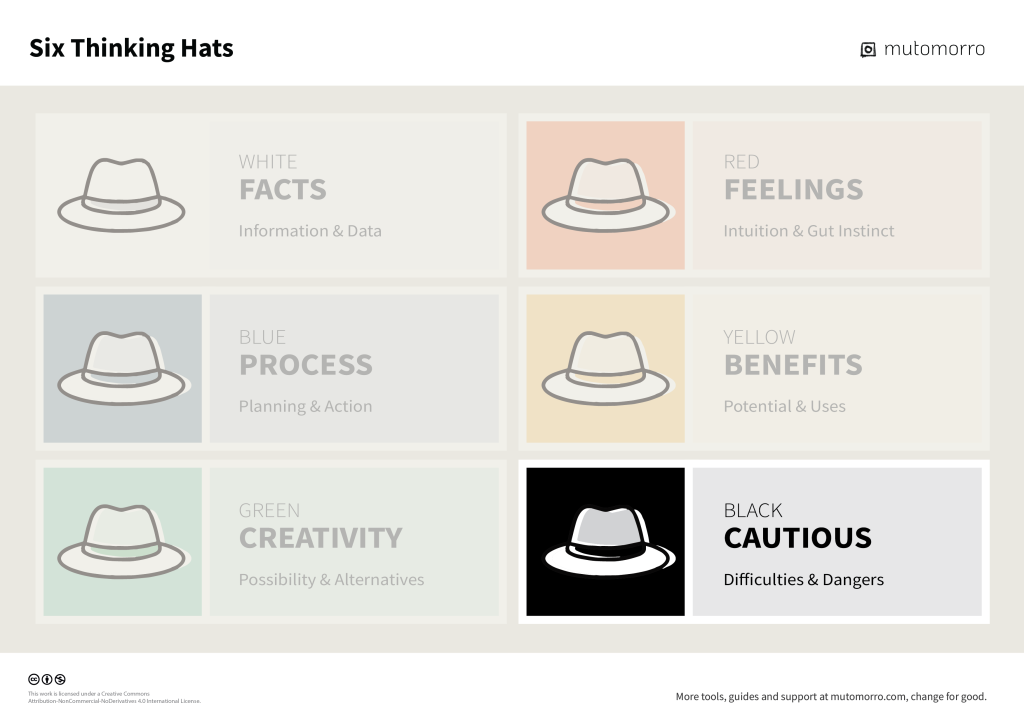
The Black Hat is caution and critical judgement: risks, weaknesses, and the ways the idea doesn't fit the facts. It's the mode that stops bad decisions - arguably the most valuable hat of the six - and also the most dangerous, because it's the mode professionals reach for by default, and overused it smothers everything else.
Key questions: What could go wrong? Where does this conflict with what we know? If this fails, what's the most likely cause?
Watch for: the Black Hat leaking into every other hat, and caution turning into attack. Risks are raised about the idea, never the person proposing it - and every serious Black Hat finding deserves a Green Hat pass at getting around it.
The six hats at a glance:
Hat | Thinking mode | Key questions | Watch for |
|---|---|---|---|
White | Facts and information | What do we know? What's missing? | Opinions dressed as facts |
Blue | Process and control | What are we deciding? Which hat next? | Nobody actually wearing it |
Green | Creativity and alternatives | What else could we do? | Judging ideas as they're offered |
Red | Feelings and intuition | What's your gut reaction? | Justifying the feelings |
Yellow | Benefits and value | What's the value, and to whom? | Vague, ungrounded optimism |
Black | Caution and risk | What could go wrong? | Overuse smothering the session |
How to run a Six Thinking Hats session
You need a decision worth the time, a facilitator willing to hold the Blue Hat, and 45-60 minutes. Everyone wears the same hat at the same time throughout - parallel thinking, not assigned roles.
There's no single official sequence - choosing one is Blue Hat work, and the right order depends on the job. For evaluating a real option (should we do this or not?), this is a dependable default:
- Blue Hat to open (5 minutes). Define the decision precisely, agree the sequence and the time-box for each hat, and appoint someone to capture each hat's output.
- White Hat (10 minutes). Lay out what's known, what's assumed and what's missing. Don't resolve the gaps - record them.
- Red Hat (2-3 minutes). A fast pulse: everyone's gut reaction, no justifications. Brisk by design.
- Yellow Hat (10 minutes). Build the case for value before hunting flaws - groups find it much harder to see genuine benefits after the criticism has landed, which is why Yellow deliberately comes before Black.
- Black Hat (10 minutes). Now the caution, with full permission: risks, weaknesses, conflicts with the facts.
- Green Hat (10 minutes). Take the Black Hat's biggest findings and design around them - modifications, alternatives, a different way in.
- Blue Hat to close (5 minutes). Summarise what each hat surfaced, state the decision or the next step, and name who does what.
Three facilitation notes that make the difference. Call the switches out loud ("we're in Yellow Hat for the next ten minutes") - naming the hat is what licenses the mode. Keep the Red Hat short, and revisit it at the end if the decision is contested - comparing the opening and closing Red Hat is often the most revealing minute of the whole session. And capture each hat's output separately, because the record is half the value: a decision made this way arrives with its evidence, its risks and its fallbacks already written down. If a hat runs dry before its time-box, switch early; if it's still producing, one extension, then move on.
Building this kind of decision discipline into a team is part of our organisational capacity building work.
Six Thinking Hats example: a service restructure decision
Here's the method on a real-scale decision. This is an illustrative example - the organisation is fictional, invented for the purpose - but the way the hats redistribute the thinking is exactly what the method reliably does.
A leadership team is deciding whether to restructure its customer service around a digital-first model: self-service for routine contact, with the phone line focused on complex and urgent cases. The debate has circled for weeks, and every meeting has ended as a stalemate between the two strongest voices in the room. The chief operating officer takes the Blue Hat and runs the sequence above.
Blue Hat (open). The question is narrowed from "should we go digital-first?" to something decidable: "do we commit to a design phase for a digital-first model - and on what conditions?" Just naming the smaller question lowers the temperature.
White Hat. The knowns go up: contact volumes by channel, what routine queries actually consist of, what comparable organisations have done. So does the missing list - and the missing list lands hardest. Nobody in the room actually knows how many of their service users couldn't or wouldn't move to self-service. It's recorded as a gap, not argued about.
Red Hat. A fast pulse, no justifications: two people energised, three uneasy, one flatly against. The register matters more than the count - the unease is now visible and legitimate, instead of spending the meeting disguised as technical objections.
Yellow Hat. The grounded case for value: routine contact resolved faster and out of hours, phone capacity freed for the cases where a conversation genuinely matters. Because everyone wears the hat, the sceptics contribute value too - and one of them names the strongest benefit of the session.
Black Hat. Caution with full permission: the users most dependent on the phone line are likely to be the least able to switch; the frontline team's skills and morale; what a botched transition would do to trust. The strongest sceptic's real objection turns out to be sharper than the version he'd been arguing for weeks.
Green Hat. Designing around the biggest risks: a phased rollout starting with the two highest-volume routine queries, an assisted-digital route and a protected phone path for the people who need it, frontline staff inside the design phase rather than consulted after it.
Blue Hat (close). The decision: proceed to the design phase, on two conditions - the protected phone path stays in scope, and the White Hat's biggest gap gets a research task with an owner and a date.
Pulled into one view:
Hat | What it surfaced |
|---|---|
Blue (open) | A decidable question: commit to a design phase, on what conditions? |
White | The facts by channel - and the gap nobody had named: who can't switch? |
Red | Honest positions on the table in minutes, not disguised as logic |
Yellow | Grounded value: faster routine contact, phone time for complex cases |
Black | The dependency risk, sharper than the sceptic's argued version |
Green | A phased rollout, an assisted-digital route, a protected phone path |
Blue (close) | A conditional decision with owners, dates and the gaps assigned |
Notice what the method contributed: the sceptic's Black Hat objection improved the plan instead of blocking it, the group's unease became data instead of friction, and the decision left the room with its risks and fallbacks already written down.
Limitations of the Six Thinking Hats
The method has real limits, and it's better to know them going in. It takes time and a willing group - a full sequence is an hour of genuine effort, and it needs someone holding the Blue Hat who's prepared to interrupt senior people mid-flow. It isn't the right tool for every situation: in a genuine crisis needing immediate action, or in contexts where cause and effect are still unknowable, structured parallel thinking can wait. Some people find hat-switching genuinely difficult - a natural deep sceptic doesn't become a Yellow Hat thinker on request, and the facilitator's job is to make the stretch safe rather than forced. And the method structures conflict; it doesn't create the willingness for it. A team that avoids conflict altogether will produce polite hats and a thin decision - the hats give productive disagreement somewhere to happen, but the honesty has to walk in with the group. For the wider decision-making structures around the method, see our article on governance that enables innovation.
Run your own Six Hats session
Our free Six Thinking Hats template puts the whole method on one page: each of the six hats and the job it does, how to run a session from opening the question in Blue to closing with a decision, and the traps to watch for - so the session ends with the group's full picture, not just whoever spoke last. It's built to run a real session with, not just read.
Download the free Six Thinking Hats template (PDF) - fill in your details and it's yours straight away.
Six Thinking Hats FAQs
What does each of the six hats mean?
In one line each: the White Hat is facts and information; the Blue Hat manages the thinking process; the Green Hat generates creative alternatives; the Red Hat gives feelings and intuition a legitimate voice; the Yellow Hat builds the grounded case for value; and the Black Hat applies caution and critical judgement. The walkthrough above covers each hat's key questions and watch-fors, with a diagram for each.
What order do the Six Thinking Hats go in?
Any order - de Bono was explicit that there's no single fixed sequence, and choosing one is the Blue Hat's job. Sessions conventionally open and close with the Blue Hat, and a dependable default for evaluating an option is Blue, White, Red, Yellow, Black, Green, Blue - with Yellow deliberately before Black, because groups find it much harder to see genuine value once the criticism has landed. Shorter sequences are fine too: a quick White-Black-Green pass is often enough to stress-test a plan.
Can you use Six Thinking Hats on your own?
Yes - de Bono intended the method for individual thinking as much as meetings. Solo, work through the hats in the same sequence, in writing: it's especially good at separating what you know from what you feel about a decision you're too close to. Single hats work alone too - two minutes of deliberate Black Hat on your own plan is cheap insurance.
Six Thinking Hats or DACI - which should I use?
They do different jobs and combine well. Six Thinking Hats structures the thinking - it makes sure a decision has been looked at from every angle. The DACI Framework structures the decision rights - who drives, who approves, who contributes, who's informed. If your meetings circle without concluding, start with the hats; if decisions get made but unravel because nobody agreed who owned them, start with DACI. A strong pattern is DACI to set the roles, then a hats session as the way the contributors contribute.
Is Six Thinking Hats free to use?
Yes, in the sense that matters day to day: the method is published in de Bono's own books, and running your own meetings with the six hats - teaching your team the modes, using the sequence in your own sessions - is normal practice, as with any published thinking method. The name itself is closely held: Six Thinking Hats is marked as a registered trademark on the de Bono Group's site, and formal training and certification in the method come from the de Bono organisations; we're not affiliated with them. Our free template is our own guide to running the method with your team.
Sources and further reading
- Edward de Bono, Six Thinking Hats (1985; Penguin Life edition) - the method from the source, subtitled "Run better meetings, make faster decisions"
- The de Bono Group - Six Thinking Hats - the method as its home teaches it, with formal training and certification
We share thinking on organisational change and development on LinkedIn - practical ideas for people doing this work inside their own organisations.
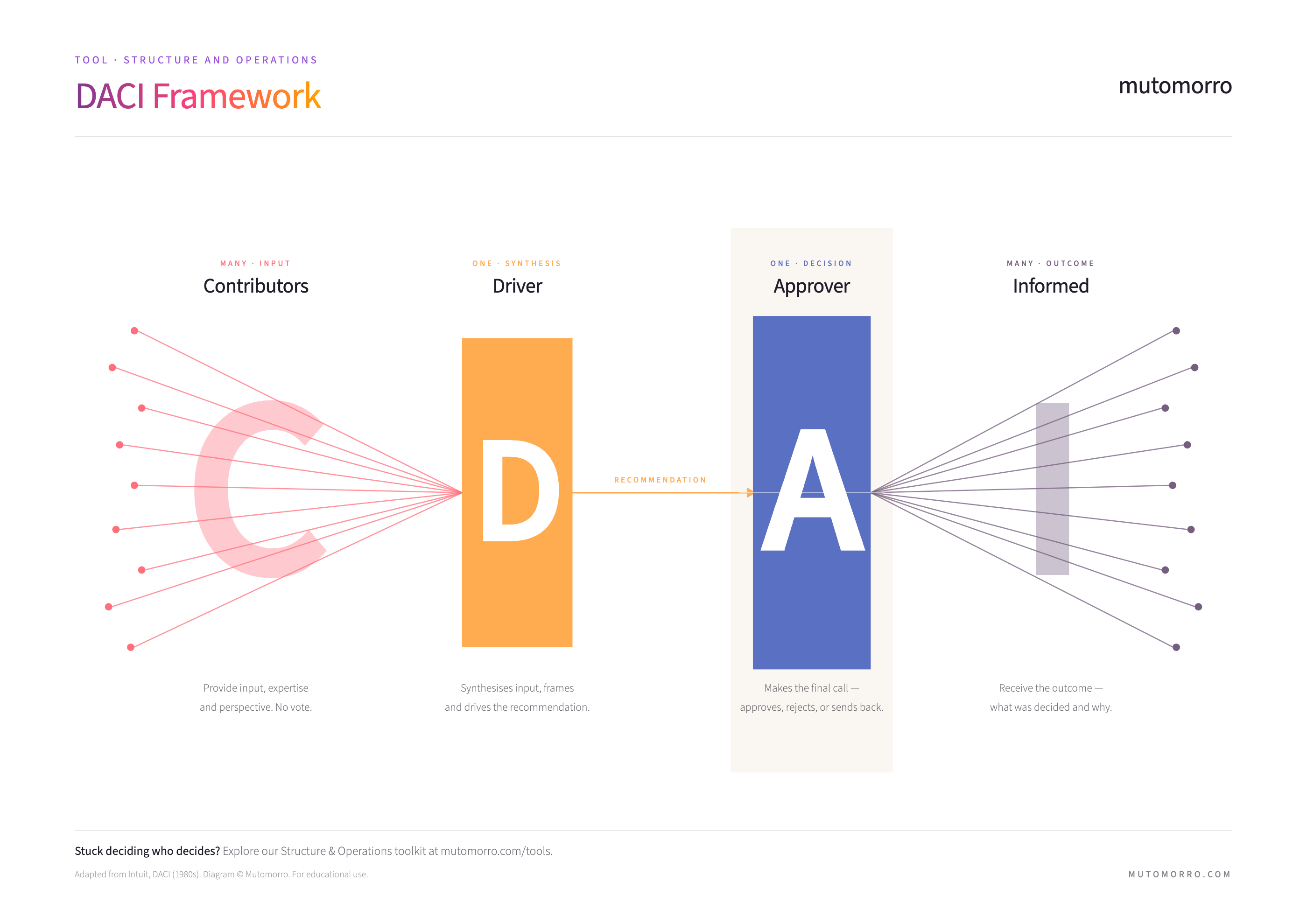
The DACI Framework is a decision-making tool that clarifies who plays what role in a decision - Driver, Approver, Contributors, and Informed. It cuts through ambiguity about who owns what, especially when decisions involve multiple people or teams.
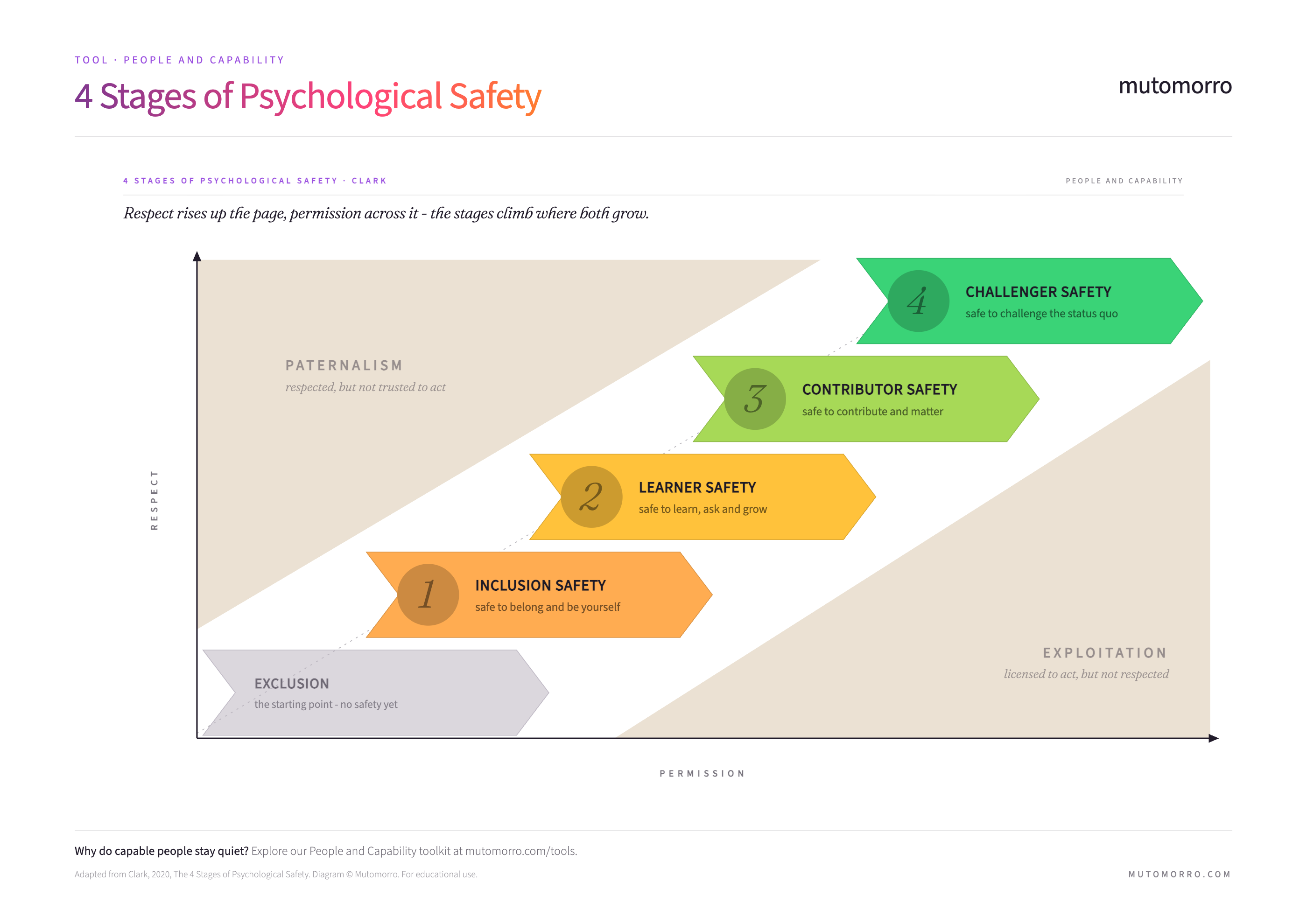
The 4 Stages of Psychological Safety is a framework that maps how safe people feel to be themselves, learn, contribute, and challenge the status quo. It helps leaders understand what conditions people need before they'll speak up and take risks.
James Freeman-Gray is the founder of Mutomorro. He's an organisational development practitioner who has spent over twenty years working with leaders across public, private and nonprofit sectors - helping organisations pull together around a common purpose, joined up in how they work. More about who we are and what it's like to work with us.
De Bono's Six Thinking Hats is the tool I use when a team keeps going round in circles on a decision. By deliberately separating different types of thinking - facts, emotions, risks, benefits, creativity, process - the conversation becomes structured without becoming rigid. It gives quiet voices permission to speak and dominant voices a structure to listen.
Last reviewed: July 2026
Ready to use Six Thinking Hats?
Download the free template - includes practical guidance for workshops and team sessions.
Get the free template
Want to put these ideas into practice?
Whether you're navigating a merger, rethinking how you're structured, or trying to shift a culture that isn't working - underneath, it's the same job: getting the whole organisation pulling in the same direction. Start with a conversation.