Edgar Schein's Culture Model
Edgar Schein's Culture Model explores organisational culture at three levels - visible artefacts, stated values, and the deeper underlying assumptions that really drive behaviour. It helps organisations get beneath the surface of what their culture actually is.
Get the free template
Edgar Schein's culture model reads an organisation's culture at three depths: the artefacts you can see, the values the organisation states, and the underlying assumptions people hold without noticing they hold them. Its central claim is simple and uncomfortable - the deepest layer is the one that decides behaviour, and it is the layer nobody has written down.
That makes it a diagnostic tool rather than a change model. It will not tell you what your culture should be. It will tell you where to look, in what order, and why the answer you get from a values statement is rarely the answer you get from watching a decision being made.
Level | What it is | Where you find it | How you reach it |
|---|---|---|---|
1. Artefacts | The visible layer - environment, symbols, language, behaviour | Office layout, dress, documents, meetings, how people talk to each other | Observe and collect. Easy to gather, harder to interpret |
2. Espoused values | What the organisation says it believes | Mission and values statements, strategy documents, what leaders say publicly | Read the documents, then ask people what they mean in practice |
3. Underlying assumptions | What people take for granted about how things work here | Patterns of behaviour, what gets decided, what never gets questioned | Watch decisions and patterns over time. People cannot simply tell you |
What is Edgar Schein's culture model?
Edgar Schein's culture model is a framework for understanding organisational culture as something layered rather than singular. Instead of treating culture as one thing you either have or lack, it separates culture into three levels that differ in how visible they are and how much they influence what people do.
The levels run in one direction. Artefacts sit at the surface, easy to see and collect. Espoused values sit beneath them - the beliefs and principles an organisation states about itself. Underlying assumptions sit at the bottom, largely unconscious, and they are where the model locates the real drivers of behaviour.
The order matters because influence runs upwards while visibility runs downwards. The layer you can see most easily has the least explanatory power. The layer that shapes the most is the one you cannot observe directly at all. Schein's point was that culture work which stays at the top of the pyramid tends to change what an organisation displays without changing what it assumes.
The model also explains a pattern most people recognise from the inside: an organisation whose stated values and everyday behaviour have quietly parted company. That gap is not a sign of bad faith. It usually means the espoused values were adopted sincerely and the underlying assumptions were never surfaced, so the older assumptions carried on running things. When the two disagree, the assumptions tend to win.
Who was Edgar Schein?
Edgar Schein was a social psychologist and professor at the MIT Sloan School of Management, where he worked for more than sixty years. He is widely credited as one of the founders of organisational culture as a field of study, and he is often described as its father.
Schein first set out the three-level model in a 1984 article in Sloan Management Review, "Coming to a New Awareness of Organizational Culture". His 1985 book Organizational Culture and Leadership developed it and brought it to practitioners, and it has stayed in print through several editions since.
His other work is worth knowing if you use this model, because it shows what he thought the model was for. Humble Inquiry - the practice of asking rather than telling - was his answer to the problem this framework creates. If assumptions cannot be reached by asking directly, you need a way of asking that does not put people on the spot or invite the official answer. He also developed career anchors, and process consultation, which reframed the consultant's job as helping rather than advising.
Schein died on 26 January 2023, aged 94, having worked until the day he died. MIT Sloan's account of his enduring management ideas is a good short introduction to the breadth of it.
How is Edgar Schein's culture model used?
The model is used to work out what is really driving behaviour in an organisation, rather than what an organisation reports about itself.
Its most common use is diagnostic - the first stage of culture work, before anyone decides what to change. You gather artefacts, collect stated values, and then look for the distance between the two. That distance is the useful finding. It points at the assumptions doing the actual work.
It is also used as a root-cause tool. If a behaviour keeps recurring despite policy, training and encouragement, the model suggests the cause sits deeper than the level anyone has been working at. A team that will not raise problems early is rarely fixed by a communications campaign about openness; something in the assumptions makes raising problems feel costly.
Though it was written about whole organisations, it works at smaller scales too. Leadership groups, departments and individual teams all carry their own artefacts, stated values and assumptions, and often those diverge from the wider organisation's. Reading a single team through the three levels can explain a lot about why it behaves differently from the one next door.
Where the model connects to broader culture work, it pairs naturally with our culture change approach - and it sits close to the Enacted Culture dimension of the EMERGENT framework, which is concerned with the same distinction between culture as stated and culture as lived.
How to use Edgar Schein's culture model
Work from the top down, because that is the order in which the evidence becomes available. Do not expect the bottom layer to arrive quickly.
1. Artefacts
Easy to observe, collect and analyse. Harder to interpret from.

Artefacts are everything visible: the physical environment, the symbols, the language, and the behaviour you can watch happening.
Start with the space. Office layout, who has a door, where people eat, what is on the walls, how the place is maintained. Then the language - the words used in meetings, in emails, in documents, and the words that never appear. Then the behavioural artefacts, which are often the richest: how meetings run, who speaks and in what order, how decisions get made, how disagreement is handled, what happens when something goes wrong.
The discipline here is to collect before you interpret. Artefacts are suggestive rather than conclusive, and it is easy to over-read them. An open-plan office might indicate a belief in collaboration, or it might indicate a property decision made three years ago for reasons nobody remembers. A casual dress code might reflect informality, or an industry norm. Treat each artefact as a question rather than an answer, and look for patterns across several rather than conclusions from one.
Useful prompt: if you had to explain this place to someone from the outside using only what they could see in a day, what would you tell them?
2. Espoused Values
Requires investigation and enquiry to uncover and validate.

Espoused values are the beliefs, principles and philosophies an organisation states about itself.
Gather them from the written record first - mission and vision statements, values statements, strategy documents, induction materials, the careers page. These are the official account, and worth taking seriously as evidence of intent. Organisations rarely write down values they do not want.
Then test them. Ask people what a stated value looks like on a normal Tuesday. Ask for an example of a time it shaped a decision. Ask what would happen if someone acted against it. The answers tell you whether a value is operating or aspirational - and both are legitimate findings. An aspirational value is a genuine signal of where an organisation is trying to get to.
This is where the gap starts to show. You are not looking for hypocrisy. You are looking for the places where the stated value and the lived experience diverge, because each of those is a clue about the assumption sitting underneath.
3. Underlying Assumptions
The ultimate drivers of behaviour, decisions and how the organisation functions.

Underlying assumptions are the beliefs so embedded that nobody thinks to mention them: what counts as good work here, what is safe to say, who gets listened to, what happens to people who fail, whether time or quality wins when they conflict.
These cannot be collected by asking. By definition, people cannot easily name what they take for granted - which is precisely why Schein developed Humble Inquiry as the method. You reach assumptions indirectly, by looking at patterns:
- Watch decisions, especially difficult ones. What got protected when something had to give?
- Look at what is rewarded and promoted, as against what is stated.
- Notice the exceptions. When a rule is bent, for whom, and why?
- Listen for the things said with a laugh, or prefaced with "obviously".
- Look at what never gets discussed. Silence is data.
The test of a candidate assumption is whether it explains the artefacts and the gap you found in the values. If you can name an assumption that accounts for both, you have probably found something real.
This layer is the one that connects to the Iceberg Model, which makes the same argument about visibility and influence in a different shape, and it is the reason the Cultural Web is a useful companion - the Web gives you six specific places to look for the evidence Schein tells you to look for.
What does Schein's culture model look like in practice?
Imagine a leadership team that has decided speed of delivery is the problem, and has set a value of "move fast, decide early".
At the artefact level, the visible picture is mixed. There are decision logs and delegation frameworks. There are also standing weekly meetings where the same items reappear for a third and fourth time, and a habit of adding one more person to the invitation list each round.
At the espoused values level, everyone can recite the commitment to fast decisions. Pressed for an example, most people describe a time a decision was escalated for safety rather than made locally - and they describe it approvingly, as diligence.
The gap is now visible, and it points somewhere specific. The candidate assumption is not that people dislike speed. It is that being wrong in public is more costly here than being slow. That single assumption explains the growing invitation lists, the repeated agenda items, and the escalation-as-diligence story - all of them are sensible behaviour if you believe visible error carries a price.
Which changes what the work is. A campaign about moving fast pushes against the assumption and loses. Changing what happens when a local decision turns out wrong - who carries it, how it is talked about, whether it appears in someone's review - works on the layer that is actually driving things.
What are the limitations of Schein's culture model?
Three are worth holding in mind.
It diagnoses rather than changes. The model tells you where culture lives and in what order to look. It does not tell you how to shift an assumption once you have named it, and the naming is the easier half. Pair it with something that gives you levers - our note on why culture change fails covers the gap between diagnosis and movement.
The bottom layer is hard to verify. Assumptions are inferred, not observed, which means they can be inferred wrongly, and a confidently named assumption can be harder to shift than an unnamed one. Treat any assumption you identify as a hypothesis to test against further evidence rather than a finding to act on immediately.
It can imply more coherence than exists. A single three-level reading suggests one culture. Most organisations of any size carry several - by function, site, profession or generation - and Schein wrote about occupational subcultures himself. If a reading feels contradictory, that may be accurate rather than incomplete.
It is also worth saying that direction of travel is not fixed. Schein accepted that changing artefacts - tools, policies, visible behaviour - can influence values and, over time, reach assumptions. Working top-down is slower and less certain, but it is a real route, and often the only one available.
Schein's culture model, the Cultural Web and the Iceberg Model
These three get compared often because they share an argument. They differ in what they give you.
Model | Core idea | Best for | What it gives you |
|---|---|---|---|
Schein's culture model | Culture has three levels; the deepest drives behaviour | Understanding why stated values and behaviour diverge | A sequence for looking, and a reason to keep going deeper |
Culture shows up across six interlocking elements | Gathering evidence systematically | Six specific places to look | |
Events sit above structures, patterns and mental models | Finding where change has most effect | Points of intervention |
Schein tells you how deep to go. The Cultural Web tells you where to look. The Iceberg tells you where to push. They stack comfortably - use Schein to frame the enquiry, the Web to collect, and the Iceberg when you move from understanding to acting. If you want to characterise the culture you find rather than just describe it, the Competing Values Framework gives you a way to name it.
Where to start
Pick one recent decision that surprised you - something where the outcome did not match what you would have predicted from the values on the wall.
Write down three things: what was visibly true about how the decision was made, what the organisation states it believes about decisions like that, and what would have to be taken for granted for the actual outcome to make sense. That third answer is your first candidate assumption, and it took twenty minutes.
Then test it against a second decision. If it explains that one too, you have something worth working on. If you would rather do this properly with a group, our culture assessment work uses these three levels as its spine, and there is a charity culture change case study showing what it looks like across a whole organisation.
Schein's model is at its sharpest on the gap between espoused values and lived assumptions. If closing that gap is the work in front of you, a Mission, Vision and Values Workshop is a facilitated day to land on values your organisation can genuinely stand behind - rather than a set on the wall that nobody recognises.
Sources
- Edgar Schein, "Coming to a New Awareness of Organizational Culture", Sloan Management Review, Winter 1984 - the article the three-level model first appeared in
- Edgar Schein, *Organizational Culture and Leadership* (1985; Wiley 5th edition) - the book that developed and popularised it
- MIT Sloan, 5 enduring management ideas from Edgar Schein - a short overview of his work and its reach
We share thinking on organisational change and development on LinkedIn - practical ideas for people doing this work inside their own organisations.
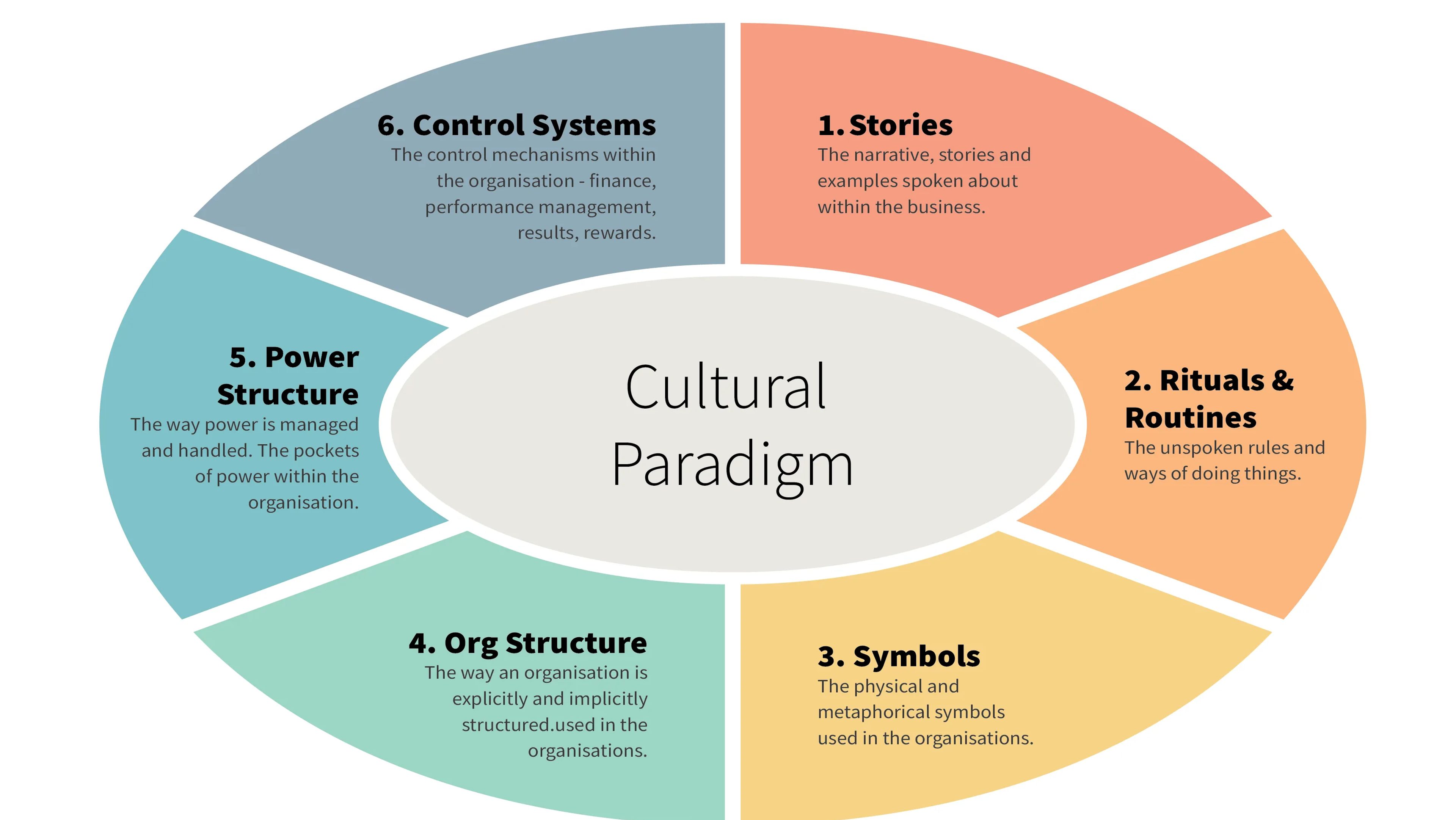
The Cultural Web is a model for understanding and mapping organisational culture across six interconnected elements. It helps you see how stories, rituals, symbols, power structures, controls, and organisational structures shape the way things are done.
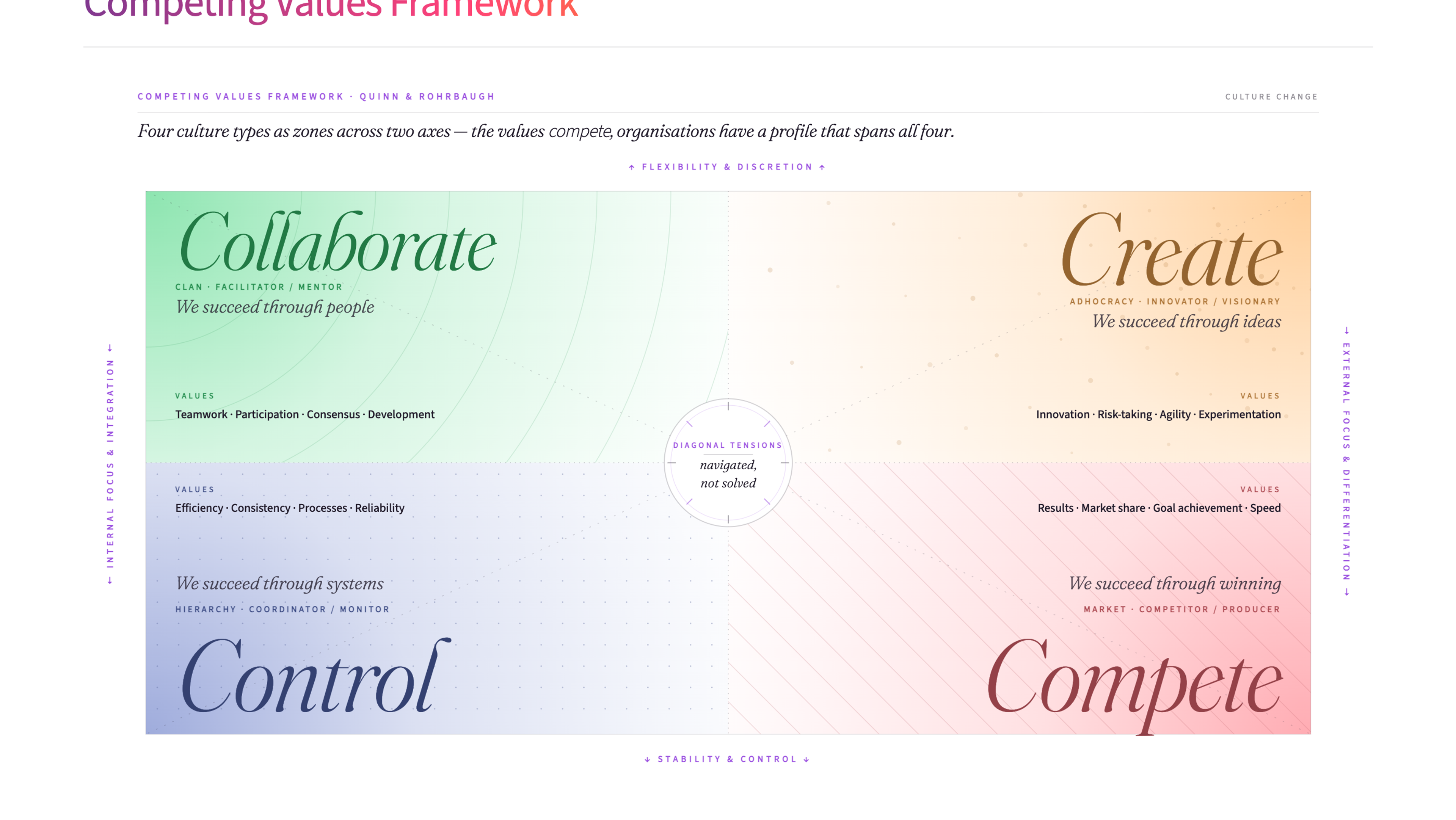
The Competing Values Framework is a model for understanding organisational culture by mapping it across two dimensions - flexibility versus stability, and internal versus external focus. It reveals which of four culture types your organisation leans towards.
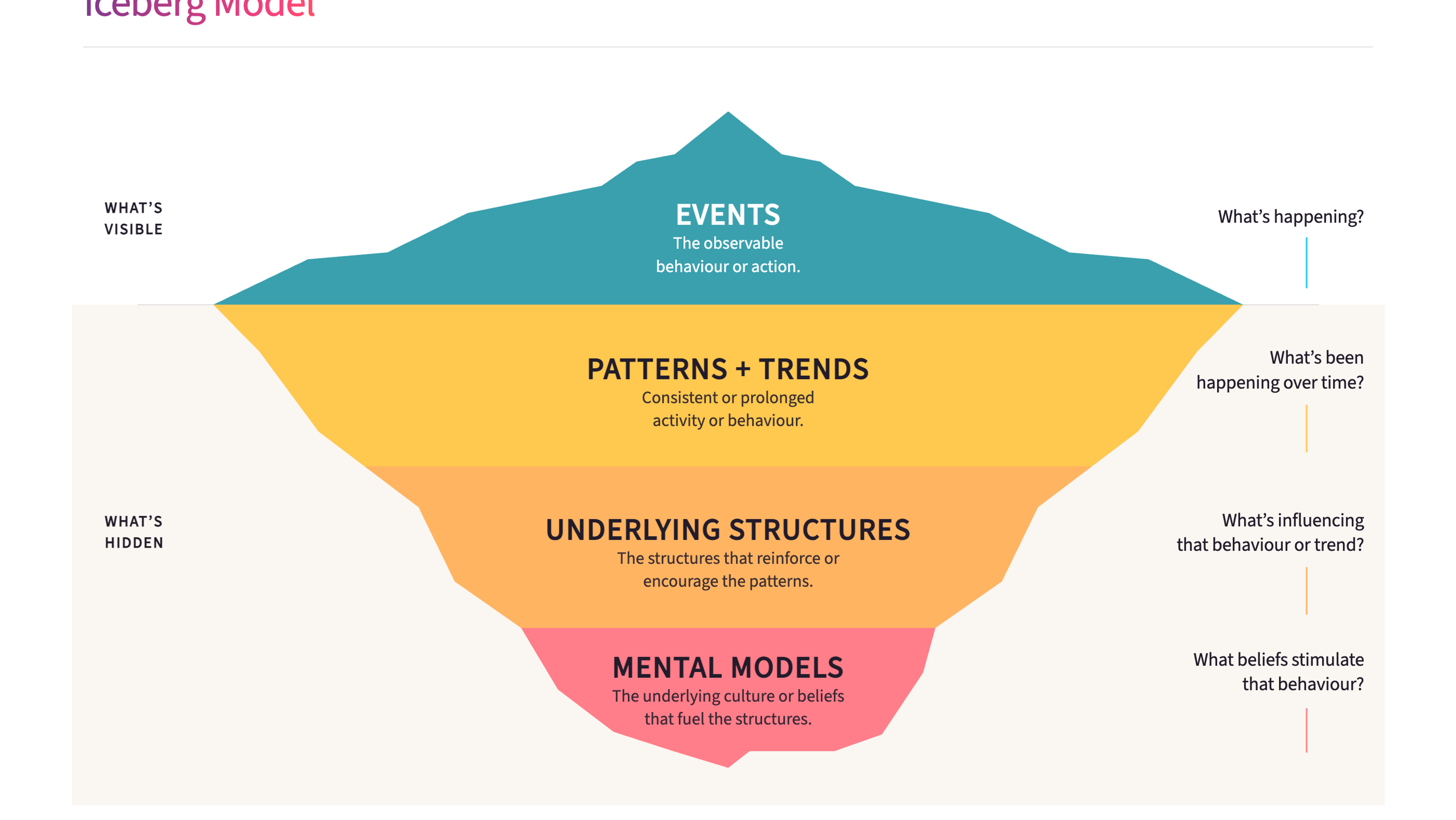
The Iceberg Model is a systems thinking tool that helps you look beneath surface-level events to find the patterns, structures, and mental models driving them. It's a way of seeing the deeper causes behind what's happening in your organisation.
A practical guide to developing organisational culture. Cuts through the theory to explain what culture actually is, why most culture change programmes fail, and how to develop culture in a way that lasts - by working with your organisation as a living system, not a machine.
Psychological safety is one of the strongest predictors of team performance - but it's often misunderstood. This article explores what it actually looks like in practice, why it matters beyond the research headlines, and what leaders can do to build the conditions where honesty, learning, and real collaboration become possible.
Most culture change efforts don't last. The pattern is remarkably consistent - and it points to something fundamental about how culture actually works.

The strategy is clear. So why does the organisation keep doing something different? The answer usually isn't about communication or buy-in. It's about the conditions nobody designed for.
See past the values on the wall
Our culture assessment reads the artefacts against the espoused values - the gap between what's said and what's lived - and tells you what to act on.
James Freeman-Gray is the founder of Mutomorro. He's an organisational development practitioner who has spent over twenty years working with leaders across public, private and nonprofit sectors - helping organisations pull together around a common purpose, joined up in how they work. More about who we are and what it's like to work with us.
Schein's model has shaped how I think about culture work. The idea that the most powerful drivers of culture are the ones people can't see - the underlying assumptions - explains why so many culture programmes fail. They change the posters on the wall but leave the assumptions untouched.
Last reviewed: August 2026
Ready to use Edgar Schein's Culture Model?
Download the free template - includes practical guidance for workshops and team sessions.
Get the free template
Want to put these ideas into practice?
Whether you're navigating a merger, rethinking how you're structured, or trying to shift a culture that isn't working - underneath, it's the same job: getting the whole organisation pulling in the same direction. Start with a conversation.