Enacted Culture
Whether what the organisation says it values matches what people experience day to day.
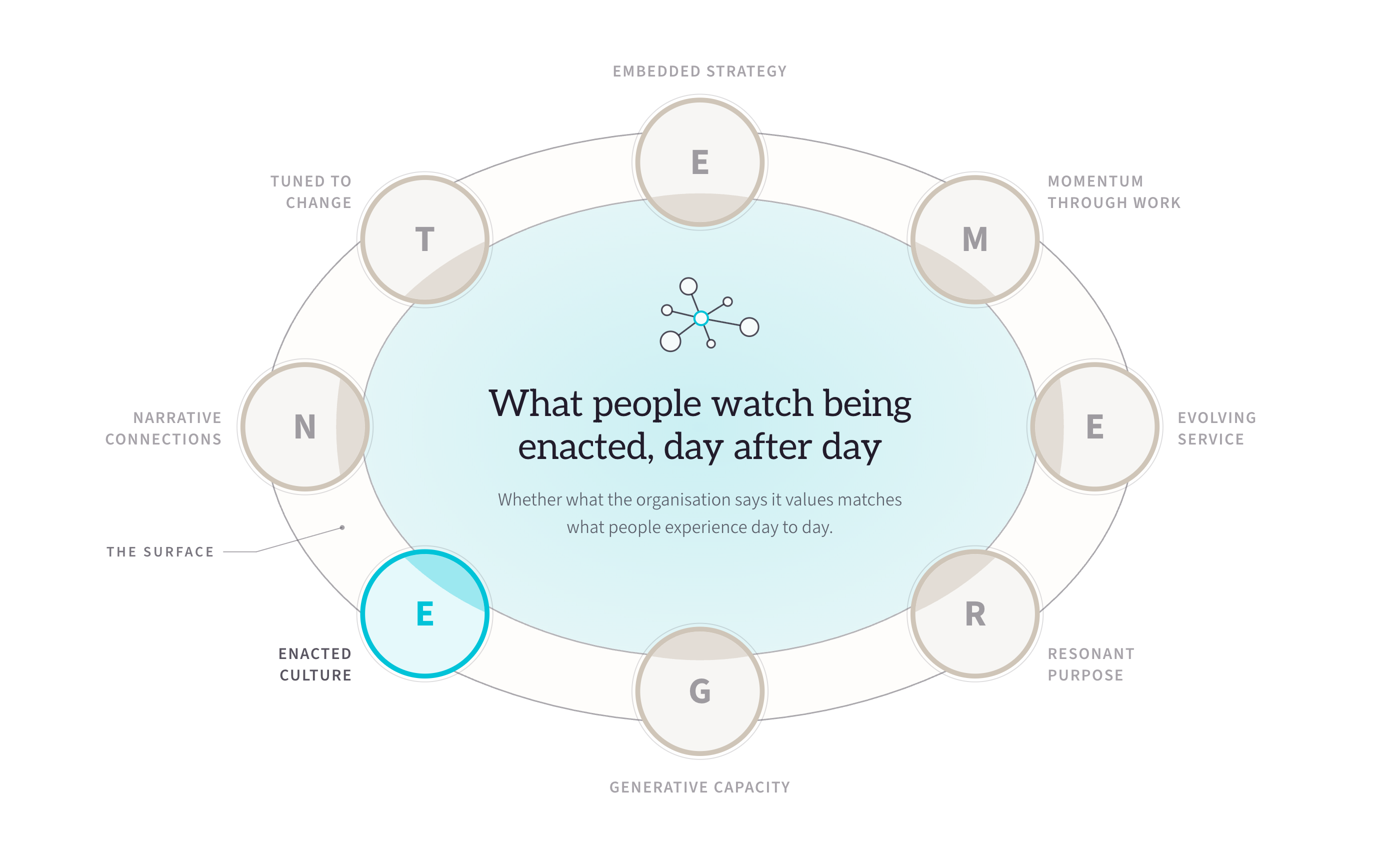
If a new starter spent their first week just watching what happens - never reading a single document - what would they conclude this organisation actually values?
What it is
Watch what happens after someone speaks up in a meeting with an idea that challenges the plan. Not just the response in the room - what happens next. Whether the idea gets engaged with or quietly shelved. Whether the person is thanked, ignored, or subtly repositioned. Everyone present sees it, and everyone learns from it - not what the organisation says it values, but what happens here when you do that. Culture builds this way: act by act, consequence by consequence, witnessed by everyone. The lessons accumulate into the unwritten operating system people actually follow. This lens looks at what your organisation is enacting - because that, not the values statement, is what everyone is learning from.
Why it matters
Some of what we call culture has a measurable relationship with performance - though not the part that gets written down. Three economists tested the values companies advertise against how those companies perform, reading the values published on the corporate websites of every firm in the S&P 500. Set against profitability and market valuation, those advertised values showed no detectable correlation with either. What did track with performance was something no organisation can write for itself: across 679 US companies, and surveys of more than 400,000 of their employees, firms whose staff rated their top managers as trustworthy and ethical were more productive and more profitable. These are associations rather than proof of cause, and the firms are American and self-selected - they had put themselves forward for a workplace award. But the split between the two halves is the finding: the words a company chose told you nothing about its profitability or its market value, and what its people made of the managers above them did.
The nearest reading from this side of the Atlantic comes from a single sector, measured in unusual depth. The 2025 NHS Staff Survey reached 751,088 staff across all 206 NHS trusts in England. In it, 60.29% said they feel safe to speak up about anything that concerns them. Asked separately whether they were confident their organisation would address a concern they raised, 47.59% said yes. Both are down on 2024, when the figures were 61.83% and 49.51%, and the survey's raising-concerns score is at a five-year low. That is a single sector in England rather than a picture of UK employers, and it records what staff expect would happen rather than what happened to anyone who actually spoke up. But the shortfall between the two isn't a shortage of courage. It's what a workforce has come to expect, and expectations like that are built out of what people have watched happen.
Most organisations have done the values work sincerely. The statement was debated, the words chosen with care, and leaders mean them. But culture doesn't form from what's written. It forms from what's witnessed. Every day, people watch what actually happens: which behaviour gets rewarded, what happens to the person who raises a difficult truth, which corners get cut when deadlines bite, who gets promoted and for what. Each of those moments is public evidence about what's really true here - and people update on the evidence, not the aspiration.
That's also why culture always tells the truth. It can't be faked for long, because it's made of thousands of witnessed moments that no communications plan can choreograph. The values on the wall are a hypothesis. What people do - and what happens to them when they do it - is the data.
What it can tell you
Looked at through this lens, four things come into view.
The distance between the stated culture and the enacted one. Every organisation has both: the values in the handbook and the operating system people actually follow. Listen to the words people use when they describe the culture - whether they reach for the language of the values statement or for completely different words. The size of that gap, and whether it widens as you move further from leadership, is one of the most honest readings an organisation can take.
What the consequence chains are teaching. Promotions, recognition, tolerance - these are the loudest cultural signals an organisation sends, because everyone watches them. What gets someone ahead here? And what does the organisation tolerate in its most visible, most successful people? If those answers contradict the values, everyone has already noticed - and already adjusted.
What happens to mistakes and difficult truths. When someone errs, is the story people tell afterwards a story of learning or a story of consequences? When someone raises an uncomfortable truth, are they thanked or quietly sidelined? These moments are watched more closely than any town hall, and they set the risk appetite of everyone who witnesses them.
What pressure reveals. Culture is easiest to perform when things are calm. Under real pressure, it either holds or reverts to something more survivalist - tighter control, less trust, shorter horizons. And notice the pockets where the culture feels genuinely different: healthier, more open, more alive. The conditions in those pockets are proof of what's possible in the rest.
How to observe it
Culture shows itself in the gap between what's stated and what's experienced. These prompts help you see what your culture actually enacts - not what it claims to value.
Listen for
- When someone makes a mistake, is the story people tell about it a story of learning - or a story of consequences?
- Is there a conversation that happens after the meeting - in the corridor, on the walk back to desks - that tells a different story from the one in the room?
- When people describe the culture, do they use the words from the values statement - or completely different words?
- Do people talk about trust as something they feel - or something they've learned not to rely on?
Watch for
- When values and expediency conflict on a routine Tuesday - not the high-profile moment when everyone's watching - which wins?
- Look at who gets promoted. Do their behaviours match the stated values - or do they match a different, unwritten set of rules about what actually gets rewarded here?
- When someone raises a difficult truth, what happens to them? Not on paper. In practice. Are they thanked - or quietly sidelined?
- Do people take genuine risks - proposing new ideas, challenging decisions, admitting they don't know? Or does everyone play it safe?
Measure
- What's the gap between stated values and experienced reality - and does that gap widen as you move further from leadership?
- How does psychological safety vary across teams and locations? The variation often matters more than the average - it tells you culture is locally held, not organisationally consistent.
- What do exit interviews reveal about why people actually leave - and how different is that from the official narrative about retention?
Notice
- When the organisation is under real pressure, does the culture hold - or does it revert to something more survivalist? Tighter control, less trust, shorter horizons. Pressure reveals the real culture.
- Are there pockets where the culture feels genuinely different - healthier, more open, more alive? What conditions are different there? Those pockets are proof of what's possible.
- How big is the gap between front-stage culture - the one visitors and new hires see - and backstage culture, the one people live with daily? The size of that gap is a measure of cultural honesty.
How to have meaningful conversations about it
- What gets someone promoted here - and is that the same thing the values statement would predict?
- When values and expediency conflict on a routine Tuesday - not the high-profile moment - which wins?
- When someone raises a difficult truth, what happens to them? Not on paper. In practice.
What you can do about it
You don't need a programme to start. Ask five people who've been here at least a year what they had to learn about how things really work that nobody told them in the induction. You're not collecting complaints - you're mapping the unwritten rules, the informal operating system beneath the official one. The consistency of the answers will be striking.
Or run the promotions test. At your next leadership session, list the last five promotions or significant recognitions and ask honestly what behaviour each one rewarded. Then put the values statement next to the list. The overlap - or the gap - will show you exactly where your enacted culture and your stated culture have drifted apart. No survey needed; the answer is in decisions you've already made.