Resonant Purpose
Whether purpose is sharp enough to guide action, felt in daily work, and visible in how things operate.
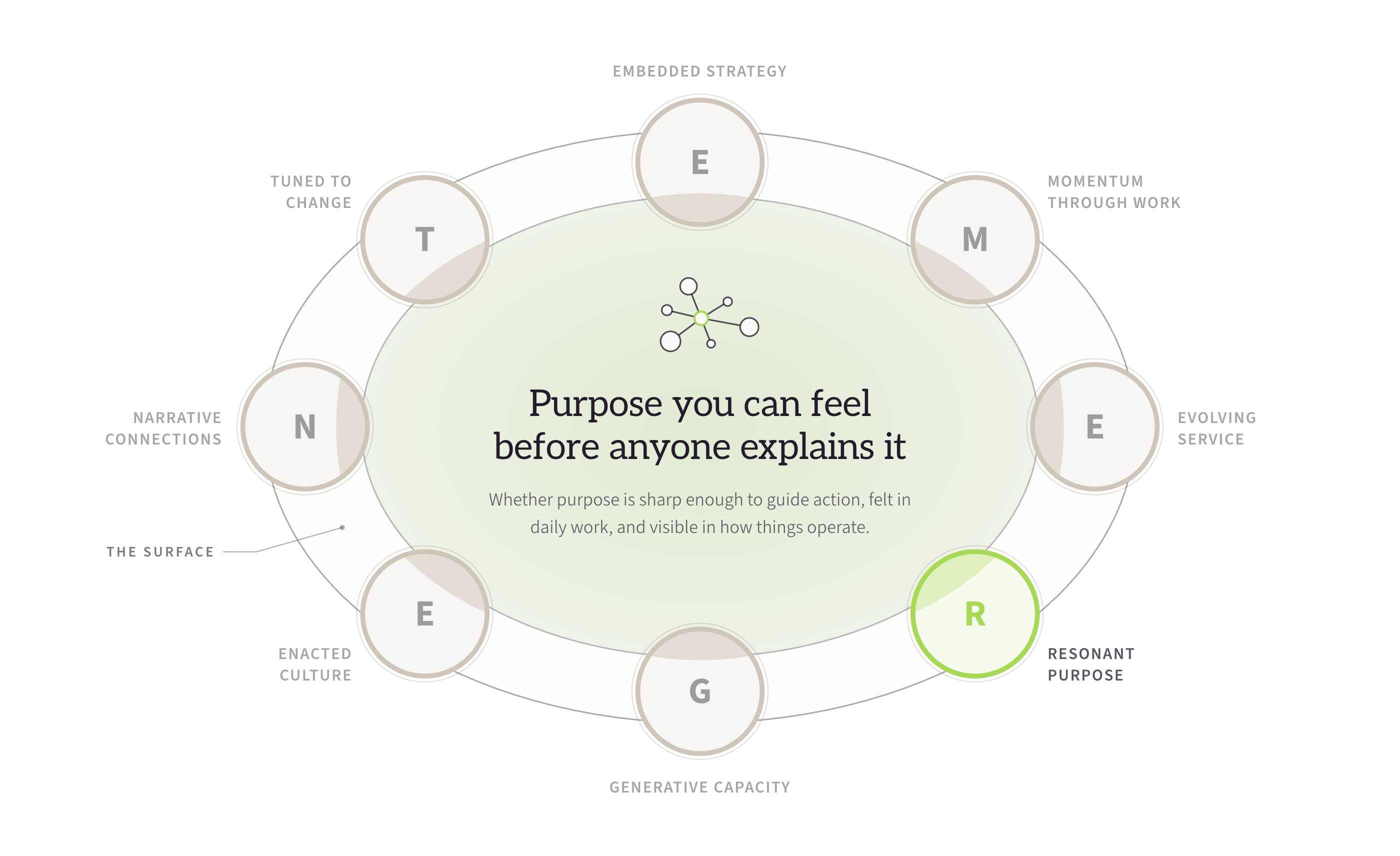
Does your purpose travel through the organisation under its own power - or does it need to be carried?
What it is
Every organisation has a purpose, and most have invested real thought in articulating it. The statement exists; people know it; leaders mean it. What varies is what the purpose does. In some organisations it lives mainly at altitude - in the strategy, the annual report, the town hall - and needs carrying to go anywhere else. In others you can feel it before anyone explains it: people at different levels make choices that pull in the same direction, not because they've been told to, but because what this place is for has landed deeply enough to guide without instruction. That's purpose resonating - amplified by the system because it connects to something people already care about. This lens looks at which of those your purpose is doing.
Why it matters
Most organisations have a purpose, and most put real work into it: the wording, the sign-off, the launch. That work happens at the top. What happens to purpose below that is harder to see, and it is the part the evidence keeps pointing at.
The most careful evidence we could find is a peer-reviewed study of 429 US public companies, published in Organization Science and built from more than 456,000 employee survey responses. On its own, the purpose employees reported had no relationship with financial performance. What did relate was purpose held together with clarity from management: firms scoring high on both went on to perform better in later years, both in their accounts and on the stock market, even after controlling for how they were already doing. And the perceptions driving that result came from one layer - middle managers and professional staff, rather than senior executives or hourly and commissioned workers. That is an association rather than a cause, and these are large, long-established US employers that had put themselves forward for a best-workplaces list, so they are not a representative sample of anything. But it is unusually precise about where the relationship showed up: not among the senior people, and not among those furthest from them, but in the layer that turns intent into work.
The picture closer to home is thinner, and it asks a simpler question. In a survey of more than 2,000 employees at UK and Ireland organisations turning over at least £10 million, EY Lane4 asked how much their organisation's purpose affected their day-to-day role. Half of business owners said it had a great impact. Among middle managers that fell to 26%, and among entry-level staff to 24%. That is self-reported perception rather than observed decisions, from a firm that sells purpose work and without published group sizes, so read it as the shape of a gradient rather than a measurement of one. It is also a different question from the one the US study asked, and neither result is evidence for the other. But the shape is the point: what people say purpose does for their own work roughly halves immediately below the top.
So the statements exist. In the same survey, 86% of employees said their organisation has a purpose statement - and 42% of them did not know what it was. Somewhere between the statement and the lived reality of daily decisions, something gets lost.
The pattern that matters isn't whether an organisation has a purpose. It's whether that purpose is specific enough to settle a trade-off, connected enough to shape someone's Tuesday afternoon, and visible enough in how things work that you'd recognise it without ever reading the statement.
Something we keep seeing is the difference between purpose people know and purpose people feel. Both organisations can articulate why they exist. But in one, purpose gets referenced - in strategies, in reports, at the occasional town hall. In the other, you can sense it before anyone explains it. Competing priorities settle more easily, because what matters here has landed deep enough to guide without instruction. Purpose that's landed that deeply doesn't need pushing. When it connects to something people care about, they carry it forward - and when it doesn't match what they experience, no amount of repetition creates the connection.
That's also where unity begins. Plenty of things can coordinate an organisation - structures, plans, processes. But if anything can unite one, it's a common purpose: the clarity of what we're all here to do, felt at every level rather than just stated at the top. When that clarity is present, people don't need pulling together. They already are.
What it can tell you
Looked at through this lens, four things come into view.
How far the signal travels. Purpose almost always registers strongly near the top - leadership lives with it daily. The revealing read is what happens with distance. An organisation where senior leaders can describe the purpose and frontline teams describe something else entirely doesn't have a purpose problem. It has a resonance problem: the signal isn't reaching the system. The variation between levels and teams is often more telling than any average.
Whether purpose settles anything. The everyday test of purpose isn't the statement - it's the trade-off. When budget gets cut, when two teams disagree, when an attractive opportunity doesn't quite serve the mission: does purpose feature in how those moments resolve? A purpose that never settles a contested decision is describing the organisation, not guiding it.
Whether the words match the experience. Resonance doesn't come from eloquence. The organisations where purpose genuinely resonates rarely have the finest statements - what they have is a small gap between what they say and what people experience. Where daily experience contradicts the stated purpose, no rewording closes the distance.
What your communication effort is telling you. When purpose is landing, it tends to need surprisingly little promotion - it shows up in decisions, and people can see it. When the instinct is to communicate harder - more posters, more mentions, more reminders - that's usually a signal in itself: purpose on artificial life support. The most resonant organisations often talk about purpose less and let it drive visible choices more.
How to observe it
Purpose is invisible until you know what to look for. These prompts help you notice where it's resonating in your organisation - and where the signal fades.
Listen for
- When the budget gets cut and something has to go, what's the argument for what stays? Is purpose part of that argument?
- When two teams disagree about priorities, what language do they reach for to make their case?
- When someone pushes back on a decision - says "we shouldn't do this" - what reasons do they give? Do those reasons connect to purpose?
- When a new opportunity arrives that's commercially attractive but doesn't serve the mission, how does that conversation go?
Watch for
- At the edges of the organisation - decisions made far from leadership, in moments no one reports on - does purpose still show up?
- Do strategic choices flow from purpose? Or does purpose get retrofitted to justify decisions already made?
- When a decision costs the organisation something because it serves the purpose, is that celebrated or quietly resented?
- When someone new joins, where do they learn what this place is actually for - the induction pack or the people around them?
Measure
- What percentage of people can describe the organisation's purpose accurately - in their own words, not verbatim?
- How much does that vary between levels, teams, and locations? The variation is often more revealing than the average.
- How recently was purpose part of a working conversation - not a presentation or town hall, but an actual decision?
Notice
- When someone challenges a decision by invoking purpose, is it treated as a powerful argument - or an inconvenience?
- Do new initiatives get tested against purpose? Or does purpose get tested against new initiatives?
- When you look at the last five significant decisions, how many of them could have gone the same way if the organisation had a completely different purpose?
How to have meaningful conversations about it
- How far from the boardroom can you go before purpose stops influencing what happens?
- If your purpose disappeared from every document overnight, what would actually change about how you work?
- When purpose and pragmatism pull in different directions, which wins - and how do people feel about it?
What you can do about it
You don't need a programme to start. Ask six people at different levels and in different teams the same question: what is this organisation for? Don't prompt, don't correct, don't show them the statement first. You're not testing them - you're listening for where the signal is strong, where it's faded, and where it's telling a different story entirely.
Or open your next team meeting with one question: where did purpose show up in our work this month - and where was it absent? No preparation, no slides - an honest five minutes. What people say, and what they don't, will give you a remarkably clear picture.