Generative Capacity
Whether the organisation is growing its people and building collective capability.
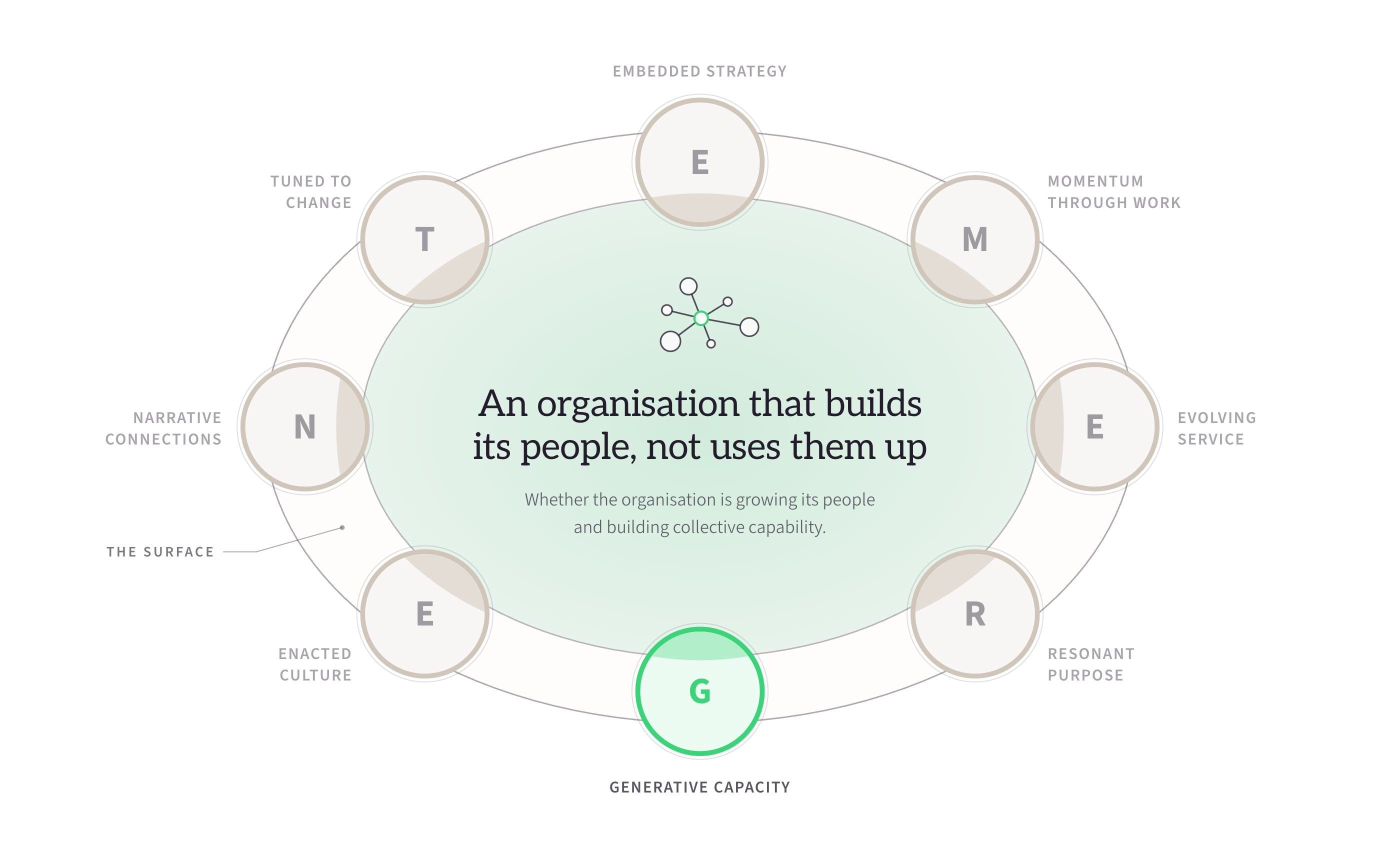
Think of someone who's just finished a demanding year here. Are they more capable and more energised for it - or just more tired?
What it is
Watch what a year of work does to people. In some organisations, giving your best is how you grow: people are trusted with things that stretch them, knowledge accumulates and moves between colleagues, and the organisation gets collectively wiser as it works. Working hard builds something - in the person and in the system. In others, working hard only spends something: people run faster to stay in place, give more than they get back, and end the year not stretched but worn. This lens looks at which of those your system is doing - whether it builds people up or uses them up.
Why it matters
Organisations invest serious effort in developing their people. There are budgets for it, programmes, appraisal conversations that ask what someone wants to grow into. When capability genuinely builds, it changes what organisations can do.
But there's a pattern the investment alone doesn't solve. Some organisations run strong development programmes and still leave their people depleted. Skills get built. Courses run. And yet something about how the system operates consumes more than it creates. People grow - but at a cost. And the cost does show up: in wellbeing scores, engagement surveys, sickness absence, turnover. It's usually read as a wellbeing problem, and met with wellbeing initiatives. Read through this lens, it's something else: a symptom. Wellbeing is one of the things a generative system produces - and one of the first things a depleting system consumes.
One large workforce publishes numbers on both. In the 2025 NHS Staff Survey - 751,088 responses from staff at all 206 NHS trusts in England - 68.47% of staff said they have opportunities to improve their knowledge and skills. In the same survey, 43.03% said they often or always feel worn out at the end of a working day or shift. Two separate questions, put to a whole workforce rather than tracked through the same individuals; the survey tests no relationship between them, and it is one employer system in one country, self-reported, at a 49% response rate. Taken for what it is, it still says something worth sitting with: a workforce can report, in quantity, both that the chance to develop is there and that people are worn out by the end of the day. Development being available is not the same as the system giving back more than it takes.
There is also the question of how much capability is being bought in. The Department for Education's Employer Skills Survey, through its follow-up survey of training investment covering 5,935 UK employers, puts training spend in 2024 at £1,700 per employee, down 29.5% in real terms since 2011. That figure counts what training costs, not what the work teaches, and it averages across every size and sector of employer. Which is close to the point: if capability only ever arrives as purchased training, there is steadily less of it arriving.
The distinction that matters isn't whether an organisation develops its people. It's whether the system builds them up or uses them up. Whether someone finishing a demanding year is more capable and more energised - or just more tired.
Something we keep seeing is the difference between organisations that have capability and organisations that produce it. In one, capability is a stock - you audit it, find the gaps, buy training to fill them. In the other, it's closer to a flow: people come out of projects stronger than they went in, knowledge moves because sharing is natural, and development happens through the work rather than alongside it. When that's present, the organisation gets wiser, not just bigger. When it's absent, every new challenge means another hire.
What it can tell you
Looked at through this lens, four things come into view.
What a year here does to people. The same demanding year can leave someone more capable and more energised - or just more tired. When people describe how they've grown, listen for whether they credit the work and the people around them, or describe growing despite the environment. Treat burnout, disengagement and the treadmill feeling as system readings, not individual failings - they're what being used up looks like from the inside. And notice what gets celebrated. In hero cultures - where every success story is one person absorbing impossible load against the odds - the organisation is quietly teaching everyone that being used up is what good looks like.
Where knowledge lives - and whether the organisation is accumulating. Notice who people actually go to when they need help, then notice whether that knowledge is flowing or pooling. Where it flows, it creates capacity. Where it pools, it creates dependency - a handful of indispensable, overloaded people, and critical capabilities that would leave the building with them. How many of your critical capabilities depend on fewer than three people is a fair measure of how fragile the system is. And the collective question matters as much as the individual one: an organisation can be full of capable people and still not be getting wiser, because nothing they learn compounds.
How safe it is to stretch. Development means attempting things you can't yet do, which means it involves mistakes. What happens after someone errs while trying something new - whether it's treated as a natural part of development or as evidence they shouldn't have been trusted - sets how much stretching anyone will risk. And watch how work is allocated: if the most capable person always gets the hardest work, they're carrying the load while nobody else gets the chance to grow into it.
What the hiring reflex reveals. When demand increases, is the first instinct to hire or to develop? The reflex tells you whether the system believes in its own capacity to grow people. An organisation that needs to hire every time demand rises has a stock of capability; one where people grow into new challenges has a system that generates it. The difference compounds over years.
How to observe it
Generative capacity reveals itself in what happens to knowledge and capability over time. These prompts help you see whether your system is building people up or quietly using them up.
Listen for
- When people describe how they've grown, do they credit the work and the people around them - or do they describe growing despite the environment?
- When a team hits a problem no one's faced before, do they reach out to colleagues across the organisation - or does each team solve things in isolation?
- When someone struggles with something new, is the instinct to support them through it - or to route the work to whoever can do it fastest?
- Do managers talk about developing their people as a natural part of the job - or as an extra task competing with "the real work"?
Watch for
- When work is allocated, is development potential considered - or does the most capable person always get the hardest work while others never get stretched?
- When a key person leaves, does the team absorb the loss within weeks - or does a capability gap open that takes months to fill?
- Is knowledge shared through practice - mentoring, pairing, collaborative work - or does it exist only in documentation that nobody reads?
- When demand increases, is the first instinct to hire or to develop? The reflex tells you whether the system believes in its own capacity to grow people.
Measure
- What proportion of people say they're growing in their role - versus stagnating or just coping?
- How many critical capabilities depend on fewer than three people? That number tells you how fragile the system is.
- Do teams emerge from projects stronger than they went in - with new skills, new relationships, new understanding? Or just more tired?
Notice
- Is the organisation getting more capable over time - or just bigger? More people doesn't mean more wisdom. Watch whether the collective intelligence is growing or just the headcount.
- Do senior people visibly invest time in developing others - and is that investment valued and celebrated, or invisible and unrewarded?
- Where does learning actually happen? If the answer is only "on courses," the system isn't generative. Real generative capacity builds people through the work itself.
How to have meaningful conversations about it
- If your three most knowledgeable people left tomorrow, what would the organisation lose that it couldn’t replace?
- When someone struggles with something new, is the instinct to support them - or to route the work to whoever can do it fastest?
- Do teams emerge from projects stronger than they went in - or just more tired?
What you can do about it
You don't need a programme to start. Ask three people at different stages of their career what the most valuable thing they've learned here is - and how they learned it. Listen for whether it came from a course or from a person, from a programme or from being trusted with something that stretched them. The pattern will tell you where the real work of building capability is happening.
Or make the knowledge map visible. Ask each person in your team to name one thing they know how to do that nobody else in the team can. Then ask: what would it take for that knowledge to live in more than one person? You're not writing a training plan - you're making the concentration of knowledge visible, and opening a conversation about what sharing it would mean.