Momentum through Work
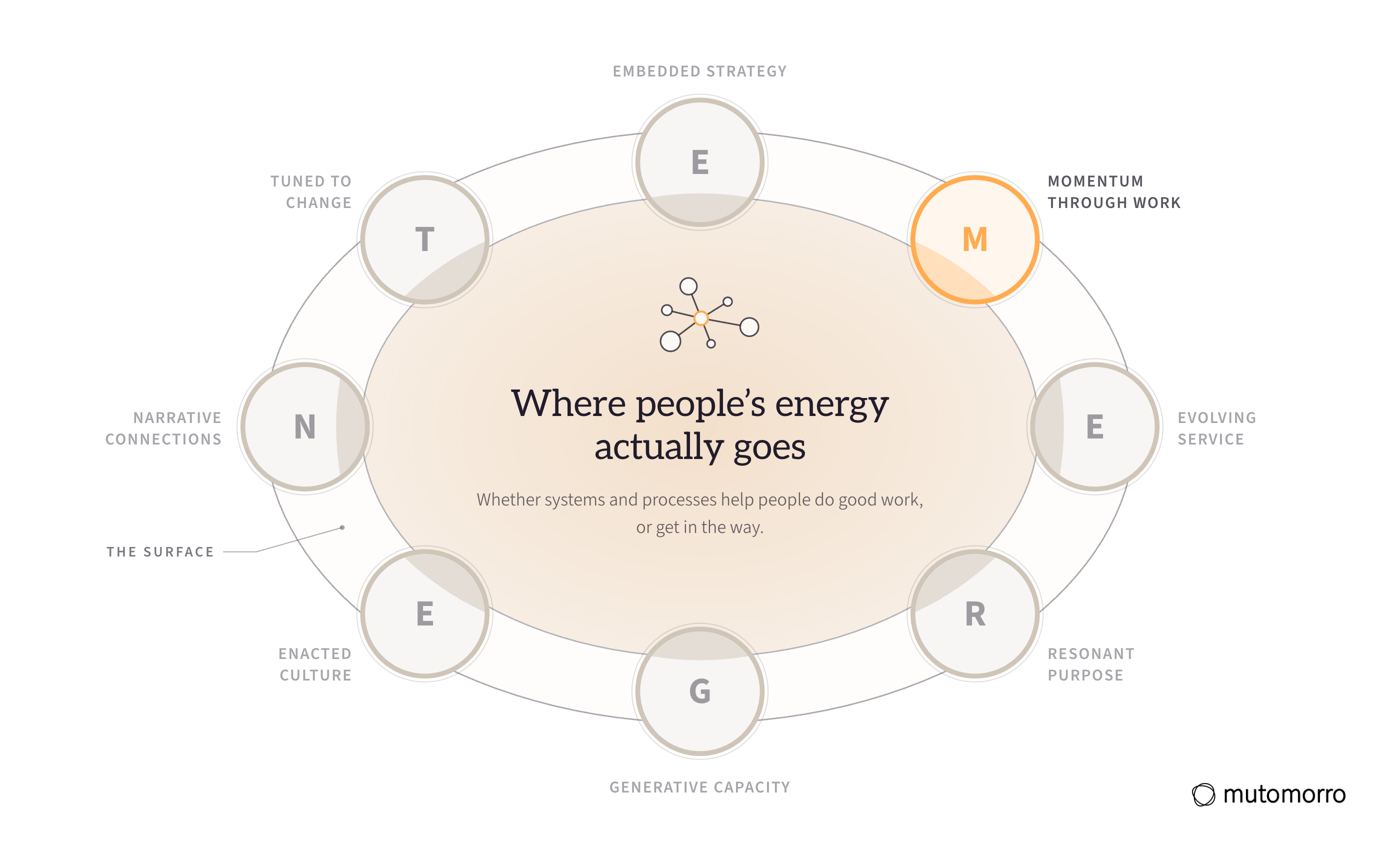
Whether systems and processes help people do good work, or get in the way.
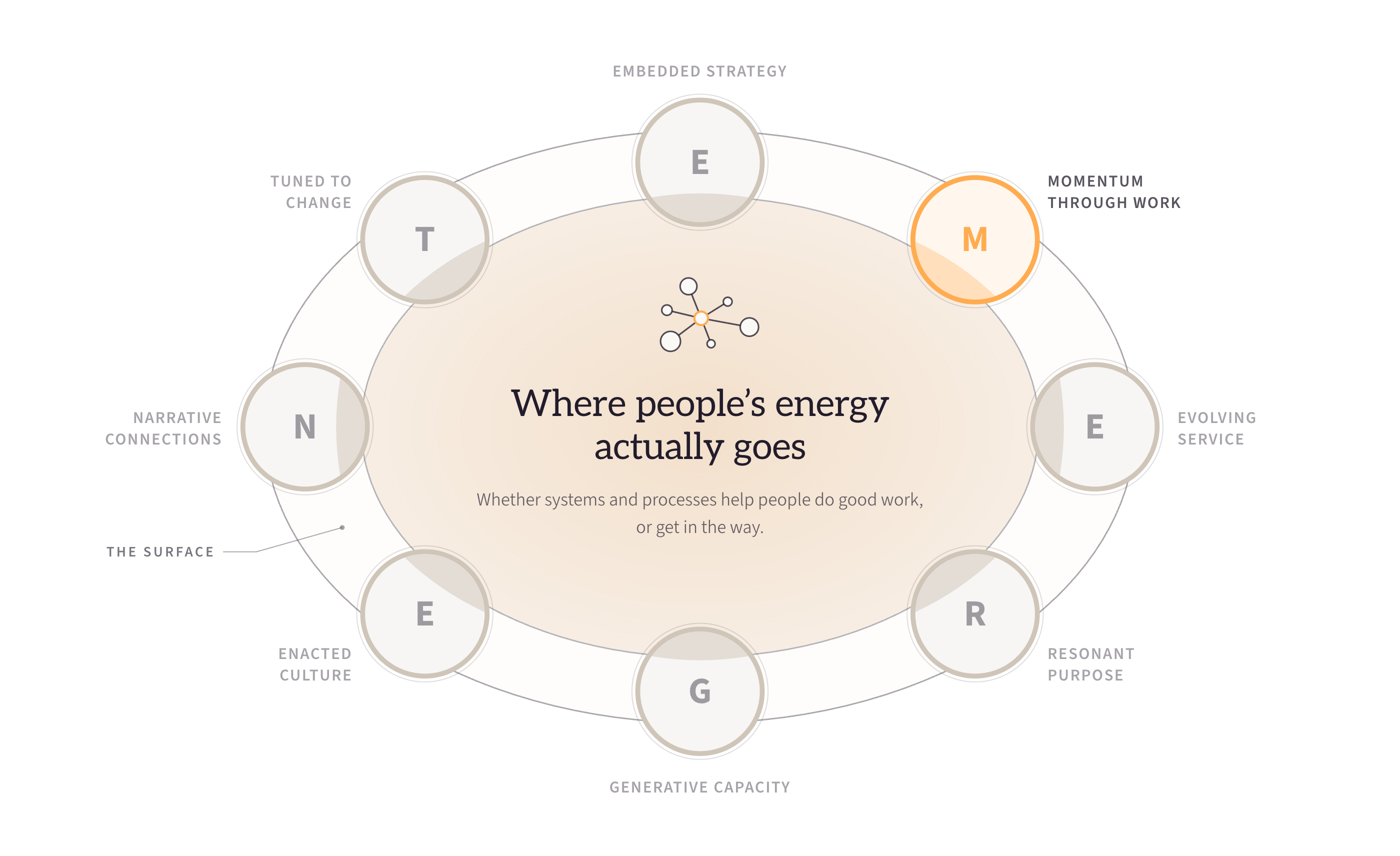
When your people finish a day's work, have they spent their energy on the work itself - or on everything that surrounds it?
What it is
Think about the last day at work where things genuinely moved - where one piece of work led naturally into the next and you left with more energy than you expected. Then think about the busy day you couldn't point to anything from. The difference between the two usually isn't effort. It's what the system did with the effort. This lens looks at where a day's energy actually goes: whether it reaches the work people came to do, or gets absorbed by everything around it. When energy reaches the work, something compounds - finishing one thing sets up the next, and the work generates its own momentum.
Why it matters
Every organisation runs on people's effort - but not all of that effort reaches an outcome. Some gets absorbed along the way: by processes that exist because they've always existed, by coordination overhead that grows quietly as organisations scale, by decisions that stall between teams waiting for someone to take ownership.
That absorption is hard to measure directly. What the big national surveys do measure is something next to it: how much say people are offered, against how much they turn out to have. The Skills and Employment Survey has tracked British working life since 1986, interviewing employees face to face in their own homes across England, Wales and Scotland. In its 2024 wave, 74% said their employer held meetings where staff could express their views about what was happening in the organisation. 28% thought they could influence organisational decisions affecting their work. The same survey tracks something closer in, too: the share of employees with significant discretion over their own tasks - what they do, how they do it, to what standard - fell from 44% in 2012 to 34% in 2024.
Something similar shows up at closer range, though it has to be read carefully. The 2025 NHS Staff Survey drew 751,088 responses from staff at all 206 NHS trusts in England. Just under 70% said they were able to make suggestions to improve the work of their team or department. 54% said they were able to make improvements happen in their own area of work. Neither survey asks what accounts for the difference, so neither tells you what creates it in any particular organisation - and two surveys putting different questions to different people are not one measurement. One covers Britain across every sector; the other is NHS England alone. What they have in common is only a shape: in both, more people can speak than can move anything.
None of this is deliberate. Nobody designs an organisation to waste people's energy. But friction accumulates. Each individual process, approval or meeting makes sense in isolation. Collectively, they can absorb more of what people have to give than anyone ever intended.
People arrive ready to do good work - capable, caring, clear on what matters. Then the day happens. They get caught in approval loops, wait for decisions that sit three levels up, spend an hour in a meeting that could have been a sentence, chase information that lives in someone else's inbox. None of these people are unproductive. They're working flat out. Their energy is just being spent on everything that surrounds the work rather than the work itself.
What it can tell you
Looked at through this lens, four things come into view.
Where the energy actually goes. Not how hard people are working - almost everyone is working hard - but how much of that effort reaches the work itself versus navigating everything around it. That ratio, more than almost anything else, determines what the organisation is capable of.
Where the flow breaks. Work rarely stalls at random. It stalls at the same places, again and again - the handoff nobody owns, the approval layer that adds time without adding safety, the decision that sits waiting for someone three levels up. Follow a single piece of work from start to finish and the blockages show themselves: not as anyone's failure, but as the points where the system stops enabling the work and starts preventing it.
What kind of tired people are. There's a difference between being tired from good work and being tired from fighting the system. The first is sustainable - sometimes even energising. The second is corrosive, and it compounds: when the effort required to keep things moving exceeds what people can sustain, momentum doesn't just stall, it reverses. People stop raising problems, stop suggesting improvements, stop pushing for better - because the cost of pushing has become too high relative to anything changing.
What the workarounds are telling you. When friction has been around long enough, people stop expecting it to be fixed and build routes around it. Workarounds exist everywhere - the question is whether anyone reads them as signals. Every workaround is a map of where the system is failing, and organisations that pay attention to that map tend to be the ones where momentum builds rather than drains.
How to observe it
Momentum isn't about speed. It's about whether the system carries work forward or absorbs the energy people put into it. These prompts help you see where flow exists and where friction hides.
Listen for
- When you ask people what slows them down, do they point to the work itself - or to everything that surrounds it? Approvals, meetings, unclear handoffs, chasing information?
- When teams describe a good week, are they describing output and impact - or getting through the backlog?
- Listen to the verbs people use. "Building, creating, delivering" - or "waiting, chasing, aligning, updating"?
- When something needs doing urgently, do people describe cutting through the system - or working around it? Workarounds are the system telling you where it's broken.
Watch for
- How many layers of approval does a typical piece of work pass through? Could any of those layers be removed without meaningful risk?
- When work stalls between teams, does someone own the handoff - or does it sit in no-one's-land until someone chases?
- Do your meetings advance work or report on it? Count how many meetings this week produced a decision versus how many were updates that could have been an email.
- When a team delivers something fast and well, was that because the system supported them - or because they found a way around it?
Measure
- What proportion of people's time goes to the core work they were hired for versus coordination, reporting, and internal administration?
- Pick a recent decision. How long from the moment it was needed to the moment it was made - and where in the chain did it stall?
- How many recurring meetings exist? What percentage of regular attendees would say each one is necessary?
Notice
- Is there a consistent bottleneck - a team, a role, a stage - where work predictably slows? That's not a people problem. It's a system signal.
- Does finishing one piece of work naturally set up the next - or does every new task require rebuilding context, reforming teams, seeking fresh approvals?
- Where have people built informal routes around the official process? Those workarounds are a map of where friction lives. Follow them.
How to have meaningful conversations about it
- If you followed a piece of work from start to finish, where would it stall - and why?
- When you ask people what slows them down, do they point to the work itself - or to everything that surrounds it?
- How much of people’s time goes on coordinating, chasing, and getting permission versus actually doing the work?
What you can do about it
You don't need a programme to start. Ask five people across different teams where their work gets stuck and what they do when it does - then listen for the workarounds. The informal phone call that bypasses a broken process, the spreadsheet that exists because two systems don't talk to each other. The people navigating them have already diagnosed the problem; they just haven't been asked.
Or try one clearing. At your next team meeting, ask everyone to name one thing that, if removed, would make their work flow better - one source of friction, not a transformation programme. You'll probably hear the same points named from different angles. Pick the one that appears most often and remove it. Then notice what happens. Momentum builds from small clearings, not grand redesigns.