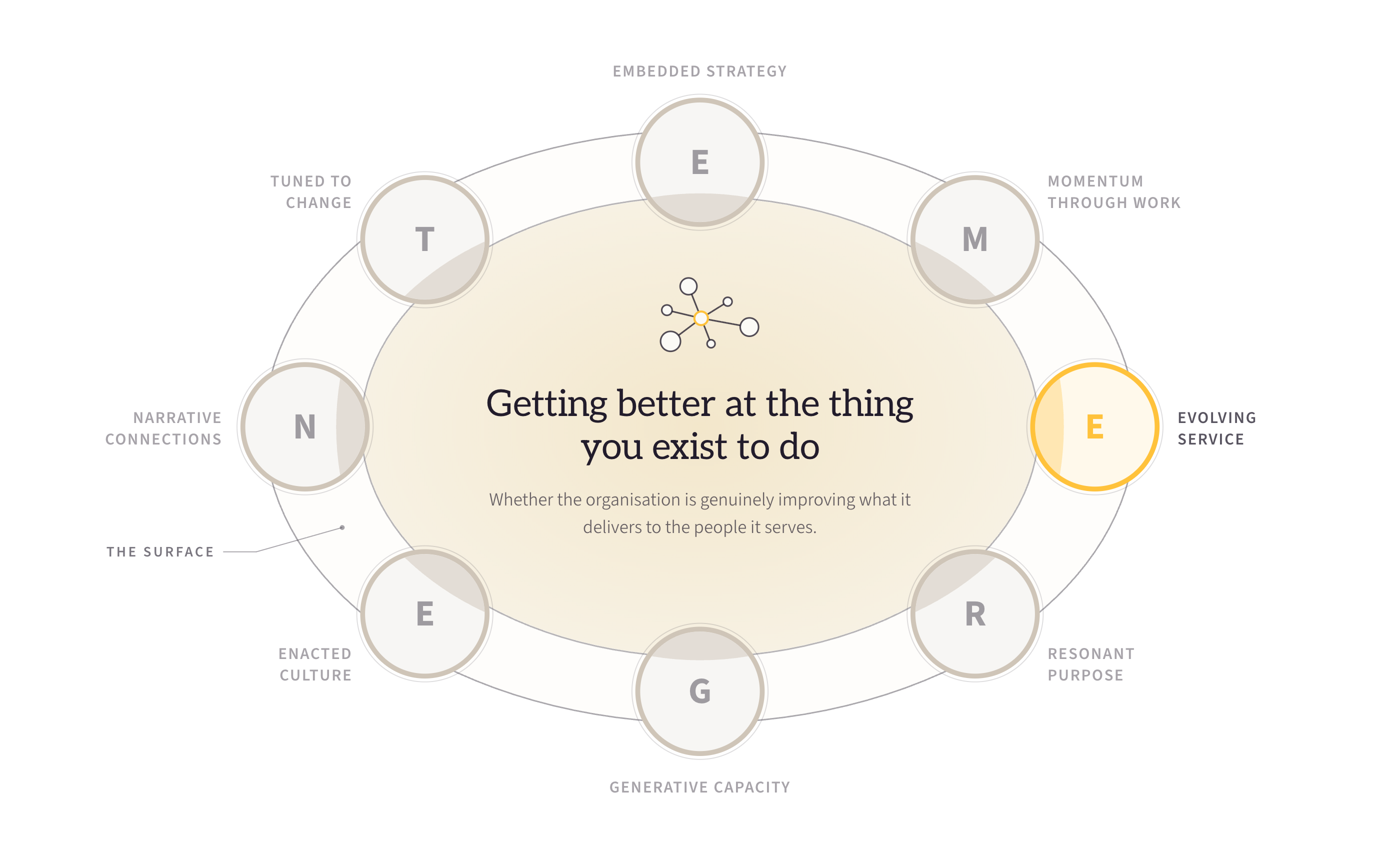
Evolving Service
Whether the organisation is genuinely improving what it delivers to the people it serves.
When did what you deliver last change because of something you learned from the people you serve?
What it is
Somewhere in your organisation, someone knows exactly what the people you serve need. They're close to it - they hear the feedback, spoken and unspoken, and they can feel the gap between what's offered and what's wanted. This lens looks at what happens to that knowledge. In some organisations it flows: it reaches people who can act, it shapes what happens next, and what you deliver this year is better than last year because of it. The service evolves, because the relationship with the people it serves is alive. In others, the knowledge goes nowhere - and the organisation keeps delivering what it's always delivered, not because anyone decided to stop improving, but because nothing turns proximity into change.
Why it matters
Every organisation exists to deliver something of value to someone. The question isn't whether that delivery is good enough today - it's whether it's getting better.
That sounds obvious, but the distance between delivering a service and responding to the people who use it is wider than most organisations realise. In the Regulator of Social Housing's tenant satisfaction measures for 2024-25, covering 299 large landlords in England, the median landlord had 71.8% of its tenants satisfied with the overall service. On the separate measure of whether a landlord listens to tenants' views and acts on them, the median was 61.6%. Same year, same sector, same tenant surveys: people rate the service itself more highly than they rate being heard by it.
The view from inside is no more encouraging. In the 2025 NHS Staff Survey, which 751,088 staff at NHS trusts in England completed, just over half - 54.16% - felt able to make improvements happen in their own area of work. That is one sector, and it records what people feel able to do rather than what actually changed. But the question has gone to NHS staff every year since 2021, and the answer has stayed between 53% and 56% throughout.
What we notice in practice isn't a lack of effort. Most organisations genuinely try to improve, and many are sincerely focused on the people they serve - there are surveys, feedback programmes, improvement projects, action plans. The effort is real. What varies is whether the effort converts: whether all that listening and trying actually changes what the person on the receiving end experiences.
Often it doesn't, and the reasons are structural rather than motivational. Feedback gets collected but never quite reaches someone with the authority to act on it. The same problems cycle back, because what got fixed was the symptom rather than the cause. The people closest to the service know exactly what needs to change, but operational demands consume every available hour. And so improvement happens when something breaks badly enough to force it - not because anyone stopped caring, but because the route from caring to changing was never quite there.
A service that's genuinely evolving looks different. Not dramatic leaps - a continuous stream of adjustments, grounded in evidence, felt by the people it serves. Getting better, year on year, at the thing you exist to do.
What it can tell you
Looked at through this lens, four things come into view.
Whether knowledge reaches the people who can act on it. An organisation can be rich in customer focus - surveys running, dashboards live, feedback programmes in full swing - and still find that nothing on the receiving end changes. The insight almost always exists; the people closest to the service carry an extraordinary amount of it. The question is the distance between hearing and acting. Every layer between the person who receives the service and the person who designs it is a place where the signal can fade.
Whether you're evolving or churning. Every organisation fixes things, but there's a meaningful difference between fixing the symptom and fixing the cause. Where the same issues keep cycling back - different surface, same root - that's churning: high activity, low progress. Root-cause learning is what separates evolution from repair.
Whether the whole value stream is alive. Evolution isn't only an edge-of-the-organisation question. Finance, operations, IT and HR deliver something too - their people just sit in the next office rather than outside the building. Whether those internal services are getting simpler, more responsive and more useful shapes the organisation's capacity as much as anything at the front line.
Whether there's room to improve at all. People often see clearly what needs to change and simply can't get to it. When the urgent crowds out the important - when improvement is the thing that happens after the real work is done - it doesn't happen at all, because the real work is never done. An organisation can want to evolve as much as it likes. Without breathing room, it won't.
How to observe it
Evolution shows up in the distance between what the people you serve actually experience and what the organisation does about it. These prompts help you see whether that distance is closing or quietly growing.
Listen for
- When people talk about what they deliver, do they talk about the people on the receiving end - or about the process of delivering it?
- When a frontline team knows something isn't working for the people they serve, what happens to that knowledge? Does it reach someone who can act on it?
- When someone suggests doing something differently, is the instinct curiosity or defensiveness? "That's interesting, tell me more" - or "we've tried that before"?
- Is the definition of "good" owned by the organisation or shaped by those it serves? Who gets to say whether the service is working?
Watch for
- When a service change is proposed, is the first question "what do the people we serve need?" or "what's feasible within our current setup?"
- Do investment decisions reference real evidence from those you serve - or are they driven by internal assumptions about what they want?
- Are there services or approaches the organisation is clearly attached to beyond their usefulness - things that persist because "that's what we do"?
- When feedback contradicts an internal assumption, which wins?
Measure
- How recently has what you deliver changed in a substantive way - not cosmetic, but meaningfully different?
- Of the changes made in the last year, how many were proactive versus reactive? Improving something working versus fixing something broken tells you very different things.
- Can you trace specific improvements back to specific insights from the people you serve? If you can't, the feedback loop may not be real.
Notice
- Is improvement continuous or episodic? A steady stream of adjustments suggests a living feedback loop. Occasional big changes suggest improvement only happens when it's forced.
- Do the people you serve feel like partners in shaping what happens next - or like recipients who occasionally get surveyed?
- How far is the person who designs the service from the person who receives it? Every layer of distance is a place where the signal can fade.
How to have meaningful conversations about it
- When a frontline team knows something isn’t working, what happens to that knowledge?
- Do people talk about what they deliver in terms of the people on the receiving end - or in terms of the process of delivering it?
What you can do about it
You don't need a programme to start. Ask three people who deliver your service directly what the people you serve need that you're not quite getting right yet. Don't ask for evidence or business cases - just ask what they see. People close to delivery carry insight that has nowhere to go; this conversation gives it somewhere.
Or bring one real story from the people you serve to your next team meeting. Not data - a story. Something specific that happened to someone as a result of your service. Then ask: what does this tell us, and is there something we could do differently? You're not launching a review. You're reconnecting the team to the experience their work creates - and opening the door to one small evolution.