Making the Integration Work
Making the Integration Work keeps the two organisations running as one and the deal's promised value landing over time, and it builds your own people's ability to run the integration from here. You can keep us alongside on a light ongoing rhythm, or take the capability and go it alone.

Making the Integration Work keeps a completed merger integration fit and improving, and it covers six things: the value the deal promised measured against the original deal thesis, the combined operating model held as one way of working, the lessons each integration teaches folded into a reusable playbook, integration decisions owned in your own line, the integration refreshed as the business and market move, and your own people's ability to run all of it. The deal keeps realising the value it was meant to, and the two organisations stay one rather than drifting back into two.
This is a blend you decide, scoped with you. We build the capability into your own people first: the integration owner, the review rhythm, the value scorecard and the playbook, so you can sustain this deal and run the next one yourselves. On top of that you can keep us on an optional light ongoing rhythm, checking realised value against the deal thesis and acting as a critical friend at whatever cadence you choose. Take the capability build and run it alone, keep us on a light rhythm, or both, and that balance can shift as your people take more on.
Acquirers gain an average 13.2% total shareholder return above their sector index in the run-up to a deal, then give back an average 7.4% in the two years after close. The value the deal promised erodes after close without sustained integration (KPMG, 'The M&A Dance: Orchestrating synergies and value creation in public company acquisitions', 2025).
When this helps
Clients bring this in once a merger integration has been delivered and they want it to keep working. These are the situations we are most often asked into. If one sounds like yours, this is a good place to start.
The situation | How it helps |
|---|---|
The integration is delivered and you want it to last | Keeps the deal's value measured against the original thesis and the combined operating model held as one, so the result stays fit rather than fading once attention moves on |
A past integration quietly slipped once the programme ended | Puts a light review rhythm and a named owner in place, so value that starts to slip shows up early and gets recovered while it still can be |
You want to own and run the integration in-house | Builds your own integration owner, review cadence, value scorecard and playbook, so you sustain this deal and run the next one without depending on us |
You want a critical friend on call, not another programme | Gives you a light ongoing rhythm scoped to your cadence, so you have expert eyes on realised value when you want them and nothing heavy when you do not |
The acquired business or the market is shifting | Revisits the integration where the deal thesis or conditions have changed and course-corrects, so the combined organisation stays fit as things move |
You inherited a completed integration that is decaying | Re-measures realised value against the deal thesis, finds where legacy teams are drifting back to old systems, and reinforces the single agreed way of working |
What keeping the integration fit involves
We keep six things fit, and lead with the two that decide whether the deal was worth doing:

The deal's value, tracked against the thesis
We keep the deal's cost and revenue value measured against the original deal model. Value that starts to slip shows up early, while there is still time to recover it.

The two organisations working as one
We watch the combined operating model for reversion, where legacy teams drift back to their own systems and ways of working. We reinforce the single agreed way of working so the merger stays one organisation.

The lessons each integration teaches
We run structured integration retrospectives after each deal. What this integration taught you folds into a reusable playbook for the next one.

Integration decisions owned in your line
As the integration office winds down, we keep its governance alive in permanent line ownership. Integration decisions hold instead of unravelling back into two organisations.

The integration refreshed as conditions move
We revisit the integration where the deal thesis, the market or the acquired business has changed. The combined organisation stays fit rather than locked to how things were at close.

Your own integration capability
We build your own integration owners, review cadences and playbook, so you sustain this deal and run future ones yourselves. An optional light review against your baseline keeps us reachable as a sounding board.

Why these six
These six are what keeps a delivered integration paying out instead of quietly coming apart. The deal's value and the single operating model are the two the whole merger was for, so they lead: if realised value drifts or the two sides revert to their old systems, the deal stops delivering whatever the paperwork says. Ownership in the line and the playbook are what make the sustaining durable, so it holds when the integration office closes and improves deal after deal. Refresh keeps the integration fit as conditions move. The capability build is what hands all of it to your own people.
They follow the established post-merger integration frameworks, from tracking synergies against the deal model and transitioning the integration office to business-as-usual, through reinforcing adoption so teams do not revert, to after-action reviews feeding a repeatable integration playbook. We use them to make sure nothing that keeps the deal's value landing gets dropped, not as a model to run at you.
How it works
The work keeps a delivered integration fit and puts your own people in charge of it. It runs the same way whichever balance you choose, and it works in four ways.
- We scope how much you hold and how much we hold - We agree the blend with you up front: the capability we build into your people, and an optional light ongoing rhythm on top. Most take the capability build and can run it alone from there. Some keep us on a light rhythm as well. You decide, and the balance shifts over time as your people take more on.
- We build the capability into your people - We build the integration owner, the review forum, the value scorecard and the reusable playbook into your own organisation. Your people run the routines and the feedback loops, so sustaining this deal and running the next one sits with you, not with us.
- We set a light rhythm you run - We set a simple cadence your people own: re-measure realised value against the deal thesis from the readiness baseline, review where the operating model is reverting, and refresh the integration as conditions change. It is light enough to keep running once we step back.
- We step back, and stay reachable on your terms - When the capability is in place we hand it fully to your people and step out of the running of it. We stay available at whatever cadence you set, from a periodic value review to the occasional call, and nothing at all is a valid choice.
The thinking behind the method
A merger integration is delivered once, but the value it was meant to create lands over two to three years after close, and it erodes if nobody keeps watch. That is why the sustaining work matters as much as the delivery: without it, teams revert to their old systems, tracked value quietly slips, and the deal ends up worth less than the model promised. The point of this stage is to stop that happening by keeping the right few things measured and owned.
We make your own people the ones who do it because a capability you own outlasts a consultant you rent. Bain's work finds that acquirers who build a repeatable, in-house integration model carry a durable shareholder-return premium over those who do not, and that premium has widened over twenty years. So we build the owner, the rhythm and the playbook into your organisation, and keep ourselves optional. You get value that keeps landing, and a capability you can run on the next deal without us.
What you get
By the end, you have four things:

- A delivered integration that stays fit and keeps improving - the deal's value measured against the thesis and recovered when it slips, the two organisations held as one, and the integration refreshed as conditions move.
- Your own people running it - an integration owner, a review forum, a value scorecard and a reusable playbook built into your organisation, so you sustain this deal and run the next one yourselves.
- A light rhythm and the feedback loops in place - a simple cadence of re-measuring against the readiness baseline, reviewing for reversion and folding lessons into the playbook, ready to run without us in the room.
- The option of us on call - a critical friend at the cadence you choose, from a periodic value review to nothing at all, never a heavy retainer and never a condition.
Owned by you, supported by us, as much or as little as you need.
When we step back - and staying on call
This is the final stage of the arc, so it closes the loop. Once your integration owner, review rhythm, scorecard and playbook are in place, we hand the running of it fully to your people and step back. You keep sustaining the deal's value and holding the two organisations as one without us in the room.
We stay on call at the cadence you choose, whether that is a periodic value review against the deal thesis, a health-check on the operating model, or simply the occasional call. And when the world moves enough that a bigger reset is needed, rather than a light course-correction, the re-measurement loop feeds straight back to a fresh diagnostic, and the four-stage cycle begins again on a clear read of where you now stand.
Where this sits
Making the Integration Work is the final stage in how we approach post-merger integration. It re-measures against the baseline set by the Integration Readiness Assessment, and it sustains and evolves the integration that the Integration Delivery Programme delivered. It keeps the whole four-stage investment fit and paying out, and when a bigger reset is needed it loops back to re-diagnose and the cycle starts again. It also stands on its own: if you have a delivered or inherited integration that is quietly decaying, you can start here.
Common questions
How is this different from the Integration Readiness Assessment?
The readiness assessment reads an integration from scratch and sets a baseline against the deal thesis. This stage re-measures realised value against that baseline over time to spot drift. It is a re-measure, not a re-assess: a lighter recalibration loop that watches whether the deal's value is still landing, rather than a full readiness read-out. If you have no baseline yet, the assessment is where to begin.
How is this different from the Integration Delivery Programme?
The delivery programme is a one-off effort that delivers the integration: the combined operating model built and the change put in place across the organisation. This stage sustains and evolves what that programme delivered. It keeps the value landing, holds the two sides as one, and builds your own people's ability to run it, and it does not re-sell delivery.
Do we have to keep you on retainer?
No. Most clients take the capability build, their own integration owner, value scorecard, review cadence and playbook, and run it alone from there. The ongoing rhythm is optional and scoped with you, never a heavy retainer and never a condition of the work. You can keep us on for a light periodic review, or step out entirely and call us when you want to.
What will our own people be able to do?
Run the integration themselves. You come away with a named integration owner, a review forum, a value scorecard measured against the deal thesis, and a reusable integration playbook. Your people can sustain this deal's value, hold the combined operating model as one, and run the next integration without us, folding each deal's lessons back into the playbook as they go.
Isn't this just re-running the audit?
No. Re-running the readiness assessment would read the whole integration from scratch each time. This re-measures realised value against the baseline you already have, so it catches drift with a light recurring loop rather than a full new audit. It is also more than measurement: it reinforces the single operating model, keeps decisions owned in your line, and turns each deal into playbook lessons.
How much of this can we run ourselves?
As much as you want, and the balance can shift over time. Most clients run the whole rhythm in-house once the owner, scorecard and playbook are built, keeping us only as an occasional sounding board. Others hold the day-to-day and keep us on for a periodic value review against the thesis. We scope that split with you and expect your people to take more on as their confidence grows.
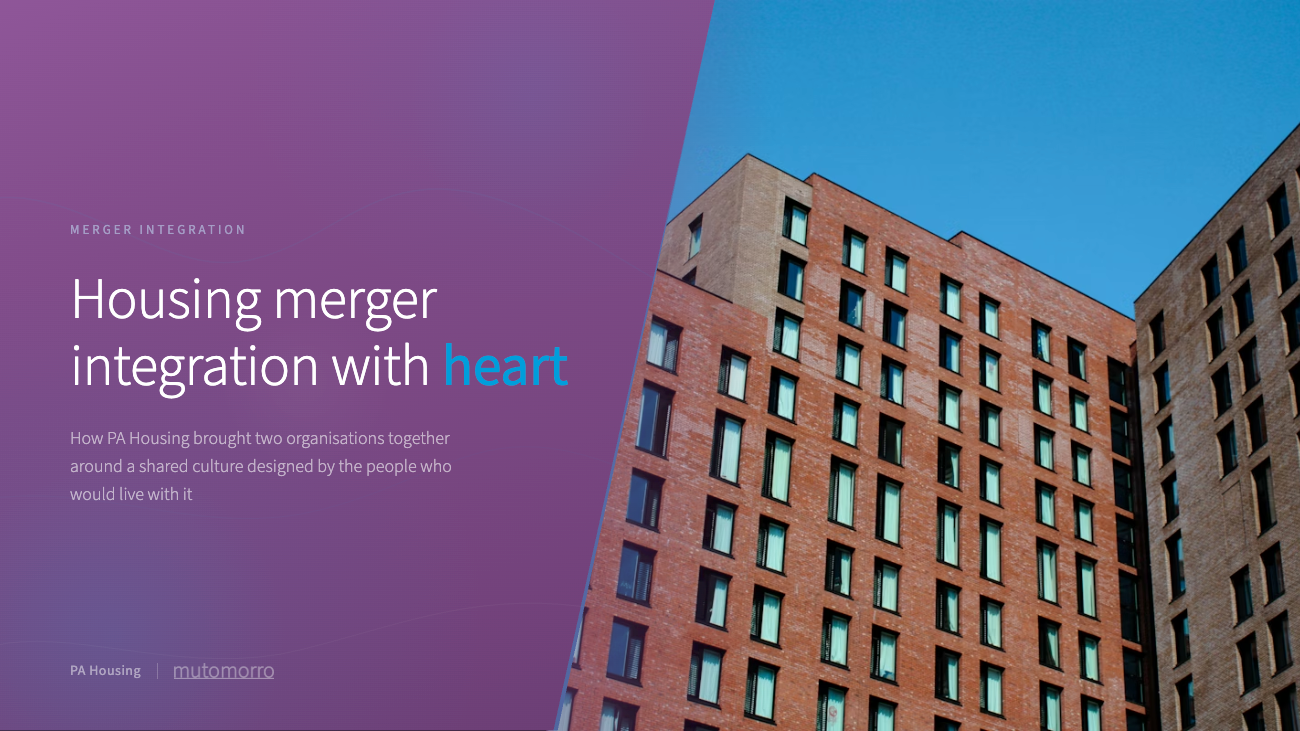
A merger that combined the best of both organisations, instead of one swallowing the other
Two housing associations merged on paper, but still operating as two organisations in practice - with the hard question of how to build a shared culture that neither had alone.
Read case study →
Two cultures becoming one - built around what customers and colleagues were both asking for
Two of London's largest housing associations becoming one - 66,000 homes, two distinct cultures, and the question of how to build something genuinely shared rather than one organisation absorbing the other.
Read case study →Two ways of working. Two sets of habits. Two cultures. We help you design how they come together - because that's the part no integration plan covers.
Strong cultures come from shared ways of working, common goals, and an environment that makes coming together easier than pulling apart. We work with leaders to cultivate exactly that - conditions where people can bring their best, find meaning in work, and translate culture into how work happens.
Change takes root when the conditions inside your organisation support it - when people have genuine agency, feel safe to adapt, and understand why it matters.
We work with the conditions inside your organisation - so improvements compound, capability builds, and getting better becomes how things work.
The Cultural Web is a model for understanding and mapping organisational culture across six interconnected elements. It helps you see how stories, rituals, symbols, power structures, controls, and organisational structures shape the way things are done.
Edgar Schein's Culture Model explores organisational culture at three levels - visible artefacts, stated values, and the deeper underlying assumptions that really drive behaviour. It helps organisations get beneath the surface of what their culture actually is.
The Change Curve maps the emotional stages people move through during organisational change, from shock and denial through to acceptance and commitment. It helps leaders understand where people are in the process and what support they need.
A merger changes structures, systems and reporting lines. But whether two organisations genuinely become one depends on something integration plans rarely design for.
Most culture change efforts don't last. The pattern is remarkably consistent - and it points to something fundamental about how culture actually works.
How organisations change without anyone deciding to change them. Drawing on decades of research - from NASA's Challenger disaster to military friendly fire incidents - this article explores why standards erode gradually, why the erosion always moves in one direction, and why the question that matters isn't 'who let this happen?' but 'how far have we travelled from what we intended?'
A practical guide to developing organisational culture. Cuts through the theory to explain what culture actually is, why most culture change programmes fail, and how to develop culture in a way that lasts - by working with your organisation as a living system, not a machine.