Integration Delivery Programme
The Integration Delivery Programme runs the integration of the two organisations across the whole business. It stands up an Integration Management Office, lands Day 1, drives the 100-day roadmap, and delivers the combined operating model, systems, people and synergy plan from your Integration Blueprint until two organisations run as one. We run it with your people, so the combined business is theirs to hold.

The Integration Delivery Programme runs your merger integration across the whole organisation, governed by an Integration Management Office, and we run seven workstreams: the IMO and governance that gives the integration one spine, Day 1 readiness and the 100-day roadmap, synergy capture and value tracking, the combined operating model stand-up, systems and data consolidation, people and culture integration, and stakeholder communications and adoption. Together they take the Integration Blueprint and make it real, from the moment of close to a functioning combined business.
A programme this size is delivered with your people, not to them. Your role in it is agreed with you and scoped to your team's capacity and the size of the deal. We can run the whole programme and hold the IMO, co-lead alongside your integration leadership, or support specific workstreams while your people hold the pen, decided together at the outset and adjusted as the work moves. We partner with technical, PM and systems specialists for the deep build, and we work so your organisation comes out more able to run its next integration itself.
Companies with a dedicated integration playbook and experienced integration leaders are around 2.5 times more likely to capture the synergies the deal projected. The discipline of a real programme is what turns the deal thesis into value delivered (Bain & Company M&A research, 2024).
When integration delivery programme helps
The Integration Delivery Programme is the step that makes a merger real once the deal is done and the plan is set. These are the situations we are most often asked into. If one sounds like yours, this is a good place to start.
The situation | How it helps |
|---|---|
You have an integration blueprint and now need to deliver it | Takes the agreed operating model, synergy plan and integration roadmap and runs them across the org, so the design becomes a working combined business rather than a document |
The deal has closed and Day 1 has to work | Stands up the IMO and lands the essentials that must run at close - payroll, customer-facing systems, legal entity, communications - so the combined business opens without breaking |
A previous integration effort stalled after the announcement | Puts a single plan, clear decision rights and a live cadence behind the work, so workstreams move together instead of drifting once the initial energy fades |
You do not have the bandwidth to run the integration alone | Brings integration leadership and IMO discipline alongside your team, taking as much of the load as you need while your people stay close to the decisions |
The synergies committed to the board are not being tracked | Turns the deal's synergy targets into a tracked value tree, holding each workstream to run-rate milestones and giving leadership a live view of value captured versus planned |
You need to integrate without disrupting the business | Sequences the work in phases and waves with owners, dependencies and a critical path, so customers and operations keep running while the two organisations combine |
What we design
We run seven workstreams across the programme, each with its own charter and plan, all reporting into one IMO:

Integration Management Office and governance
The IMO that runs the integration - decision rights, reporting cadence, a single decision log and one plan every workstream reports into - so the combined business has a clear spine from close onward.

Day 1 readiness and the 100-day roadmap
The moment of close made to work - payroll, customer-facing systems, legal entity and communications - then a sequenced Day 30 and 100-day roadmap with owners, dependencies and a critical path.

Synergy capture and value tracking
The deal's synergy targets turned into a tracked value tree, holding each workstream to run-rate milestones and giving leadership a live view of value delivered against plan.

Operating model and organisation stand-up
The combined target operating model from the Blueprint made live - structure, roles, decision rights and process harmonisation - so the business runs on one operating model, not two side by side.

Systems and data consolidation
The IT and data integration delivered - platform rationalisation, data migration and process standardisation - with technical and systems specialists brought in for the deep build.

People, culture and talent integration
The people side landed - leadership alignment, talent retention, role clarity, and two cultures brought into one enacted way of working across the merged organisation.

Stakeholder communications and adoption
Employees, customers and suppliers kept informed through the transition, and adoption of the new structures and processes driven so the change takes hold in practice.

Why these seven
These seven are the workstreams that a merger integration has to deliver together to combine two organisations into one working business. The governance workstream gives the other six a spine: without an IMO holding decision rights, cadence and a single plan, the workstreams pull against each other and the integration stalls after the announcement. Day 1 and the 100-day roadmap set the sequence, so the essentials that must work at close are landed first and early synergies are captured while attention is high. The operating model, systems, and people workstreams are where the two organisations actually merge, and synergy tracking is what keeps the whole programme honest against the value the deal promised.
The set follows the established post-merger integration frameworks - the IMO governance model, the Day 1 / 100-day plan, the standard functional workstreams and top-down / bottom-up synergy capture - so the programme covers what a full integration should, from the entity and the systems to the people and the deal value, not just the parts that are easiest to see. We use them to make sure nothing that decides whether the integration lands is left out, rather than running a branded methodology at you.
How it works
The programme delivers one thing: the integration running across the whole business, with two organisations working as one. It works by delivering that with your people rather than around them, so the combined organisation is owned and the capability to run integrations stays with you. It runs in four modes.
- We scope our role with you - At the outset we agree how much of the programme we hold and how much your team runs, scoped to your own integration capability and the size of the deal. We can lead the whole programme and run the IMO, co-lead alongside your leadership, or support specific workstreams while your people hold the pen. The scope is set together and adjusted as the work moves.
- We run it in phases and waves - We deliver in a sequence that protects the business: close and Day 1 readiness first, then the first 100 days to mobilise every workstream and prove the deal thesis, then full integration delivery across the operating model, systems and people. Each phase has owners, dependencies and a critical path, so customers and operations keep running while the organisations combine.
- We deliver it with your people - The integration is delivered by your teams and ours together, not by a team that arrives, runs it, and leaves. Your people carry the workstreams, hold the decisions and learn the IMO discipline as the programme runs, so the combined organisation is genuinely theirs by the end and they can run the next integration themselves.
- We track it to landed - We measure the programme against the baseline set in the Integration Readiness Assessment and the synergy targets from the deal, tracking run-rate value and the state of each workstream. Where the integration is not landing as planned, we correct it, and we hand over only once the combined business is running and the synergies are confirmed captured.
The thinking behind the method
We run the integration with your people rather than deliver it to them because of what an integration actually is. It is not a document to be handed over; it is thousands of decisions across two workforces, made under time pressure while the business keeps trading. A team that parachutes in, runs the programme and leaves takes the integration discipline out of the door with it, and the combined organisation is left holding a structure it does not fully understand. When your people carry the workstreams and learn the IMO cadence as it runs, the integration lands and the capability stays.
The flexible scope follows from the same logic. A large deal with a thin internal team needs us to lead and hold the IMO; a capable integration function needs us alongside for the hard parts and the outside pattern. Fixing the posture in advance would either overload your people or crowd them out. So we scope our role to the real situation and adjust it as the work moves, always working so your organisation is more capable of running its next integration than it was before this one.
What you get
By the end, you have four things:

- Two organisations running as one - the combined operating model, systems, people and customer-facing processes from the Integration Blueprint live across the whole business, delivered through the programme.
- The synergies tracked and confirmed - the deal's value targets tracked on a value tree, held against run-rate milestones, and confirmed captured against the baseline from the readiness assessment.
- Your people more capable of running it - teams that carried the workstreams and learned the IMO discipline, so they can run the steady-state organisation and the next integration themselves.
- A working integration rhythm handed over - the IMO cadence, decision log and steady-state operating rhythm handed to you intact, ready to sustain and evolve the combined organisation.
A good integration is both fast and steady, and those pull against each other: speed captures the synergies while attention is high, steadiness keeps the business running while it changes underneath. Holding both at once is the craft of the work.
How we hand it over - and what happens next
The point of the programme is a combined organisation that runs, so we take care with the handover. Because your people carried the workstreams and learned the IMO cadence as the programme ran, the handover confirms something they already hold rather than passing them something cold. We close out the workstreams, confirm the run-rate synergies captured against the baseline, and hand over the IMO discipline, the decision log and the steady-state operating rhythm intact.
From there the combined organisation is yours to run, and the work moves into ongoing Adapt - the stage that sustains and evolves the integrated business over time as markets, people and the operating model keep shifting. Some clients take that on themselves, now more able to. Others keep us alongside for the harder parts. The programme has done its job when the two organisations run as one, the value the deal promised is confirmed, and your people can hold and evolve what has been built.
Where this sits
The Integration Delivery Programme is the third stage in how we approach post-merger integration. It delivers the Integration Blueprint Design, taking that agreed operating model, synergy plan and roadmap and making them real across the org. It follows the Integration Readiness Assessment, whose baseline it is measured against, and it leads into ongoing Adapt, which sustains and evolves the combined organisation once the integration has landed. It also stands on its own - if you already have an integration design, ours or your own, and need it delivered across the business, this is where to start.
Common questions
How is this different from Integration Blueprint Design?
The Blueprint produces the plan - the combined target operating model, the synergy plan and the integration roadmap. The Integration Delivery Programme delivers that plan across the whole organisation: it stands up the IMO, lands Day 1, drives the 100-day roadmap, consolidates the systems, integrates the two workforces and captures the synergies. The Blueprint answers what the combined business should look like; this makes it real. Many clients do the Blueprint first, because delivering against a clear design sets the programme up well, but if you already have a design you can start here.
How is this different from a general change management programme?
Every large programme uses change-delivery mechanics - mobilising leaders and teams, sequencing the work, driving adoption. This programme applies them to the specific work of a merger: standing up a combined operating model, consolidating two sets of systems, integrating two workforces, and capturing deal synergies through an IMO. It is not a generic change template dropped onto any change. It delivers this domain's particular integration, with the workstreams, governance and value tracking that a merger needs.
How much do you lead, and how much do we?
That is agreed with you at the outset and scoped to your own integration capability and the size of the deal. We can lead the whole programme and run the IMO, co-lead alongside your integration leadership, or support specific workstreams while your people hold the pen. The scope is set together and adjusted as the work moves. Whatever the posture, we work so your organisation is more capable of running its next integration by the end.
Do you handle the technical and systems build?
We deliver the organisation, people and process side of the integration, and we run the systems and data workstream at the programme level - platform rationalisation, data migration and process standardisation. For the deep technical build we partner with technical, PM and systems specialists who own that work, and we hold it inside the IMO so it stays sequenced with everything else the integration depends on.
What do we walk away with?
A combined organisation that runs as one, with the operating model, systems, people and customer-facing processes from the Blueprint live across the business. The deal's synergies tracked on a value tree and confirmed captured against the baseline. Your people more capable of running the integrated organisation, having carried the workstreams themselves. And the IMO discipline, decision log and steady-state operating rhythm handed over intact, ready for what comes next.
What happens after the programme?
The combined organisation is yours to run, and the work moves into ongoing Adapt - the stage that sustains and evolves the integrated business over time as the operating model, the people and the market keep shifting. Some clients take that on themselves, now more able to after running the integration with us. Others keep us alongside for the harder parts. Because we deliver the programme with your people and hand over the IMO discipline, you can hold and evolve the combined organisation yourselves.
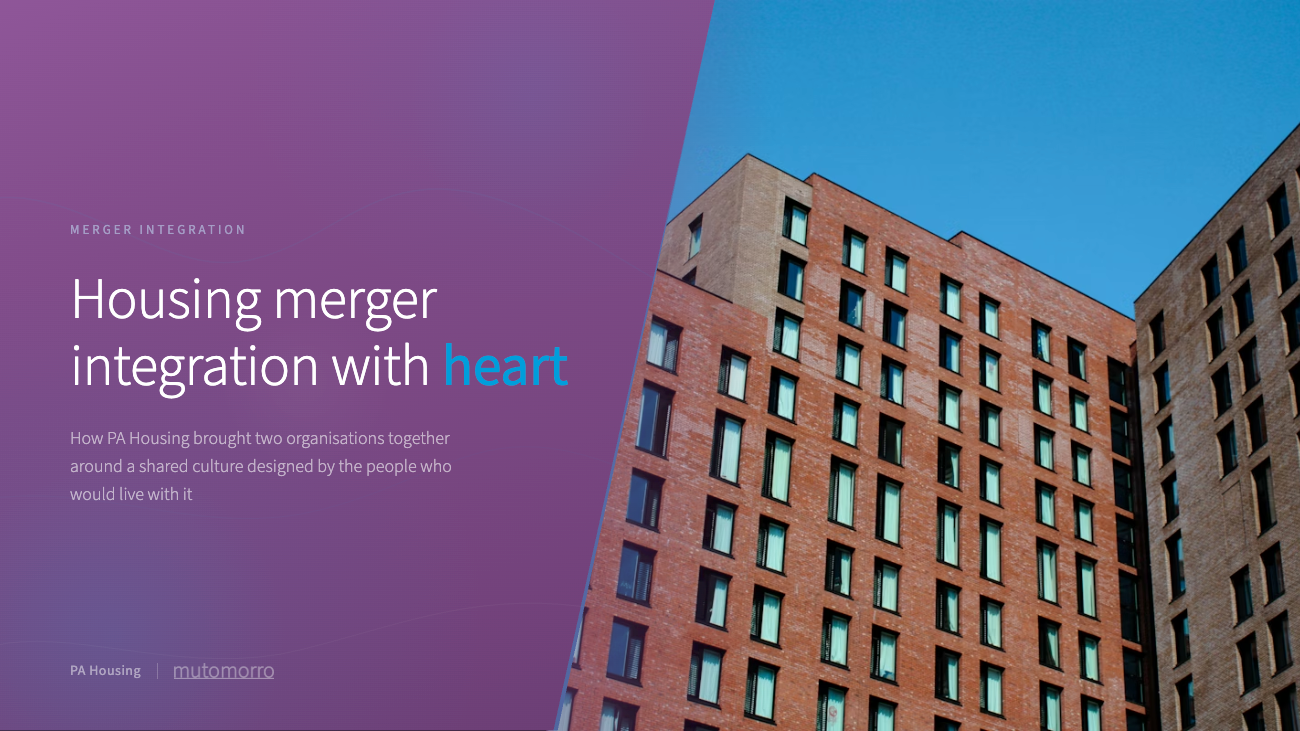
A merger that combined the best of both organisations, instead of one swallowing the other
Two housing associations merged on paper, but still operating as two organisations in practice - with the hard question of how to build a shared culture that neither had alone.
Read case study →
Two cultures becoming one - built around what customers and colleagues were both asking for
Two of London's largest housing associations becoming one - 66,000 homes, two distinct cultures, and the question of how to build something genuinely shared rather than one organisation absorbing the other.
Read case study →Two ways of working. Two sets of habits. Two cultures. We help you design how they come together - because that's the part no integration plan covers.
Change takes root when the conditions inside your organisation support it - when people have genuine agency, feel safe to adapt, and understand why it matters.
Strong cultures come from shared ways of working, common goals, and an environment that makes coming together easier than pulling apart. We work with leaders to cultivate exactly that - conditions where people can bring their best, find meaning in work, and translate culture into how work happens.
Changing the structure is the starting point. Changing how people work, decide, and collaborate within it - that's where restructuring succeeds or stalls.
The Change Curve maps the emotional stages people move through during organisational change, from shock and denial through to acceptance and commitment. It helps leaders understand where people are in the process and what support they need.
The Bridges Transition Model focuses on the human side of change - the psychological transition people go through rather than the external change itself. It maps three phases: Endings, the Neutral Zone, and New Beginnings.
The ADKAR model is a five-stage framework for managing change at an individual level - Awareness, Desire, Knowledge, Ability, and Reinforcement. It helps organisations understand what people need at each point in a change process and where things are getting stuck.
The Mendelow Power-Interest Matrix is a stakeholder mapping tool that helps you work out who matters most during a change or project. It plots stakeholders by their level of power and interest so you can plan how to engage each group.
A merger changes structures, systems and reporting lines. But whether two organisations genuinely become one depends on something integration plans rarely design for.
Change doesn't just affect what people do - it affects who they feel they are. Understanding the human experience of change helps leaders create conditions where people can adapt.
Your change initiative was well-planned, well-managed, and well-communicated. And it still didn't land. Here's what most change programmes overlook.