Wicked Problems - Free Template
A three-page PDF toolkit for understanding and navigating wicked problems. Includes a visual overview of the ten characteristics, a summary card with practical guidance, and a guide to connecting the framework with broader strategic alignment work.
Based on our full guide to Wicked Problems.
Get this PDF template
Fill in your details and download the PDF straight away.
What's in this Wicked Problems template
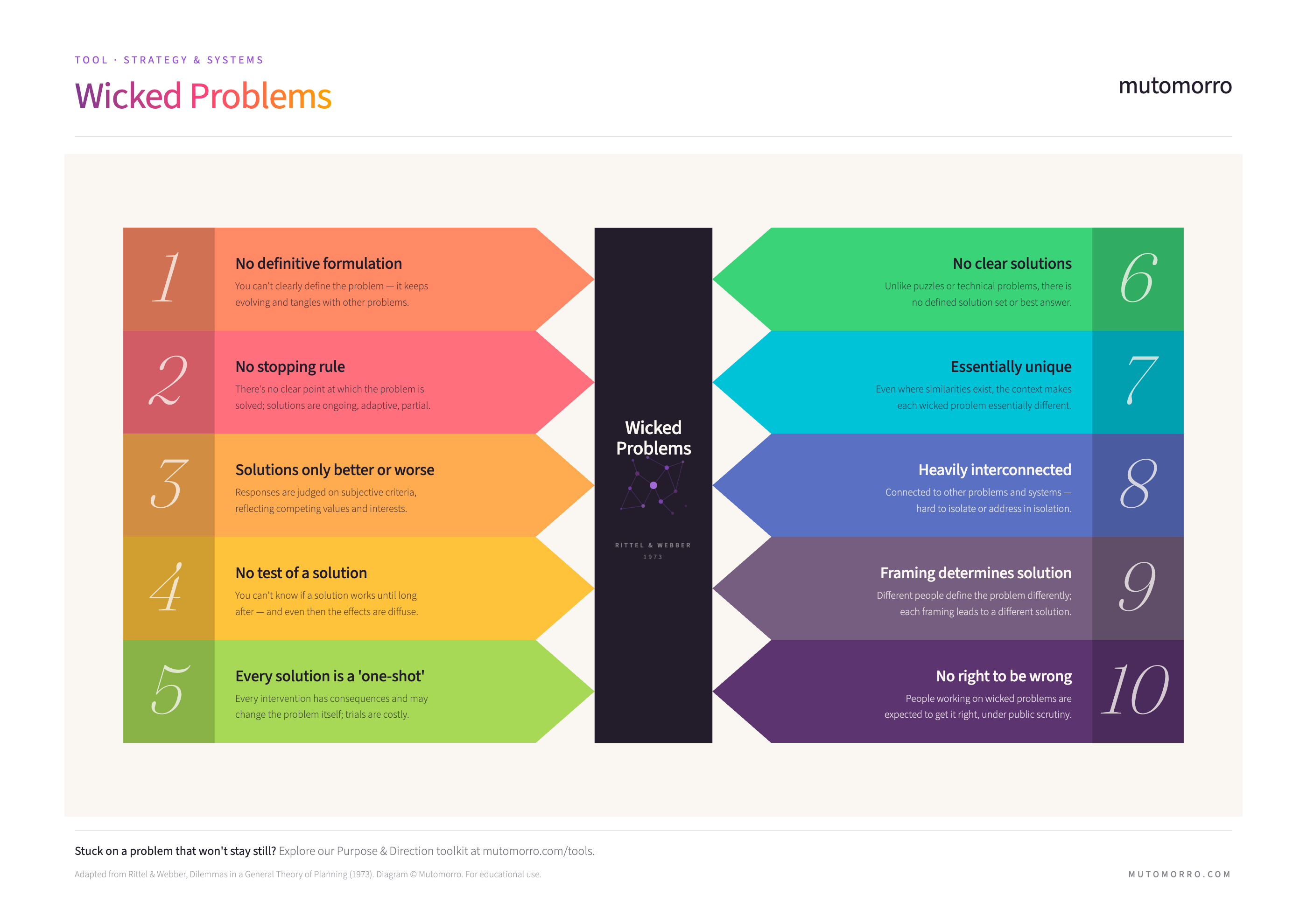
A visual diagram mapping all ten characteristics of wicked problems - from no definitive formulation to no right to be wrong - grouped into three clusters: defining the problem, finding solutions, and consequences and pressure.
A summary card with what wicked problems are, when to use the framework, practical approaches for navigating complexity, and common pitfalls to watch for. Designed to be pinned up or shared with your team as a quick reference.
A guide to connecting the wicked problems lens with broader strategic alignment work - including how Mutomorro helps organisations work with complexity rather than against it.
Tips for using it
- Start with the ten characteristics. Work through each one with your team and note which apply to the challenge you're facing. If most are present, you're dealing with a wicked problem - and that changes how you should approach it.
- Name the competing framings. Different people will see the problem differently. Rather than arguing about who's right, map the different framings explicitly. Each one reveals something the others miss.
- Design for learning, not for certainty. Plan-then-execute doesn't work when the problem shifts in response to your actions. Take small steps, learn from them, and adjust your direction as you go.
- Use it as a conversation starter. The framework's power is often in the recognition. Simply naming a challenge as a wicked problem can shift a team from frustration ("why can't we solve this?") to a more productive orientation ("how do we make progress with this?").
Strategic Alignment
When the challenges facing your organisation resist straightforward solutions, the answer is rarely a better plan. Mutomorro's strategic alignment work helps organisations navigate complexity by working with the system rather than against it.
Public Sector Change Management
The EU's most complex piece of environmental legislation needed to reach audiences who had almost nothing in common - from farmers managing land near rivers to specialist hydrogeologists monitoring groundwater.
Read the case study →