Change Plan Design
Change plan design gives you your Master Change Management Plan: a change strategy sized to this change up front, then the role-based plans that carry it - sponsorship, engagement, capability, resistance and adoption - and the measures that show it is sticking. We design it with your people, so the plan is genuinely theirs to run.

Our change plan design gives you a Master Change Management Plan your organisation can run, and we design seven parts: the change approach sized to this change, the sponsor and leadership plan, the stakeholder and impact map, the engagement and communication plan, the capability and training plan, the resistance and adoption plan, and the governance and adoption measures. You walk away with one governed plan, specific to this change and ready to put into practice.
A change plan works when the people who run it helped write it. So we design with your people, drawing on the knowledge already inside the organisation and combining it with our outside frameworks. The plan comes out both accurate and owned, and your managers and front line come away more able to lead the change themselves.
Projects with excellent change management were 93% likely to meet or exceed their objectives, against 15% for those with poor change management - a six-times increase. The plans that land are the ones the people running them helped write (Prosci, Best Practices in Change Management, 2018).
When change plan design helps
Change plan design is the next step once you know a change is coming and need a plan to carry it - often straight after a diagnostic has read the readiness. These are the situations we are most often asked into. If one sounds like yours, this is a good place to start.
The situation | How it helps |
|---|---|
A big change is coming and you need a plan to carry it | Turns intent into a worked-out change management plan, so you move from knowing the change is coming to having the plan that lands it |
A system, process or restructure change lands soon and the people side is thin | Designs the people change plan alongside your project leads, so the move to the new way of working is planned, not left to chance |
Past changes stalled once the launch energy faded | Builds in the sponsor roadmap and adoption measures that keep the change moving after go-live, not just up to it |
Senior sponsors mean well but go quiet after kickoff | Sets a specific sponsor roadmap into the plan, so leaders stay visibly active across the whole change - the single biggest driver of whether it lands |
You expect real resistance and want to get ahead of it | Maps where friction will sit and the concrete moves that turn it into adoption at the point the job actually changes |
You want a plan your managers and front line will actually run | Builds it with the people who have to run it, so it lands as theirs and gets used in practice |
What we design
We design seven parts of the change plan, and make each one concrete enough to run on:

Change approach and sizing
The shape of the whole change and the order the moves happen in, sized to how big and disruptive this change really is, so the plan builds momentum and early wins instead of overloading people.

Sponsor and leadership plan
Who leads it visibly from the top, and the roadmap that keeps senior sponsors active and aligned across the whole change - the single biggest driver of whether it lands.

Stakeholder and impact map
Who is affected and how much, group by group - what changes for each, who holds influence, and where the plan needs to work hardest.

Engagement and communication plan
The story of why this change, and the rhythm of messages - right message, right sender, right channel - that moves each group from told to bought-in.

Capability and training plan
The training, coaching and hands-on support the change needs, sized to the real gap between where people are and where the change asks them to be.

Resistance and adoption plan
Where the friction will sit, and the concrete moves - and the network of champions closest to the work - that turn resistance into adoption.

Governance and adoption measures
How progress is tracked, how the plan flexes as reality lands, and the adoption and benefit signals that show the change is sticking rather than stalling.

Why these seven
These seven are the parts that have to line up for a change plan to work as one whole. A strong communication plan with quiet sponsors goes flat; active sponsors with no capability plan leave people willing but unable. The parts that get skipped most - the sponsor roadmap, the resistance work, and the adoption measures - are the ones that decide whether the change sticks after launch or fades once the energy does. So we design them together, as a set consolidated into one plan.
The seven follow the established change frameworks - the Prosci plans, ADKAR at the person level, Kotter's coalition and short-term wins - so the plan covers what a full change plan should, from the strategy up front to the adoption signals at the end, not just a communications calendar. We use them to make sure the plan is complete, rather than as a model to run at you.
How it works
The method produces one thing: a Master Change Management Plan your organisation can run. It works by designing the plan with your people rather than presenting one to them. Your organisation already holds most of the knowledge about how this change will actually land, so our job is to draw that out, combine it with the outside frameworks and pattern-recognition you bring us in for, and shape the two into a plan that is both expert and genuinely owned. It works in four modes.
- We start by sizing the change - Before any plan is written, we size the change with you - how big it is, how disruptive, and how ready the organisation is - and set that into a strategy. This scales the whole plan to this change rather than templating it, and turns every later choice into a matter of the strategy rather than guesswork.
- We design with the people who run the work - The people doing the work know where this change will bend and break in ways no plan on paper shows. We build with them, turning that knowledge into design choices - so the plan fits how the change will really land, and is owned by the people who will run it.
- We bring the outside insight and the frameworks - An inside view on its own tends to plan around today's habits, so we bring the outside pattern - what makes changes like yours land - and frameworks that check the plan is complete and the parts line up before you commit.
- We leave the capability behind - Throughout, we work so your people learn to lead change, not just watch us plan it. By the end you have a change plan and a sharper sense of how the choices were made, so the next change is one you can plan yourselves.
The thinking behind the method
We design with your people rather than deliver to them because of a hard fact about change: the plan that gets run beats the plan that reads best. A change plan is a set of new behaviours that thousands of daily choices follow, and people follow a plan they helped write - they understand why it is shaped the way it is, and they trust that it fits how the work really goes.
So co-design gives you a plan that is both right and real. The knowledge inside the organisation makes it accurate; designing it together makes it owned; and the outside frameworks keep the two from simply reinforcing what was already there. Get all three and the change lands in practice. Miss one and you get an expert plan that gets ignored, an owned plan that misses the real risks, or a textbook plan that never gets run.
What you get
By the end, you have four things:

- The Master Change Management Plan itself - the change strategy plus the role-based plans for sponsorship, engagement, capability, resistance and adoption, consolidated into one governed plan, specific enough to run.
- A sponsor roadmap and adoption measures - the named signals that keep leaders active and show the change is being adopted and reinforced, with governance that flexes the plan as reality lands.
- A plan that is genuinely yours - built with your people, grounded in how this change will really go, so it is owned and run rather than filed.
- The capability left behind - your managers and front line come out more able to lead change, so the next one is one you can plan yourselves.
The best change plan is both expert and owned, and those pull against each other: expertise wants to hand you the answer, ownership wants your people to reach it themselves. Holding both at once is the craft of the work.
How we hand it over - and what happens next
The point of the work is a change plan your organisation can run, so we take care with how it lands. Because your people helped write it, the handover confirms something they already understand rather than revealing it cold. We walk through the finished plan and the sponsor roadmap - why it is shaped the way it is, what it settles, where it deliberately stays flexible, and what the first moves are.
From there, some organisations take the plan and run it themselves, now more able to. Others bring us alongside for implementation, where the plan becomes the day-to-day work of moving people to the new way of working. The plan has done its job when you can see the change clearly, believe in it because you built it, and know the first steps to get there.
Where this sits
Change plan design is the second step in how we approach change. It follows the Change Readiness Assessment, which reads how ready the organisation is for the change ahead, and leads into implementation, where the plan becomes the day-to-day work of moving people to the new way of working. It also stands on its own - if you already know the change is coming and want the plan designed properly and owned, this is where to start.
Common questions
Is this just a set of workshops?
No - what you get is a designed Master Change Management Plan, with a sponsor roadmap and adoption measures to run it by. We work with your people in the room, because that is how the plan becomes both accurate and owned, and the sessions are the means to that. You walk away with the worked-out plan itself, and a design your people helped shape and are ready to run.
What exactly is a change management plan?
It is the design of how a specific change will land - the strategy up front, sized to this change, then the role-based plans that carry it: sponsorship, engagement and communication, capability and training, and resistance and adoption, along with the governance and measures that keep it moving. Consolidating them into one governed plan, rather than running each in isolation, is what keeps the parts from pulling against each other.
How is this different from the Change Readiness Assessment?
The assessment reads how ready the organisation is for the change ahead - where the risks and the strengths sit, and why. Change plan design is the next step: it produces the plan that carries the change instead. The assessment answers 'how ready are we'; this answers 'what do we run'. Many clients do the assessment first, because planning on a clear read of readiness sets the plan up well, but if you already have that clarity, you can start here.
Does this cover the system, process or restructure driving the change?
We design the people side of it. Where the change is driven by a new system, process or restructure, we design the change plan alongside your project, technology or finance leads - we plan how people move to the new way of working, not the technical build, the system configuration or the financial model. So the people change is planned in full, and the technical work is shaped alongside the specialists who own it.
Why build it with our people rather than design it for us?
Because a plan only works if it is run. The plan that gets adopted beats the one that only reads best, and people run what they helped write far more readily than what is handed to them. Your managers and front line also hold knowledge about how this change will really land that no outside team can fully see. Co-design combines that inside knowledge with our outside frameworks, so the plan is both right and real.
What happens after the plan is designed?
You have a Master Change Management Plan, a sponsor roadmap and adoption measures, ready to put into practice. Some organisations run it themselves, now more able to. Others bring us alongside for implementation, the day-to-day work of moving people to the new way of working. And because we leave the capability behind, you can keep steering the change yourselves as reality lands.

Training managers called a game changer - it helped them lead change, not just survive it
A housing association in the middle of a significant transformation, with more change on the horizon than its managers had the tools or training to lead.
Read case study →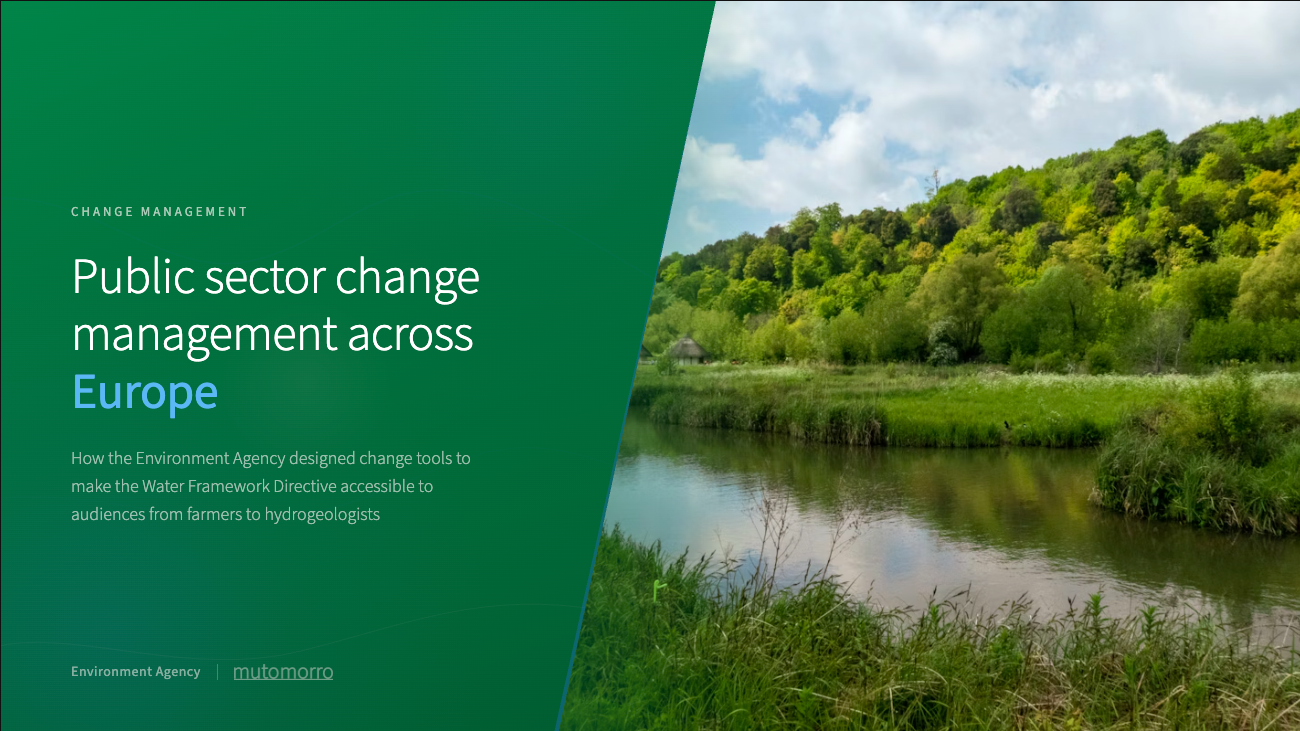
Making complex policy understandable for the people it affects most
The EU's most complex piece of environmental legislation needed to reach audiences who had almost nothing in common - from farmers managing land near rivers to specialist hydrogeologists monitoring groundwater.
Read case study →Change takes root when the conditions inside your organisation support it - when people have genuine agency, feel safe to adapt, and understand why it matters.
A clear read of whether your organisation is ready for the change you're planning - where it'll meet resistance, and what to fix before you commit.
The Change Delivery Programme runs your change plan across the organisation: the communications, the sponsorship, the learning and the go-live, delivered as live workstreams anchored to the project milestones, with a hypercare push through go-live so the new ways of working are actually in use and holding.
Making Change Stick keeps the change your delivery programme landed adopted and improving as conditions move, and builds your own people's ability to reinforce and run it. The core is the capability your team carries, with an optional light rhythm you can keep us on for as long as it helps.
Kotter's 8 Step Change Model is a structured framework for leading organisational change, from building urgency through to embedding new ways of working. It gives leaders a clear sequence to follow when the change is big and the stakes are high.
The ADKAR model is a five-stage framework for managing change at an individual level - Awareness, Desire, Knowledge, Ability, and Reinforcement. It helps organisations understand what people need at each point in a change process and where things are getting stuck.
Lewin's Change Model breaks organisational change into three stages - Unfreeze, Change, and Refreeze. Before anything can shift, the conditions holding the current state in place need to soften. Then the change happens. And then the new patterns need to solidify, or the organisation drifts back.
The Mendelow Power-Interest Matrix is a stakeholder mapping tool that helps you work out who matters most during a change or project. It plots stakeholders by their level of power and interest so you can plan how to engage each group.
The Bridges Transition Model focuses on the human side of change - the psychological transition people go through rather than the external change itself. It maps three phases: Endings, the Neutral Zone, and New Beginnings.
A strengths-based approach to organisational change. The 5D cycle - Define, Discover, Dream, Design, Deliver - helps teams build on what's already working rather than fixating on what's broken.
The traditional approach to building a case for change relies on urgency and burning platforms. But urgency wears off, and fear creates resistance. This article explores a different approach - building a case for change that's rooted in honesty, shared understanding, and a genuine picture of what's possible.
Change management and change leadership are often used interchangeably, but they're fundamentally different. This article explains what each involves, why the distinction matters, and how to develop both capabilities in your organisation.
Your change initiative was well-planned, well-managed, and well-communicated. And it still didn't land. Here's what most change programmes overlook.
During change, the stories people tell each other matter more than the communications plan. How narrative shapes whether change lands or stalls.