Restructure Implementation Programme
The Restructure Implementation Programme moves your organisation from the structure you have today into the new one your design set out. It runs the whole piece: mapping every role, the consultation and selection process, appointments and transitions, the operating-model rebuild, and a stabilised go-live on the new shape. We run it with your people, so the organisation is actually operating on the new structure by the end.

The Restructure Implementation Programme delivers the approved design across the whole organisation, and we run seven workstreams: role mapping and structure build, consultation and selection, the operating-model rebuild, people transition and TUPE, leadership and workforce engagement, systems and reporting cutover, and go-live and stabilisation. Together they move you from the current structure to the new one and leave the organisation running on it.
We deliver the programme with your people, not around them. Your team holds most of the knowledge about how the work really runs, so we build the mapping, consultation and transition process with them and hand over the playbook to run the next restructure without us. The role we take is agreed with you and sized to the work: we build the process and quality-assure the run on a smaller restructure, co-lead the programme on a larger one, or lead it fully where you need the capacity. Where the work needs deep specialist input, we partner with employment-law counsel, your HRIS and finance leads, and a PMO.
Less than a quarter of organisational redesigns succeed. Efforts commonly stall after launch or fail to improve performance once the new structure is live (McKinsey Global Survey, 'The secrets of successful organizational redesigns', 2014). The delivery beat is where a restructure is won or lost.
When restructure implementation programme helps
The Restructure Implementation Programme is where a restructure gets made real. These are the situations we are most often asked into. If one sounds like yours, this is a good place to start.
The situation | How it helps |
|---|---|
You have an approved new structure and need to make it real | Turns the blueprint into a live establishment: every role mapped, the process run, and people moved into the new shape. |
A previous restructure stalled after launch | Picks up a design that never landed and runs it through to a stabilised go-live, so the new structure is what work actually flows through. |
You do not have the bandwidth to run it alone | We co-lead or lead the programme to your capacity, carrying the plan, the governance and the day-to-day so your team is not stretched past breaking. |
You need to move without breaking the business | Sequences the change in waves and holds the operation steady, so service and delivery keep running while the structure changes underneath. |
Roles are at risk and the process has to be fair and lawful | Runs a legally-structured consultation and selection process with defensible criteria, so the people side is handled properly and holds up to scrutiny. |
Reporting lines will change but systems and budgets never catch up | Repoints the HRIS, cost centres and management reporting to the new structure, so the organisation is genuinely run on the new shape, not just drawn as it. |
What we design
We run seven workstreams, and each one moves a real part of the organisation into the new structure:

Role mapping and structure build
Map every current role to the new structure, define the new roles and reporting lines, and mark where posts are unchanged, changed, new or at risk. This is the spine the whole programme runs off.

Consultation and selection
Run the legally-structured people process: collective and individual consultation, ring-fencing, objective and defensible selection criteria, and appointments into the new structure. We build the process; employment-law counsel signs the legal detail.

Operating-model rebuild
Reconfigure how the work runs under the new shape: processes, decision rights, spans and layers, the service delivery model, and the measures and governance that hold it together. Reporting lines are the smallest part of it.

People transition and TUPE
Move people cleanly into the new structure: appointments and assimilation, moves and exits handled with care, TUPE where functions transfer, and reset objectives, contracts and reporting lines so day one is real.

Leadership and workforce engagement
Carry leaders, managers and affected teams through a period of real uncertainty: honest communication on the rationale and criteria, manager enablement for hard conversations, and active work to hold capability and morale as the shape changes.

Systems and reporting cutover
Repoint the plumbing to the new structure: HRIS and org hierarchy, cost centres and budgets, systems access and management reporting. Delivered with your HRIS and finance specialists so the new structure is what you run on.

Go-live and stabilisation
Stand the new structure up and hold it steady: sequenced cutover, day-one readiness, early-issue triage, and confirmation that work is flowing and accountabilities are clear before the programme hands over.

Why these seven
These seven are the workstreams that have to land together for a restructure to actually happen, rather than stay a redrawn org chart. Role mapping sets the spine every other workstream runs off. Consultation and selection make the people process fair and lawful. The operating-model rebuild changes how work runs, not just who reports to whom. People transition and TUPE move real people into real roles. Engagement holds capability and morale while the ground shifts. The systems cutover makes the new structure the one the organisation is run on. Go-live and stabilisation prove it is flowing before we hand over.
The distinctive work here is restructure-specific: the mapping, the ring-fencing, the statutory consultation and selection, the assimilation and TUPE, the operating-model rebuild. Leadership and workforce engagement is the backdrop every whole-org change shares, so we run it as one workstream among seven, not as the headline. The seven follow established operating-model and UK employment-law practice, so the programme covers what a full restructure has to cover, not just the parts that are easy to see.
How it works
The programme produces one thing: an organisation running on its new structure. It gets there by delivering the change with your people rather than around them, so the capability to run a restructure stays with you. It works in four ways.
- We scope our role with you - We agree what we run and what your team runs, sized to the work and your own capability. On a smaller restructure with a strong HR and change team, we build the mapping, consultation and transition playbook and quality-assure the run. On a larger or higher-risk one, we co-lead alongside you or lead it fully where you need the capacity. The posture is set with you, never fixed in advance.
- We run it in phases - We mobilise the governance and baseline the establishment from the approved design, then map and consult, then appoint and transition, then rebuild the operating model and repoint systems, then go live and stabilise. Running it in sequenced waves keeps the business trading while the structure changes underneath it.
- We deliver it with your people - Your managers run the consultation conversations, your HR and finance leads own the systems cutover, and your team learns the mapping and transition process by doing it with us. The result is a restructure your people delivered, and a playbook they hold to run the next one.
- We track it to landed - We measure the programme against the baseline the readiness review set: consultation completed lawfully, people appointed and assimilated, systems and budgets repointed, work flowing under the new model. We correct what is not yet holding before the programme hands over.
The thinking behind the method
We deliver with your people rather than for them because of a hard fact about restructures: the design is rarely where they fail, the delivery is. Efforts stall after launch or fail to lift performance once the new structure is live. A restructure is thousands of moves - roles mapped, conversations held, people appointed, systems repointed - and the ones that land are run by an organisation that owns the process, not one watching an outside team run it.
So we scope our role to your capability, run it in waves that protect the business, and build the capability in as we go. Your people hold the knowledge of how the work really runs and carry the trust the hard conversations need. We bring the process, the frameworks and the governance, and partner with counsel and specialists where the build is deep. Get that combination right and the new structure works in practice, and your team can run the next restructure without us.
What you get
By the end, you have four things:

- The new structure running - people appointed and assimilated into new roles, consultation completed lawfully and defensibly, and work flowing under the new operating model with clear accountabilities.
- Proof it landed against the baseline - the programme measured against the read the readiness review set, so you can see the new structure is real and stable, not just drawn.
- Your people more able to run it - a team that has delivered a fair, well-governed restructure and holds the mapping, consultation and transition playbook to run the next one.
- A working governance and rhythm handed over - the forums, measures and management cadence for the new structure, set up and running, ready for the next stage to sustain.
A restructure has to move fast enough to end the uncertainty and carefully enough to keep the business trading, and those pull against each other. Sequencing the change so it does both is the craft of the work.
How we hand it over - and what happens next
The point of the programme is an organisation running on its new structure, so we take care with how we hand it over. Because your people delivered it with us, the handover confirms what they already run rather than passing them something cold. We walk through the landed structure and the measures against the baseline - what is stable, what is still settling, and where the governance and rhythm now sit.
From there, the new structure needs sustaining, tuning and evolving as the organisation and its context keep moving. That ongoing work is the job of the Adapt stage, which picks up the running structure and keeps it fit over time. This programme lands the new shape and stabilises go-live, then hands over a structure that is real, owned, and set up to be sustained.
Where this sits
The Restructure Implementation Programme is the third step in how we approach restructuring. It delivers the Restructure Blueprint Design, following the Restructure Readiness Review that read whether you were ready and set the baseline, and it leads into ongoing Adapt work that sustains and evolves the structure once it is live. It also stands on its own - if you already have an approved design, ours or your own, and need it delivered across the organisation, this is where to start.
Common questions
How is this different from Restructure Blueprint Design?
The Blueprint Design produces the future-state structure: the new shape, roles, reporting lines and operating model, worked out and approved. This programme delivers that blueprint across the organisation - mapping current roles into it, running consultation and selection, moving people, rebuilding the operating model and repointing systems, and standing the new structure up. Design answers 'what to build'; this makes it real. The approved design is the programme's input, referenced not re-sold; we do not redraw the model, we deliver it.
Isn't this just change management applied to a restructure?
Every whole-org programme uses change-delivery mechanics - mobilising leaders, carrying teams through uncertainty, communicating the rationale - and this one does too. But the headline work here is restructure-specific: role mapping, ring-fencing, statutory consultation and selection, assimilation and TUPE, and the operating-model rebuild. Leadership and workforce engagement is the backdrop the programme runs in, not the offer. Our Change Management service delivers a specific planned change; this delivers a restructure in particular, with all the process and legal structure that carries.
How much do you lead, and how much do we?
It is agreed with you and sized to the work. On a smaller restructure with a capable HR and change team, we build the mapping, consultation and transition playbook and quality-assure the run from the side. On a larger or higher-risk one, we co-lead the programme alongside your team, or lead it fully where you need the capacity. Either way the work is co-created, so your people come out more able to run the next restructure themselves.
Do you handle the technical and systems build?
We deliver the organisation, people and process side, and we own the systems and reporting cutover at the level the restructure needs - repointing the HRIS hierarchy, cost centres, access and management reporting to the new structure. We do that with your HRIS and finance specialists, and where a deep technical or PMO build is needed we partner with the specialists who own it rather than claiming to run it ourselves.
What do we walk away with?
An organisation running on its new structure: people appointed and assimilated, consultation completed lawfully, systems and budgets repointed, and work flowing under the new operating model. You also walk away with proof it landed against the baseline, a team more able to run a restructure, the mapping and transition playbook to run the next one, and a working governance and rhythm handed over ready to be sustained.
What happens after the programme?
The new structure is live and stable, but it still needs sustaining, tuning and evolving as the organisation and its context change. That ongoing work is the job of the Adapt stage, which picks up the running structure and keeps it fit over time. This programme lands the new shape and hands it over real and owned; Adapt keeps it working from there.
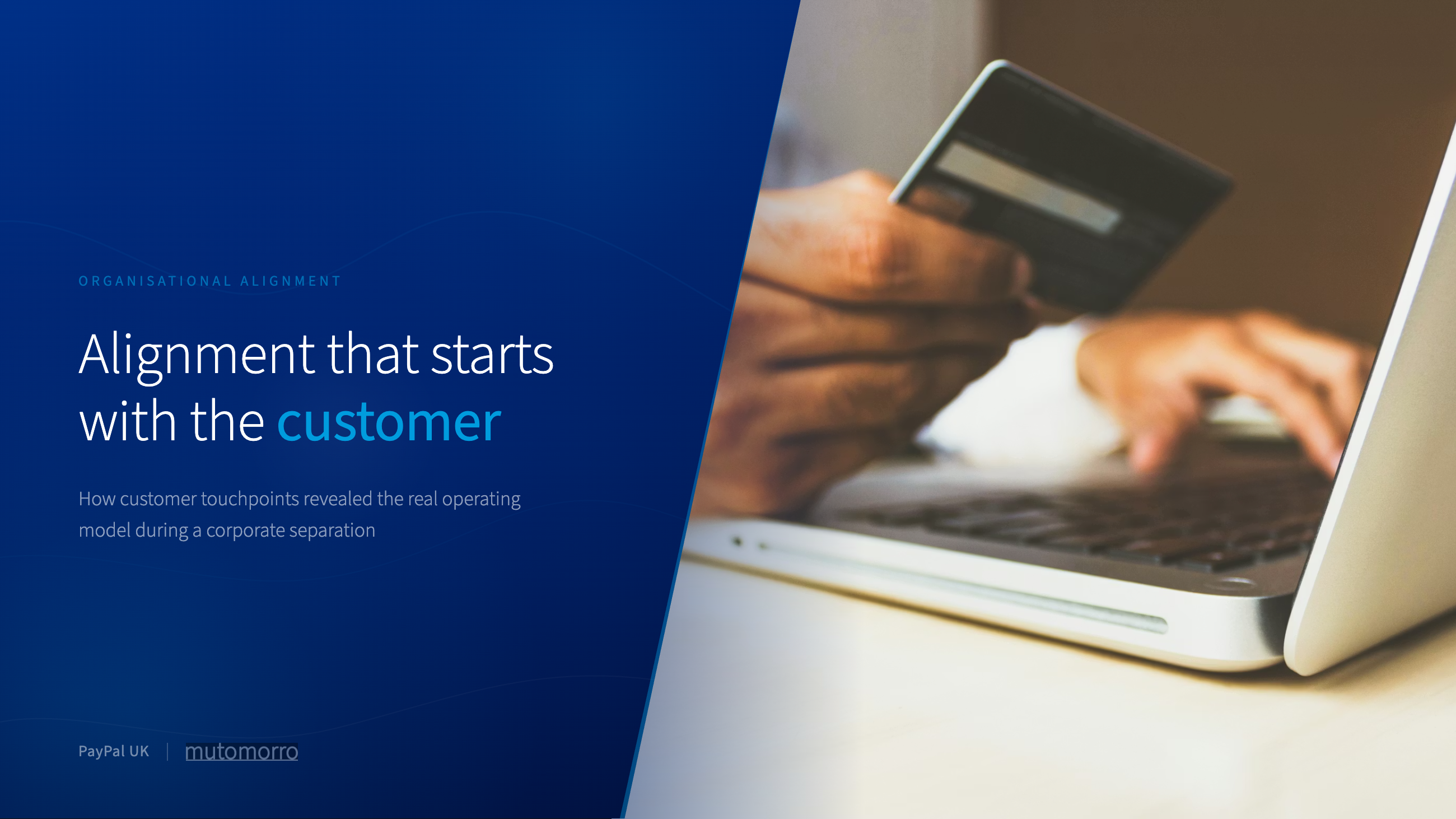
Bringing six departments together into one organisation customers could recognise
When a global payments company prepared for independence, the challenge wasn't rebranding - it was building organisational coherence across six departments that had never needed to work as one.
Read case study →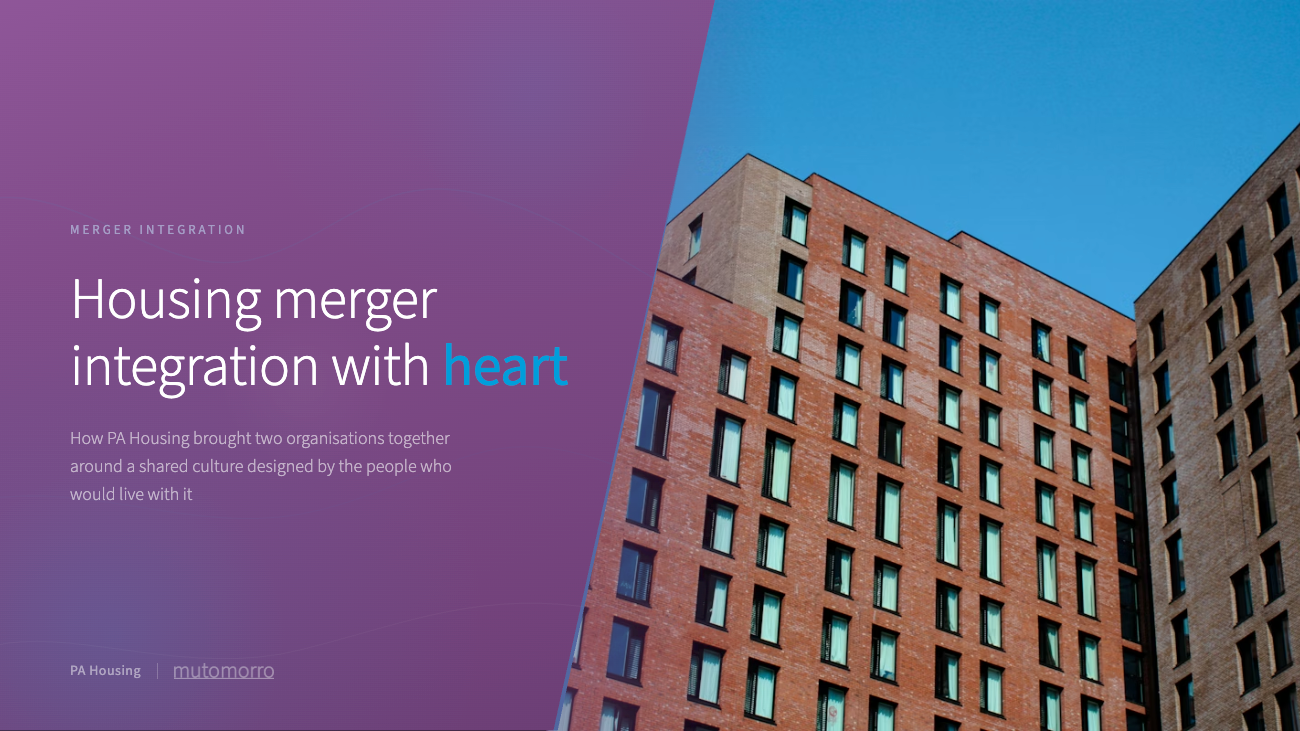
A merger that combined the best of both organisations, instead of one swallowing the other
Two housing associations merged on paper, but still operating as two organisations in practice - with the hard question of how to build a shared culture that neither had alone.
Read case study →Changing the structure is the starting point. Changing how people work, decide, and collaborate within it - that's where restructuring succeeds or stalls.
Restructure Blueprint Design gives you your restructure blueprint: the target design for the new organisation - the new shape, the decision rights at the new boundaries, the ways of working, the metrics and the sequenced move to get there - set against agreed design criteria and worked out in detail. We design it with your people, so the result is genuinely theirs.
A structural read of the organisation you have before you redraw it - the spans, layers and decision rights on the chart, and the informal network the chart never shows.
Guarding the New Structure keeps your delivered restructure fit and improving, and builds your own people's ability to run it. We watch the structure for the drift that quietly undoes a delayering, hold it to the design principles it was built on, and stand up the internal ownership that keeps this going. You can add an optional light ongoing rhythm with us, and you decide how much of that you hold yourselves.
The Bridges Transition Model focuses on the human side of change - the psychological transition people go through rather than the external change itself. It maps three phases: Endings, the Neutral Zone, and New Beginnings.
The Change Curve maps the emotional stages people move through during organisational change, from shock and denial through to acceptance and commitment. It helps leaders understand where people are in the process and what support they need.
The RASCI Framework maps five roles in any project or decision - Responsible, Accountable, Supportive, Consulted, and Informed. It helps organisations clarify who does what, reducing confusion and speeding up delivery.
The Mendelow Power-Interest Matrix is a stakeholder mapping tool that helps you work out who matters most during a change or project. It plots stakeholders by their level of power and interest so you can plan how to engage each group.
Change doesn't just affect what people do - it affects who they feel they are. Understanding the human experience of change helps leaders create conditions where people can adapt.
Resistance to change isn't a problem to overcome - it's feedback about the conditions inside your organisation. Here's what different forms of resistance are trying to tell you.
Your change initiative was well-planned, well-managed, and well-communicated. And it still didn't land. Here's what most change programmes overlook.