Integration Blueprint Design
Integration Blueprint Design gives you your post-merger integration blueprint: the integration operating model for the combined company, plus a sequenced Day 1 and first-100-days plan - worked out in detail and ready to run. We design it with people from both legacy organisations, so the result is genuinely theirs.

Our Integration Blueprint Design gives you a post-merger integration blueprint the combined company can run on, and we design eight parts: the integration thesis that names where the value comes from, the integration approach that sets what converges, the target operating model for the combined organisation, the leadership structure and decision rights, the Day 1 and first-100-days sequence, the synergy-capture plan with named owners, the merger narrative that explains the combination to both sides, and the integration management office and cadence that keeps it moving. You walk away with a blueprint specific to your two organisations and ready to put into practice.
An integration blueprint works when the people who run both sides helped design it. So we design with your people, drawing on the knowledge already inside both legacy organisations and combining it with our M&A frameworks and outside read of what usually breaks. The blueprint comes out both accurate and co-owned across both sides, and your integration leads come away more able to run this phase and the next merger themselves.
Culture clash was the No. 1 reason deals failed to achieve the promised value, in a Bain survey of executives who had managed businesses through mergers. The blueprints that get adopted are the ones the people running both sides helped design (Bain & Company, 'Integrating cultures after a merger', 2013).
When integration blueprint design helps
Integration Blueprint Design is the next step once you know the deal is happening and the two organisations have to become one - often straight after a readiness assessment has shown where the risks sit. These are the situations we are most often asked into. If one sounds like yours, this is a good place to start.
The situation | How it helps |
|---|---|
The deal is signed and you need the integration designed before close | Turns the deal thesis into a worked-out integration blueprint, so you move from knowing the deal to having the plan Day 1 runs on |
You have two operating models and need one that works | Designs a single combined operating model, deciding what merges, what stays distinct, and how fast, aligned to where the combined company is now going |
The synergies were promised in the deal and no one owns them yet | Builds a synergy-capture plan with a named owner and a baseline for each source of value, tracked and reconciled with finance |
Day 1 is approaching and it is not clear what changes at close | Sets an interim Day 1 model with a first-100-days sequence, so people know what changes at close, what holds steady, and who decides what |
The two sides are wary of each other and the merger could stall | Designs a shared merger narrative tied to both histories, so people join the combined company rather than quietly resisting it |
You want a blueprint both sides will actually adopt | Builds it with the people who run the work on both sides, so it lands as theirs and gets used in practice rather than filed |
What we design
We design eight parts of the integration blueprint, and make each one concrete enough to run on:

Integration thesis and value drivers
The one page that says where the combined value comes from, which levers deliver it, and in what order cost and revenue synergies get pursued, so everything downstream traces to a named source of value.

Integration approach and what converges
The deliberate choice of how far the two organisations combine - full absorption, preserving one side's autonomy, or a symbiotic blend - setting what merges, what stays distinct, and how fast.

Target operating model for the combined organisation
The level-one and level-two structure, the core processes and customer touchpoints, and the capabilities each part needs, designed to how the work really gets done rather than as an org chart from outside.

Leadership, governance and decision rights
The top structure, reporting lines, mandates and authority limits, and who decides what during and after the merger, so people can act on Day 1 instead of waiting for permission.

Day 1 and first-100-days sequence
The interim Day 1 model, what changes at close and what holds steady, and the ordered path to a stable operating cadence, each step with a named owner and a logged decision.

Synergy capture plan with owners
Where the value is booked, who owns each synergy, the baseline it is measured against, and how it is tracked and reconciled with finance, so value is captured rather than only promised.

The merger narrative
The shared story of why these two organisations are now one, tied to each side's history so people join it, designed as the scaffolding that carries the change, not as a separate comms exercise.

The Integration Management Office and cadence
The temporary office and the review rhythm that runs the blueprint - the functional workstreams, the dependencies between them, and the cadence that keeps leadership sighted and the plan moving.

Why these eight
These eight are the parts that have to line up for an integration to work as one whole. An operating model with a vague integration thesis chases value no one owns; a clear thesis with no Day 1 sequence stalls at close; a sharp Day 1 plan with no office to run it drifts within a month. The ones that get skipped most - the integration thesis up front, the interim Day 1 model distinct from the end state, synergy ownership against a baseline, and the office that runs the cadence - are the ones that decide whether the blueprint runs in practice or stays a diagram. So we design them together, as a set.
The eight follow the established merger frameworks, so the design covers what a full integration blueprint should - the thesis and approach, the combined operating model, the sequenced plan, and the office that runs it - not just the new org chart. The merger narrative sits underneath the rest as scaffolding, because culture clash is the single most common reason integrations fall short of their promised value. We use the frameworks to make sure the design is complete, rather than as a model to run at you.
How it works
The method produces one thing: an integration blueprint the combined company can run on. It works by designing the blueprint with people from both legacy organisations rather than presenting one to them. Both sides already hold most of the knowledge about how their work really runs, so our job is to draw that out, combine it with the M&A frameworks and pattern-recognition you bring us in for, and shape the two into a blueprint that is both expert and genuinely owned across both sides. It works in four modes.
- We start with the integration thesis and approach - Before any detailed design, we agree a one-page integration thesis with the future CEO - the value drivers, the phasing of cost and revenue synergies, the decision rights, and the must-not-break areas - and name the integration approach: absorption, preservation, or symbiosis. Those set the principles that turn every later trade-off into a matter of design rather than politics.
- We design with the people who run both sides - The people doing the work on each side know where their model bends and breaks in ways no org chart shows. We build with them, turning that knowledge into design choices, so the combined model fits how both organisations actually work and is owned by the people who will run it together.
- We bring the outside frameworks and the read on what breaks - An inside view on its own tends to design around each side's existing people and habits, so we bring the outside pattern - what makes integrations like yours work, and the frameworks that check the blueprint is complete and the parts line up before you commit at close.
- We leave the capability behind - Throughout, we work so your integration leads learn to design, not just watch us design. By the end you have a blueprint and a sharper sense of how the decisions were made, so this phase, and the next merger, is one you can run yourselves.
The thinking behind the method
We design with people from both sides rather than deliver to them because of a hard fact about mergers: the blueprint that gets adopted beats the one that looks best on paper. An integration is thousands of daily decisions made by people who did not choose to be merged, and people follow a plan they helped shape - they understand why it is built the way it is, and they trust that it fits how the work really goes on both sides.
So co-design gives you a blueprint that is both right and real. The knowledge inside both organisations makes it accurate; designing it together makes it co-owned; and the outside frameworks keep the two sides from simply defending what each already had. Get all three and the blueprint holds through close. Miss one and you get an expert plan that gets rejected, an owned plan that protects old turf, or a clever plan that never survives contact with the merger - which is the quiet cultural rejection that stalls most integrations.
What you get
By the end, you have four things:

- The integration blueprint itself - the agreed thesis and approach, the combined operating model, the leadership structure and decision rights, and the synergy-capture plan, on a page and in the detail beneath it, specific enough to put into practice.
- A Day 1 and first-100-days plan - the sequenced path from close to a stable operating cadence, with the interim Day 1 model, the phasing and dependencies, and named owners and logged decisions, plus an Integration Management Office structure ready to run it.
- A blueprint that is genuinely yours - built with people from both legacy organisations, grounded in how each side actually runs, so it is co-owned and used rather than filed.
- The capability left behind - your integration leads come out more able to run the integration and the next merger, so the moves after Day 1 are ones you can make yourselves.
The best integration blueprint is both expert and owned, and those pull against each other: expertise wants to hand you the answer, ownership wants both sides to reach it together. Holding both at once is the craft of the work.
How we hand it over - and what happens next
The point of the work is an integration blueprint the combined company can run on, so we take care with how it lands. Because people from both sides helped design it, the handover confirms something they already understand rather than revealing it cold. We walk through the finished blueprint and the Day 1 and 100-day plan - why it is built the way it is, what it settles, what it deliberately leaves open, and what the first moves at close are.
From there, some organisations take the blueprint and stand up their own Integration Management Office to run it, now more able to. Others bring us alongside for the harder parts of making it real, which is where implementation picks up. The design has done its job when both sides can see the combined model clearly, believe in it because they built it, and know the first steps through close.
Where this sits
Integration Blueprint Design is the second step in how we approach post-merger integration. It follows the Integration Readiness Assessment, which reads where the two organisations stand and where the risks sit, and leads into implementation, which turns the blueprint into how the combined company runs day to day. It also stands on its own - if you already know the deal is on and want the integration blueprint designed properly and owned across both sides, this is where to start.
Common questions
Is this just a set of workshops?
No - what you get is a designed integration blueprint, with a Day 1 and first-100-days plan to run it. We work with people from both sides in the room, because that is how the design becomes both accurate and co-owned, and the sessions are the means to that. You walk away with the worked-out blueprint itself, and a design your people helped shape and are ready to run through close.
What exactly is an integration blueprint?
It is the design of how the combined company will run once the two organisations become one. It brings together the integration thesis, the integration approach, the target operating model, the leadership structure and decision rights, the synergy-capture plan, and the merger narrative as one joined-up whole, along with a sequenced Day 1 and first-100-days plan to get there. Designing it as a set, rather than one piece at a time, is what keeps the parts from pulling against each other.
How is this different from the Integration Readiness Assessment?
The assessment reads where the two organisations stand now - what will combine cleanly, where the risks and gaps sit, and why. Integration Blueprint Design is the next step: it produces the blueprint to build instead. The assessment answers 'where are the risks'; this answers 'what to build'. Many clients do the assessment first, because designing on a clear read of both sides sets the blueprint up well, but if you already have that clarity, you can start here.
Does this cover the IT, finance and legal integration?
At the level an integration blueprint needs. We design the systems cutover sequence with your technology leads, the synergy baseline and reconciliation with your finance function, and the legal and brand workstreams as sequencing and governance - what the blueprint asks of each, and in what order. We design the integration at the operating-model and principles level, not the IT migration, the deal valuation, or the legal delivery, so where deep specialist build is needed we shape it alongside the leads who own it.
Why build it with our people rather than design it for us?
Because a merger only holds if the plan is used. The blueprint that gets adopted beats the one that only looks best on paper, and people adopt what they helped design far more readily than what is handed to them - which matters most when two wary organisations are becoming one. Your people on both sides also hold knowledge about how each organisation really runs that no outside team can fully see. Co-design combines that inside knowledge with our M&A frameworks, so the blueprint is both right and real.
What happens after the blueprint is done?
You have an integration blueprint and a Day 1 and first-100-days plan, ready to put into practice, with an Integration Management Office structure to run it. Some organisations stand up that office and implement it themselves, now more able to. Others bring us alongside for the harder work of making it real through close and beyond. And because we leave the capability behind, your integration leads can keep running the integration, and the next merger, themselves.
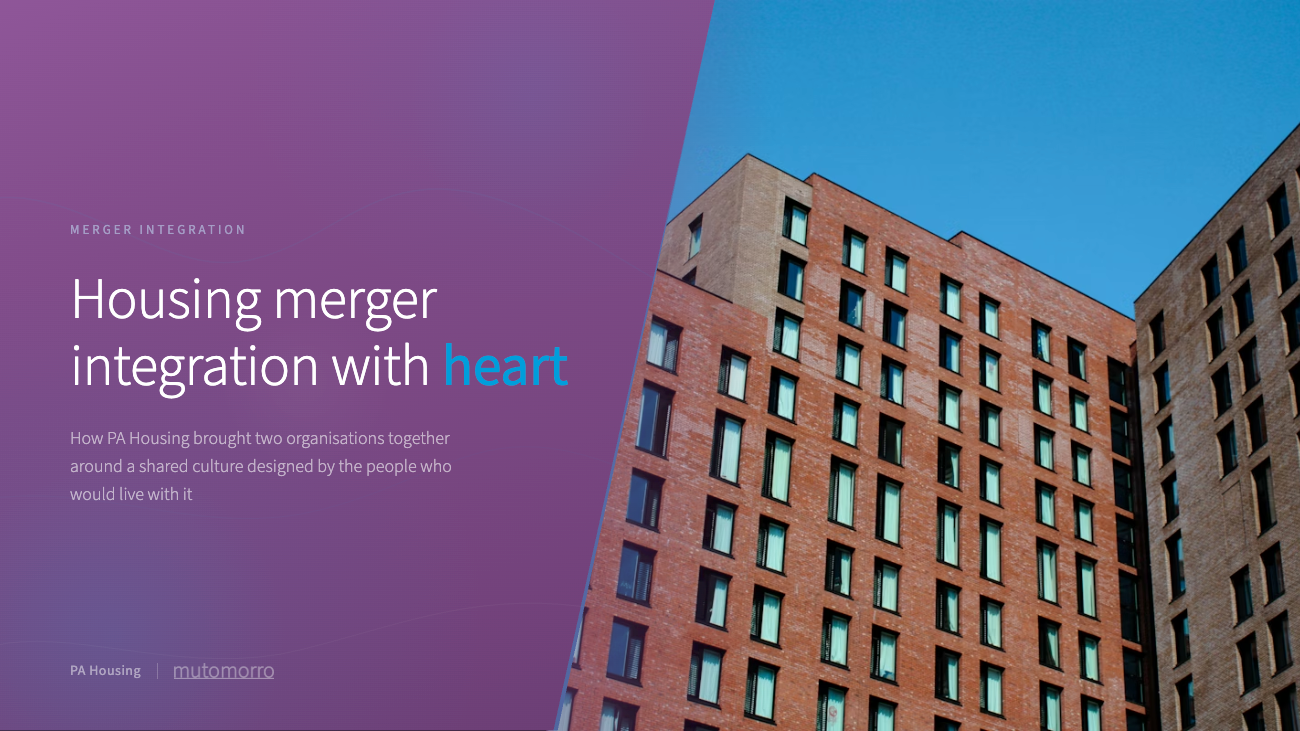
A merger that combined the best of both organisations, instead of one swallowing the other
Two housing associations merged on paper, but still operating as two organisations in practice - with the hard question of how to build a shared culture that neither had alone.
Read case study →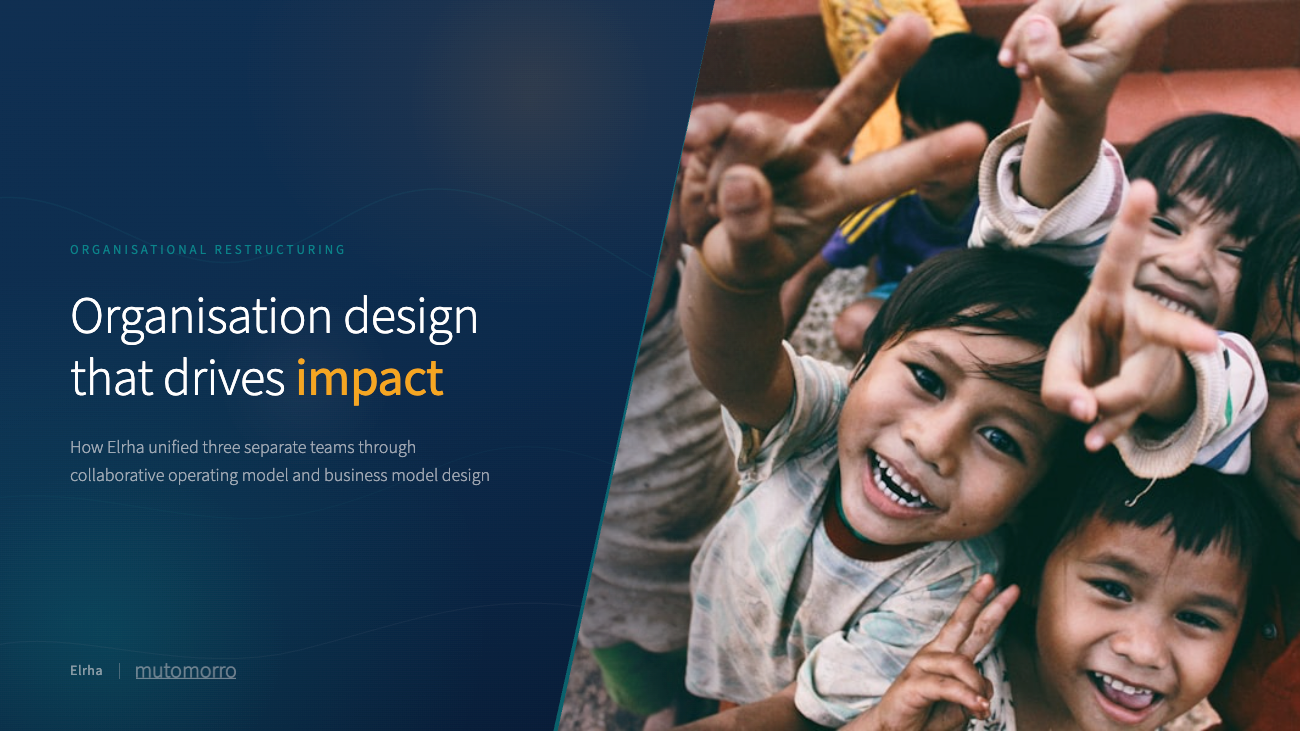
Three teams, one mission - an operating model people could see themselves in
A humanitarian charity with a bold 2040 strategy and three teams that had each developed their own way of working. The question wasn't whether to restructure - it was how to design something people would want to be part of.
Read case study →Two ways of working. Two sets of habits. Two cultures. We help you design how they come together - because that's the part no integration plan covers.
We help you design your organisation around the value you want to create - the structure, the conditions around it, and the way work actually flows between them.
Changing the structure is the starting point. Changing how people work, decide, and collaborate within it - that's where restructuring succeeds or stalls.
Strong cultures come from shared ways of working, common goals, and an environment that makes coming together easier than pulling apart. We work with leaders to cultivate exactly that - conditions where people can bring their best, find meaning in work, and translate culture into how work happens.
The Galbraith Star Model is an organisational design framework that maps five interconnected elements - strategy, structure, processes, rewards, and people. It helps leaders see how these elements need to align for the organisation to work well.
The McKinsey 7-S Model is a strategic framework that maps seven interconnected elements of an organisation - from strategy and structure to skills and shared values. It helps leaders understand how changing one part of the organisation affects everything else.
The Competing Values Framework is a model for understanding organisational culture by mapping it across two dimensions - flexibility versus stability, and internal versus external focus. It reveals which of four culture types your organisation leans towards.
The Bridges Transition Model focuses on the human side of change - the psychological transition people go through rather than the external change itself. It maps three phases: Endings, the Neutral Zone, and New Beginnings.
A merger changes structures, systems and reporting lines. But whether two organisations genuinely become one depends on something integration plans rarely design for.
Most organisational structures were designed for a different era - one where stability was the goal and change was the exception. This article explores what it means to design structures that can adapt when conditions change, and why getting this right matters more than getting the perfect org chart.
The strategy is clear. So why does the organisation keep doing something different? The answer usually isn't about communication or buy-in. It's about the conditions nobody designed for.