Keeping the Service Sharp
Keeping the Service Sharp keeps your live service fit and improving after launch, and builds your own people's ability to run that improvement themselves. Your service owner and team keep the blueprint current, work a live improvement backlog, and act on what the frontline sees. You can add a light ongoing rhythm with us on top, scoped to as much or as little as you want.

Keeping the Service Sharp keeps your live service improving, and we keep seven things working: the service blueprint as a current operating record, a prioritised improvement backlog that turns ideas into shipped changes, a frontline loop that surfaces friction and acts on it, continuous whole-journey measurement that shows where the service is slipping, a recheck against your original baseline, your own improvement practice so the work carries on without us, and an outside eye on hand when you want one. The result is a live service that stays fit for the people who use it and gets better as conditions change.
We build this so your own people run it: a named service owner, an improvement cadence, and the routines that keep the practice alive across teams. On top of that, you can keep us on a light ongoing rhythm of periodic re-measurement and health-checks, or take the practice and run it alone. You decide how much you hold and how much we hold, and that balance can shift as your team takes more on.
Customer satisfaction is 73% more likely when the whole journey works well than when only individual steps do, and each one-point gain on a ten-point journey score maps to at least a three-point rise in revenue growth. Measuring the whole journey, not single touchpoints, is what catches drift early (McKinsey, 'From touchpoints to journeys: Seeing the world as customers do', 2016).
When this helps
Clients bring us in for this once the new service is live and they want it to keep working. These are the situations we are most often asked into. If one sounds like yours, this is a good place to start.
The situation | How it helps |
|---|---|
You have launched a new service and want it to last | Sets up the practice and rhythm that keep the service fit after launch, so it keeps improving instead of levelling off once attention moves elsewhere |
A past service improvement faded once attention moved on | Builds a standing cadence and a named owner, so improvement is a routine your team runs rather than a one-off push that quietly stops |
You want to own and run the improvement work in-house | Builds the roles, routines and skills into your own people, so your team reads journey signals and ships changes without depending on us |
You want a light check-in from outside, not a big programme | Keeps us on an optional periodic rhythm of re-measurement and health-checks, scoped to as much or as little as you want |
Demand, channels or conditions are shifting | Re-measures the journey and refreshes the blueprint as things change, so the service flexes with the world instead of drifting out of date |
You inherited a live service that is quietly decaying | Reads where the whole journey is slipping, sets up the backlog and loop to act on it, and gets the service improving again under your ownership |
What keeping it sharp involves
These are the areas the work covers to keep a live service fit and improving:

Keep the blueprint current
We keep your service blueprint as a live operating record: frontstage, backstage and supporting steps updated as the service changes, so every team works from one accurate picture and improvements start from what is actually happening.

Work a visible improvement backlog
We set up a single prioritised register where every improvement idea is captured, ranked and worked in order, so good ideas get shipped and nothing is lost between people or teams.

Close the loop with the frontline
We give the people who run the service day to day a routine way to surface friction and act on it, turning what staff and users notice into small, frequent improvements rather than an occasional big review.

Watch the whole journey, not just the parts
We track how the live service performs the way real people move through it end to end, so you see where it is slipping before your users feel it. Individual steps can each score well while the journey as a whole underperforms.

Recheck against your baseline
We periodically re-measure the journey against the baseline from your Service Design Audit to confirm the design is holding and spot drift early. This is a lighter recalibration against the original numbers, not a re-run of the full audit.

Build your own improvement practice
We build the roles and rhythms that let your people run this without us: a named service owner, a regular improvement cadence, and the habits that keep the skill alive across teams.

Keep an outside eye on hand
You can keep us on an optional light rhythm of periodic health-checks and course-correction as demand, channels and conditions change, scoped to exactly what you want to keep.

Why these seven
The first four are where a live service actually stays sharp: a current blueprint everyone works from, a backlog that gets ideas shipped, a frontline loop that catches friction early, and whole-journey measurement that shows drift before users feel it. Together they turn improvement into something that happens every week, not once a year.
The last three are how the practice becomes yours and stays honest. Re-measuring against the Service Design Audit baseline keeps you anchored to known numbers. Building the owner, cadence and habits puts the practice in your hands. And keeping an outside eye available for the periodic checks is there if you want it, never required. These follow the established continual-improvement frameworks - ITIL's improvement register, the GOV.UK service-owner role, the living service blueprint - used to keep the practice complete rather than run at you as a model.
How it works
The work produces one thing: a live service that keeps improving, owned and run by your own people. It is the lightest and longest-running stage, a standing rhythm rather than a programme. It works in four modes.
- We scope how much you hold and how much we hold - We agree the blend with you. The core we always build is your internal capability to keep the service improving. On top of that, the ongoing rhythm with us is optional. You can run the practice alone, keep us on a light periodic cadence, or both, and that balance can shift over time as your people take more on.
- We build the capability into your people - We put the practice in your hands: a named service owner accountable for the live service, a regular improvement cadence, and the routines that keep the blueprint current and the backlog moving. Your team learns to read whole-journey signals and act on them, so the work does not depend on us.
- We set a light rhythm you run - We set a repeating loop your owner and team run: continuous whole-journey tracking, periodic re-measurement against the Service Design Audit baseline, regular health-checks, and course-correction as conditions change. It is a cadence, not a build.
- We step back, and stay reachable if you want us - Once the practice is running, we hand it over and step back. You choose whether to keep us on hand for the periodic checks and refreshes, and at what cadence, from a light annual look-in to nothing at all.
The thinking behind the method
A service decays when improvement depends on the people who launched it. Once the launch programme ends and attention moves on, the blueprint goes stale, ideas pile up unworked, and the journey drifts back toward the problem you started with. So the product here is not more delivery from us. It is a team that runs continual improvement itself.
That is why the capability is the thing we build, and the ongoing rhythm with us is only an option on top. In the earlier stages, building your people's capability is the method that makes change stick. Here the capability is the point: a service owner, a cadence, a maintained blueprint and a working backlog that let your team keep the service fit without us. We stay reachable for the periodic checks if you want, but the practice is designed to stand on its own, and to need us less over time.
What you get
By the end, you have four things:

- A live service that stays fit and keeps improving - measured across the whole journey, refreshed as conditions change, and getting better rather than drifting back toward the problem you started with.
- Your own people owning and running it - a named service owner, an improvement cadence, and the habit of keeping the blueprint current, so the practice runs in-house.
- A light rhythm and the feedback loops in place - a prioritised improvement backlog, a frontline loop, and periodic re-measurement against your Service Design Audit baseline.
- The option of us on hand - an optional periodic cadence of health-checks and course-correction, scoped to as much or as little as you want, and easy to wind down as your team gets confident.
Owned by you, supported by us: as much or as little as you need, and less over time as your team takes it on.
When we step back - and staying on hand
This is the final stage, so it closes the loop. We hand the practice fully to your people: the service owner, the cadence, the blueprint discipline and the backlog are theirs to run. From there you choose the cadence you want from us, from a light periodic health-check to nothing at all, and the ongoing rhythm winds down as your team grows confident.
The re-measurement is also what tells you when a lighter recalibration is no longer enough. When demand, channels or conditions move far enough that the service needs a bigger reset rather than steady improvement, the loop points back to the diagnostic, and a fresh Service Design Audit starts the cycle again from a new baseline.
Where this sits
Keeping the Service Sharp is the final, Adapt stage in how we approach service design. It sustains the live service delivered by the Service Launch Programme, and it re-measures against the baseline set in the Service Design Audit. It keeps the whole four-stage investment fit rather than letting it fade once the launch programme ends, and when the world moves enough that a bigger reset is needed, its re-measurement loops back to a fresh audit to start the cycle again. It also stands on its own: if you have a delivered or inherited service that is quietly decaying, you can start here.
Common questions
How is this different from the Service Design Audit?
The audit assesses the service from scratch and sets a baseline: what is working, where it is slipping, and by how much. Keeping the Service Sharp re-measures the live journey against that baseline to confirm the design is holding and to catch drift early. It re-measures against known numbers rather than re-assessing from the ground up. If conditions have moved far enough that a full re-assessment is warranted, that is a fresh audit, and the loop points back to it.
How is this different from the Service Launch Programme?
The launch programme delivered and launched the new service as a defined piece of work. Keeping the Service Sharp sustains and evolves what is now running. It is an ongoing cadence rather than another build, so it does not re-sell delivery. The programme gets the new service live; this keeps it fit and improving afterwards.
Do we have to keep you on retainer?
No. The core we build is your own capability to keep the service improving, and you can take that and run it alone. The ongoing rhythm with us is optional and scoped with you, from a light periodic health-check to nothing at all, and it can wind down as your team gets confident. It is never a heavy retainer.
What will our own people be able to do?
Your team runs continual improvement itself. You have a named service owner accountable for the live service, an improvement cadence, the habit of keeping the blueprint current, and the skill to read whole-journey signals and work them through a prioritised backlog. The practice lives in your people, not in us.
Isn't this just continuous improvement by another name?
It draws on the same established practice, but the point is that your own team runs it. Rather than us doing continuous improvement for you, we build the owner, cadence, blueprint discipline and backlog that let your people run it themselves, anchored to your service blueprint and your Service Design Audit baseline. The product is the practice in your hands, with us on hand only as much as you want.
How much of this can we run ourselves?
All of it, once the capability is built. That is the aim: a service owner, cadence, maintained blueprint and working backlog that let your team keep the service improving without us. Most clients keep us on a light periodic rhythm for the re-measurement and health-checks at first, then take more on over time. You decide the balance, and it can shift as your team grows confident.
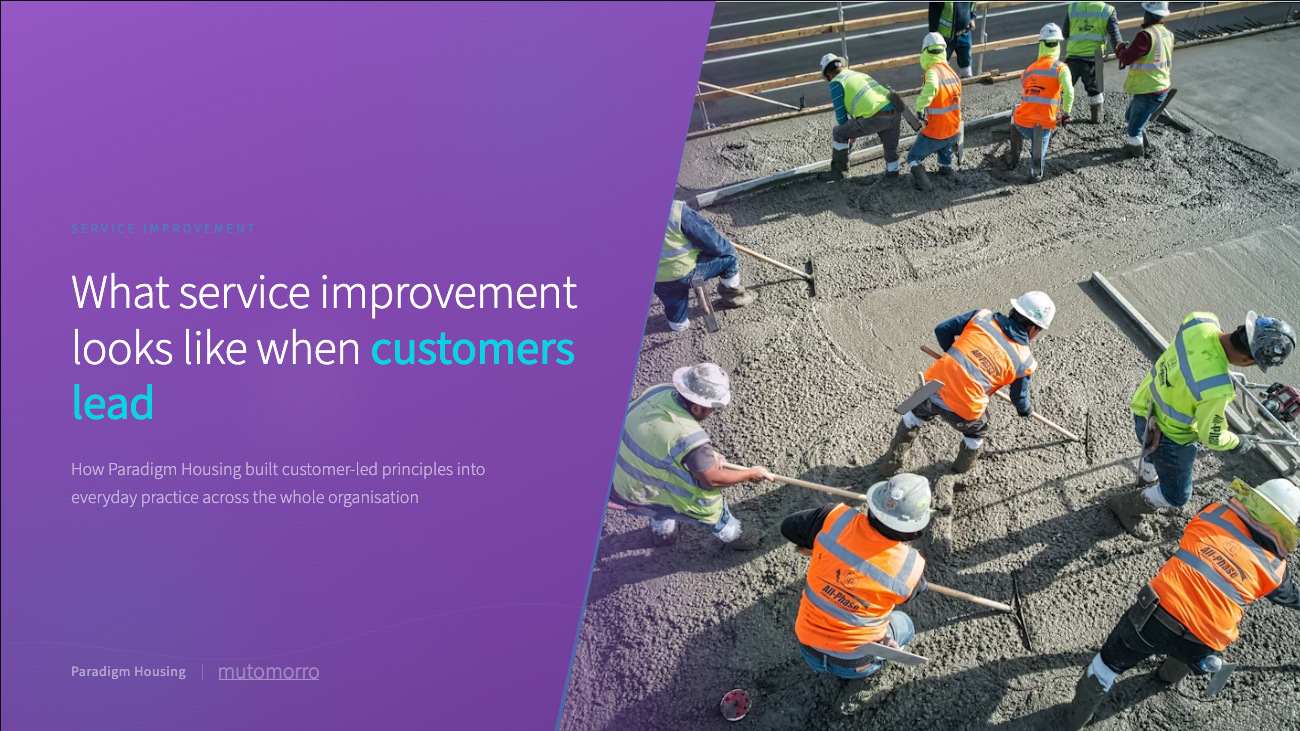
Service improvement led by customers and teams, not handed down by consultants
A growing housing association where staff could recite the values but customers experienced something different - and previous improvement efforts kept addressing symptoms rather than causes. Getting every team working to one standard of service, rather than handing customers between them, was the real job.
Read case study →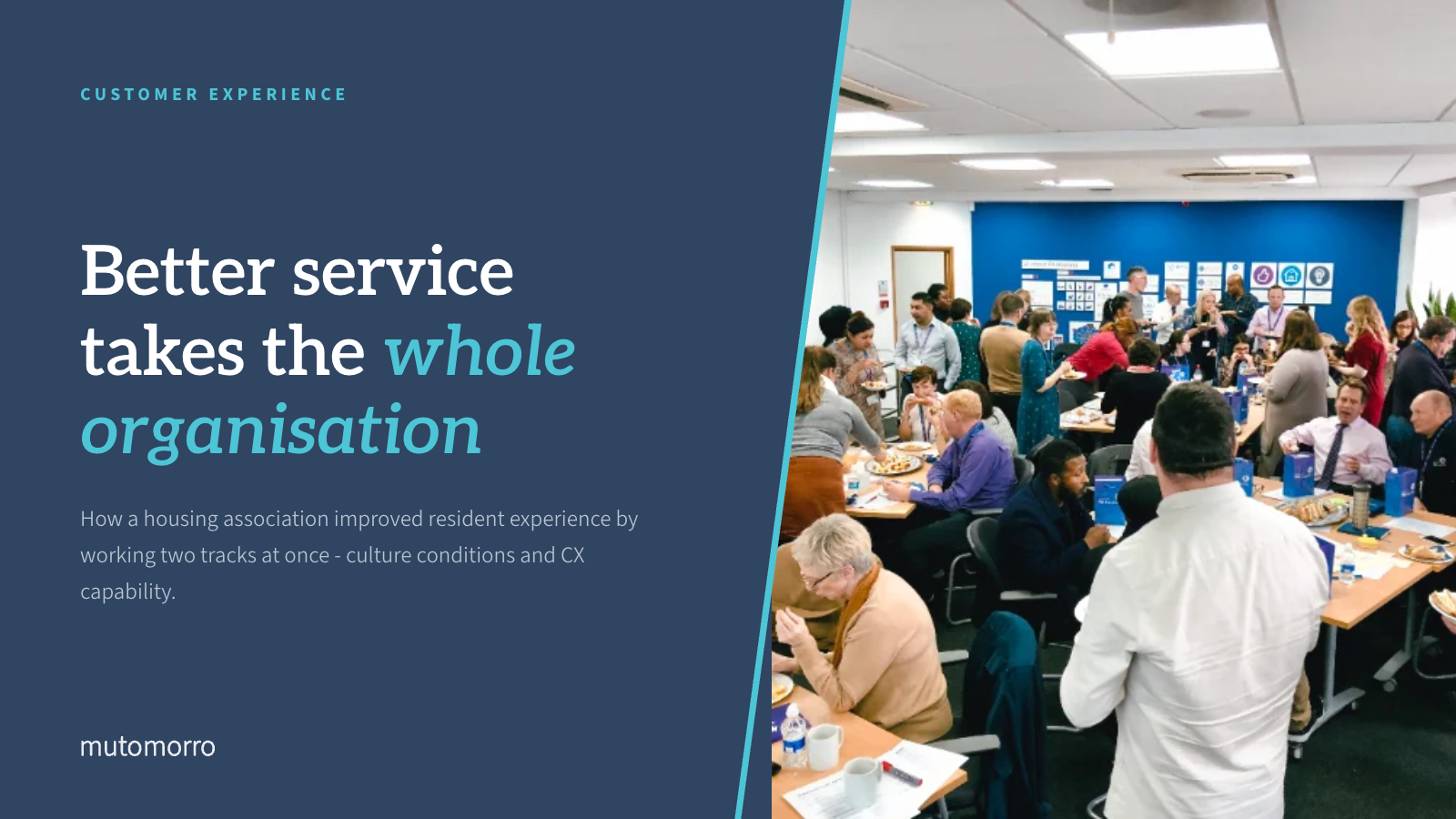
Customer experience shaped by how the whole organisation works, not just the frontline
A housing association with around 9,000 homes had invested in journey mapping, customer profiles and resident research - but the data pointed to something the CX toolkit couldn't fix alone. Culture work without CX capability would produce good intentions and no change. CX capability without the culture shift would produce better-mapped journeys that still fell through the same gaps. They needed both.
Read case study →Most service design stops at user research and journey maps. We work both sides - designing the service and shaping the organisational conditions that determine whether it actually gets delivered.
The Service Launch Programme takes your designed service live: the blueprint stood up end to end across the front-stage steps customers see, the back-stage processes behind them, the systems it runs on and the measurement that tracks it. We deliver it with your teams, so the service is running the way it was drawn and owned by the people who run it.
Service model design gives you your service blueprint: the end-to-end design for how the service actually runs - the user journey, what people see and touch, the work behind the front line, and the systems and evidence that hold it together, worked out in detail and ready to put into practice. We design it with your frontline staff and, where it fits, the people who use the service, so the result is genuinely theirs.
A read of the service itself, end to end - whether the backstage holds up every frontstage moment, and whether what the frontline learns ever reaches the design.
A service blueprint is a detailed map of how a service actually works - what the user sees and experiences on the front end, and everything happening behind the scenes to make it possible. It helps organisations redesign services by showing the full picture.
A Gemba Walk is a Lean practice where leaders go to the place where work actually happens to observe, listen, and understand. It bridges the gap between how leaders think work gets done and how it really gets done.
The PDCA Cycle (Plan, Do, Check, Act) is a continuous improvement framework for testing and refining processes. It creates a repeating loop of planning a change, trying it, checking whether it worked, and adjusting before the next round.
Kaizen is a Japanese continuous improvement philosophy built on the idea that small, ongoing changes add up to significant results over time. The Kaizen Cycle gives teams a structured way to identify improvements, test them, and build them into everyday work.
Every organisation has friction - the unnecessary effort, the needless complexity, the things that make simple work harder than it should be. This article explores how to find it, understand where it comes from, and reduce it without creating new problems in the process.
The skills that make someone good at service design - empathy, experience mapping, designing conditions - are the same skills leaders need to create environments where people do their best work. What changes when that lens runs all the way through the organisation.