ORCA
The ORCA framework helps you assess whether your organisation is ready for change by examining three dimensions - evidence, context, and facilitation.
Get the free template
Most change initiatives don't fail because the idea was wrong. They fail because nobody checked whether the ground was ready. ORCA is a structured way of asking that question - looking at three dimensions of readiness before a change begins, so you know what you're working with rather than finding out the hard way.
What is ORCA?
ORCA stands for Organisational Readiness to Change Assessment. It's a framework for evaluating whether an organisation is genuinely prepared to take on a change initiative - not just whether the business case is strong, but whether the conditions around it are right.
The framework comes from the PARIHS model (Promoting Action on Research Implementation in Health Services), which was originally developed to understand why some evidence-based practices get adopted in healthcare settings and others don't. Helfrich and colleagues turned the theory into a practical assessment instrument in 2009 - a way of measuring readiness rather than just talking about it.
But the insight behind ORCA isn't specific to healthcare. Any organisation planning a significant change - a restructure, a new operating model, a technology shift, a cultural programme - benefits from asking the same question: is the ground solid enough to build on? If you're exploring the broader topic of assessing change readiness, ORCA gives you a structured way to do it.
ORCA examines three dimensions: Evidence (is the case for change well-founded?), Context (is the organisational environment conducive?), and Facilitation (are the right conditions in place to support implementation?). Think of them as three layers of ground beneath your change initiative. All three need to be solid. If any one is weak, the foundation gives way - regardless of how good the plan looks on paper.
How ORCA works - three strata, one foundation
The three dimensions aren't sequential steps. You don't complete one and move to the next. They're concurrent - three lenses you look through at the same time to build a picture of how ready your organisation is for what's coming.
Each dimension has its own set of sub-scales: the specific things you're assessing within that area. Some dimensions have more sub-scales than others, and that's fine - facilitation naturally involves more moving parts than evidence. The point isn't to score every item equally; it's to notice where the ground is solid and where it isn't.
Dimension | The question it asks | What you assess |
|---|---|---|
Evidence (the bedrock) | Is the case for change solid? | Research evidence, practical experience, user preference, local data |
Context (the middle layer) | Will the environment hold it? | Leadership, culture, evaluation, resources, communication, receptivity |
Facilitation (the surface layer) | Can it carry the change into practice? | Purpose, role, skills, style, experience, resources, boundaries, continuity, recognition |

Evidence - is the case solid?
Evidence is the bedrock. Before anything else, you need to know that the change you're proposing is grounded in something real - not assumption, not enthusiasm, not "everyone else is doing it."
ORCA looks at four aspects of evidence:
Research evidence. What does the published evidence say? If you're introducing a new way of working, a new service model, or a new tool, is there research supporting its effectiveness? This doesn't mean you need a peer-reviewed paper for every decision, but you should be able to point to something more than a hunch.
Practical experience. What has your organisation (or similar ones) learned from trying this before? Experience counts as evidence. If three previous restructures have stalled because middle management wasn't brought along early enough, that's data.
User preference. What do the people affected by this change think about it? Not whether they want it (people rarely welcome change unprompted), but whether there's a receptiveness to the direction. A new digital system imposed on a team that hasn't been consulted is a different proposition from one that responds to problems the team has been raising for months.
Local data. What does your own performance data, feedback, and intelligence tell you? If you're proposing a change to improve customer outcomes, do you have baseline data showing where outcomes currently fall short? Local data turns a general case into a specific one.
The guiding question for this layer: does the evidence hold up to scrutiny, or are there gaps that need addressing before you move forward?

Context - will the environment hold?
Context is the middle layer - the organisational environment that's built up over time. Even with strong evidence, change can stall if the conditions around it aren't right. This is often where readiness falls apart, because context is harder to see and harder to shift.
ORCA assesses six aspects of context:
Leadership. How do senior leaders behave around change? Not what they say in town halls, but what they do when priorities compete. Do they protect time and resources for change work, or does it get squeezed by operational demands? Leadership behaviour sets the tone for everything else.
Culture. What's the prevailing attitude toward change? Some organisations have a culture of experimentation - trying things, learning, adjusting. Others have a culture of caution, where new ideas are treated as risks to be managed. Neither is right or wrong in absolute terms, but knowing which one you're working in shapes how you approach implementation.
Evaluation. Does the organisation have a habit of measuring what matters? If there's no culture of evaluation - no regular feedback loops, no outcomes tracking - it'll be hard to know whether the change is working once it's underway. Evaluation isn't just about the change itself; it's about the organisation's capacity to learn.
Resources. Are the practical resources available? Time, money, people, technology. Change that requires significant effort from teams already operating at capacity is change that won't get the attention it needs. Be realistic about what's available, not what's theoretically possible.
Communication. How does information flow? Are there effective channels for reaching the people who need to know? Is there two-way communication, or just top-down broadcasting? Poor communication is one of the most common reasons change initiatives lose momentum - people can't support what they don't understand.
Receptivity. How open is the organisation to this specific change right now? Receptivity isn't a fixed trait - it shifts depending on timing, trust, recent experience, and how much change is already in flight. An organisation that's just been through a painful restructure may have limited appetite for another round, even if the next change is well-evidenced.

Facilitation - can it carry the change?
Facilitation is the surface layer - the active conditions that directly support implementation. This is where readiness meets action. You can have strong evidence and a supportive context, but without the right facilitation structures, the change won't translate from plan to practice.
This dimension has the most sub-scales, because making change happen involves a lot of moving parts:
Purpose. Is there a clear, shared understanding of why this change is happening? Not a mission statement on a slide - a genuine answer to "why are we doing this?" that people at every level can articulate.
Role. Are implementation roles defined? Who is leading, who is supporting, who is championing the change within their teams? Ambiguity about roles is one of the fastest ways to lose momentum. Mapping who holds influence using something like the Mendelow Matrix can help clarify this.
Skills. Do the people involved have the skills they need? This applies to both the skills required by the change itself (new systems, new processes) and the skills required to manage the transition (facilitation, coaching, communication).
Style. How is the implementation being led? Directive, collaborative, consultative? The style needs to match the context. A burning-platform situation might need more direction; a cultural shift needs more collaboration.
Experience. What implementation experience exists in the organisation? Have the people leading this done something similar before? Experience isn't just about the leader - it's about whether the organisation has built change capability over time.
Resources. Are resources specifically allocated to implementation - not just the change itself, but the process of making it happen? Project time, facilitation support, communication materials, training capacity.
Boundaries. Is the scope clear? What's in, what's out, and what decisions have already been made? Without clear boundaries, change initiatives expand until they become unmanageable.
Continuity. Is there a plan for sustaining the change beyond the initial push? Many change efforts deliver an impressive launch and then fade. How will this one maintain momentum once the project team moves on?
Recognition. How will progress be noticed and acknowledged? Not grand celebrations - just a clear signal that effort is valued and movement is being tracked. Recognition sustains energy through the middle period when the initial enthusiasm has worn off but the results aren't yet visible.
How to use ORCA
ORCA works best as a structured conversation, not a form-filling exercise. The sub-scales are prompts for discussion, not boxes to tick.
Step 1: Clarify the change. Be specific about what you're assessing readiness for. "Digital transformation" is too broad. "Moving our case management system from paper to digital within the next 12 months" is a change you can assess readiness against.
Step 2: Work through each dimension. Take Evidence, Context, and Facilitation in turn. For each sub-scale, ask: where are we on this? What's strong? What's weak? What don't we know? Use a simple scale if it helps (strong / developing / weak / unknown), but the conversation matters more than the score.
Step 3: Look at the picture. Step back and read the assessment as a whole. Where is the ground solid? Where are the gaps? Pay particular attention to dimensions where you're unsure - "unknown" is often more revealing than "weak," because it means you're making assumptions you haven't tested.
Step 4: Decide what to do about the gaps. Not every gap needs filling before you start. Some can be addressed during implementation. But some are deal-breakers - if the evidence is thin, or leadership isn't genuinely behind the change, starting anyway is a recipe for expensive failure. The assessment should help you distinguish between gaps you can work with and gaps that need addressing first.
Step 5: Revisit as you go. Readiness isn't static. Context shifts, resources change, new evidence emerges. Run the assessment again at key milestones - not as a full repeat, but as a check-in. Has anything changed that affects the foundation?
Example
A medium-sized professional services firm is planning to move from a traditional office-based model to a hybrid working approach. Before committing, the leadership team runs an ORCA assessment.
Evidence: Strong. They have external research on hybrid models, data from their own pandemic-era remote working experience, and survey results showing that 78% of staff want more flexibility. The case is well-founded.
Context: Mixed. Leadership is supportive, but the culture is built around presence - being seen in the office has traditionally been associated with commitment. Communication channels work well for broadcast messages but less well for two-way dialogue. Resources are available, but there's no evaluation framework for measuring whether hybrid working is delivering what it's supposed to.
Facilitation: Weak in places. The purpose is clear, but roles aren't defined - nobody has been asked to lead the transition. Skills gaps exist around managing remote teams. There's no implementation plan, no communication strategy, and no thought given to how the change will be sustained once the initial policy is in place.
The assessment doesn't tell the firm to abandon the change - the evidence is strong and the context is workable. But it shows that jumping straight to a policy announcement would be premature. The firm decides to spend six weeks building the facilitation layer: appointing a project lead, defining the approach to transition, developing manager capability, and creating feedback loops. The change happens - but on solid ground.
Limitations
It's a diagnostic, not a prescription. ORCA tells you where the ground is strong and where it's weak. It doesn't tell you what to do about it. You'll need other tools - like ADKAR for structuring the response or Burke-Litwin for understanding the organisational variables - to move from assessment to action.
The sub-scales are broad. "Leadership" and "culture" are each enormous topics. ORCA gives you a structured way of asking the question, but the depth of the answer depends on the quality of the conversation. A superficial pass through the sub-scales will produce a superficial assessment.
It requires honesty. The assessment is only as good as the willingness to surface uncomfortable truths. If the room isn't safe enough to say "leadership isn't genuinely behind this" or "we don't have the resources," the assessment will paint a rosier picture than reality.
It's point-in-time. Readiness is dynamic. An assessment done in January might not hold by March if the context shifts - a new CEO, a budget cut, a competing priority. Build in check-ins rather than treating the initial assessment as fixed.
Getting started
Pick a change that's currently being planned or discussed in your organisation. Something specific - not "improve performance" but "introduce quarterly development conversations for all managers by September."
Gather three to five people who know the organisation well and who'll be honest. Walk through the three dimensions together, using the sub-scales as conversation prompts. Don't try to score everything precisely - focus on where the group agrees the ground is strong, where it's weak, and where you're not sure.
The most useful output isn't a number. It's a shared understanding of what needs to be true before this change can succeed - and a clear view of what's already true and what isn't.
We share thinking on organisational change and development on LinkedIn - practical ideas for people doing this work inside their own organisations.
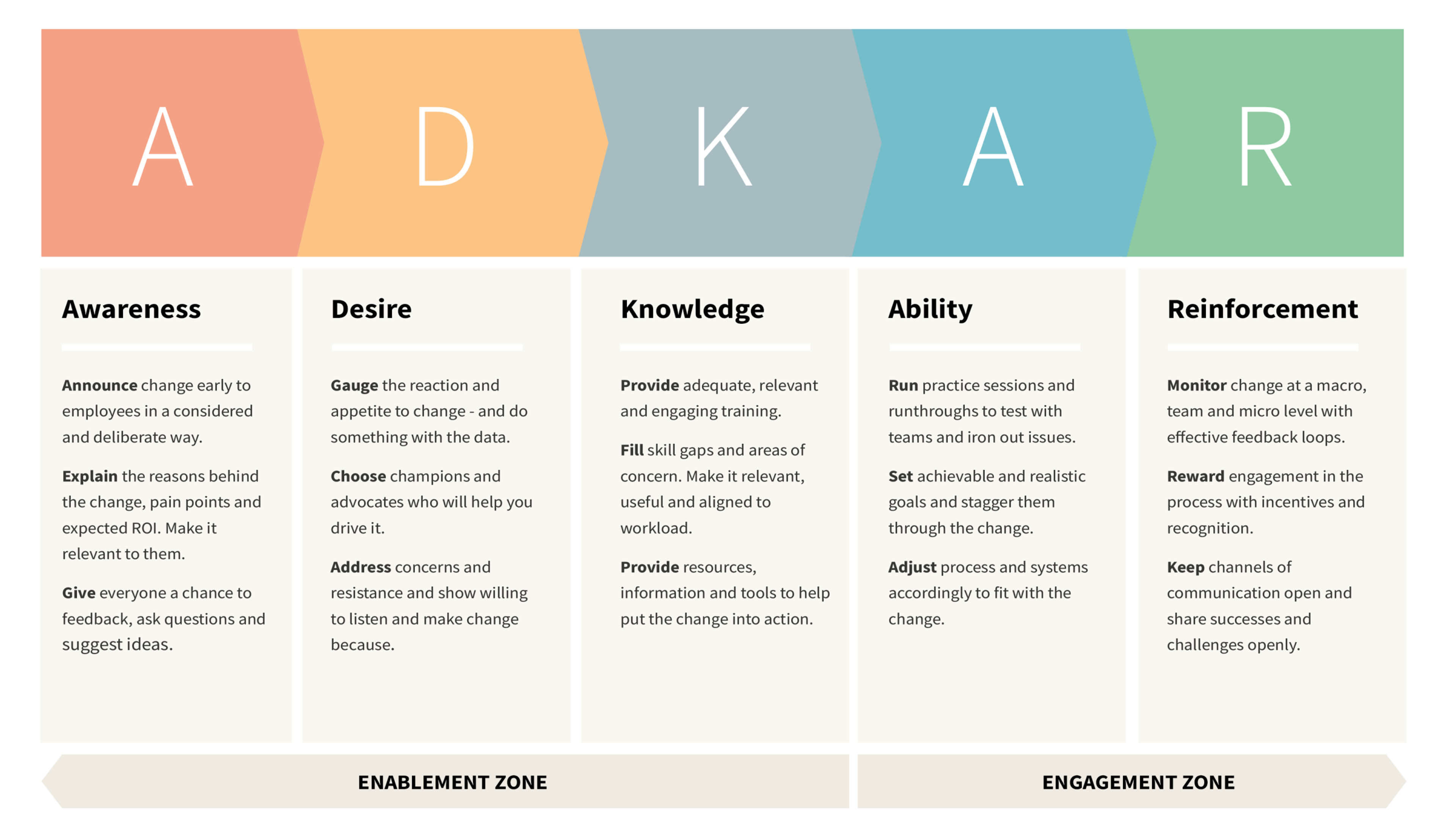
The ADKAR model is a five-stage framework for managing change at an individual level - Awareness, Desire, Knowledge, Ability, and Reinforcement. It helps organisations understand what people need at each point in a change process and where things are getting stuck.
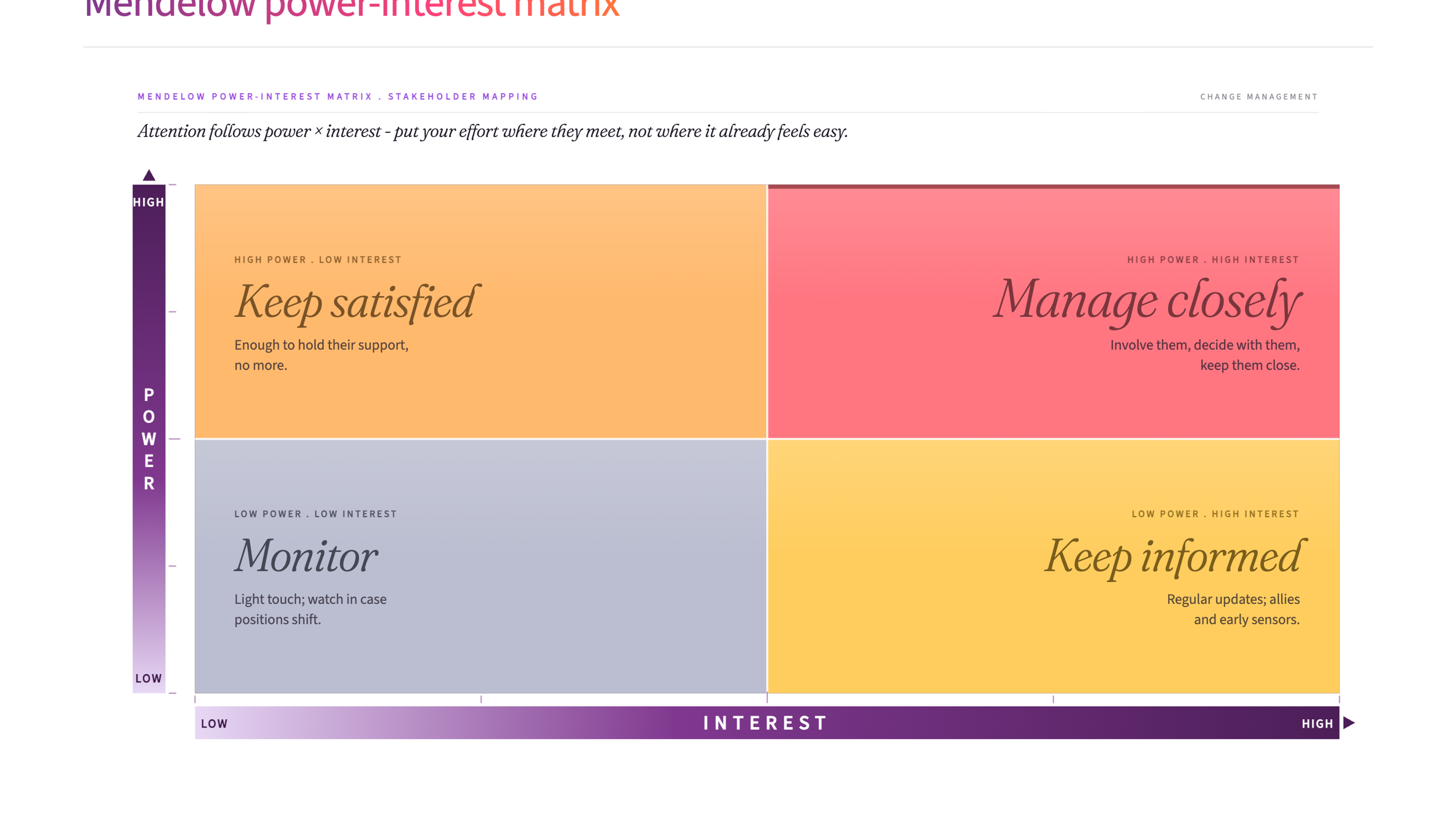
The Mendelow Power-Interest Matrix is a stakeholder mapping tool that helps you work out who matters most during a change or project. It plots stakeholders by their level of power and interest so you can plan how to engage each group.
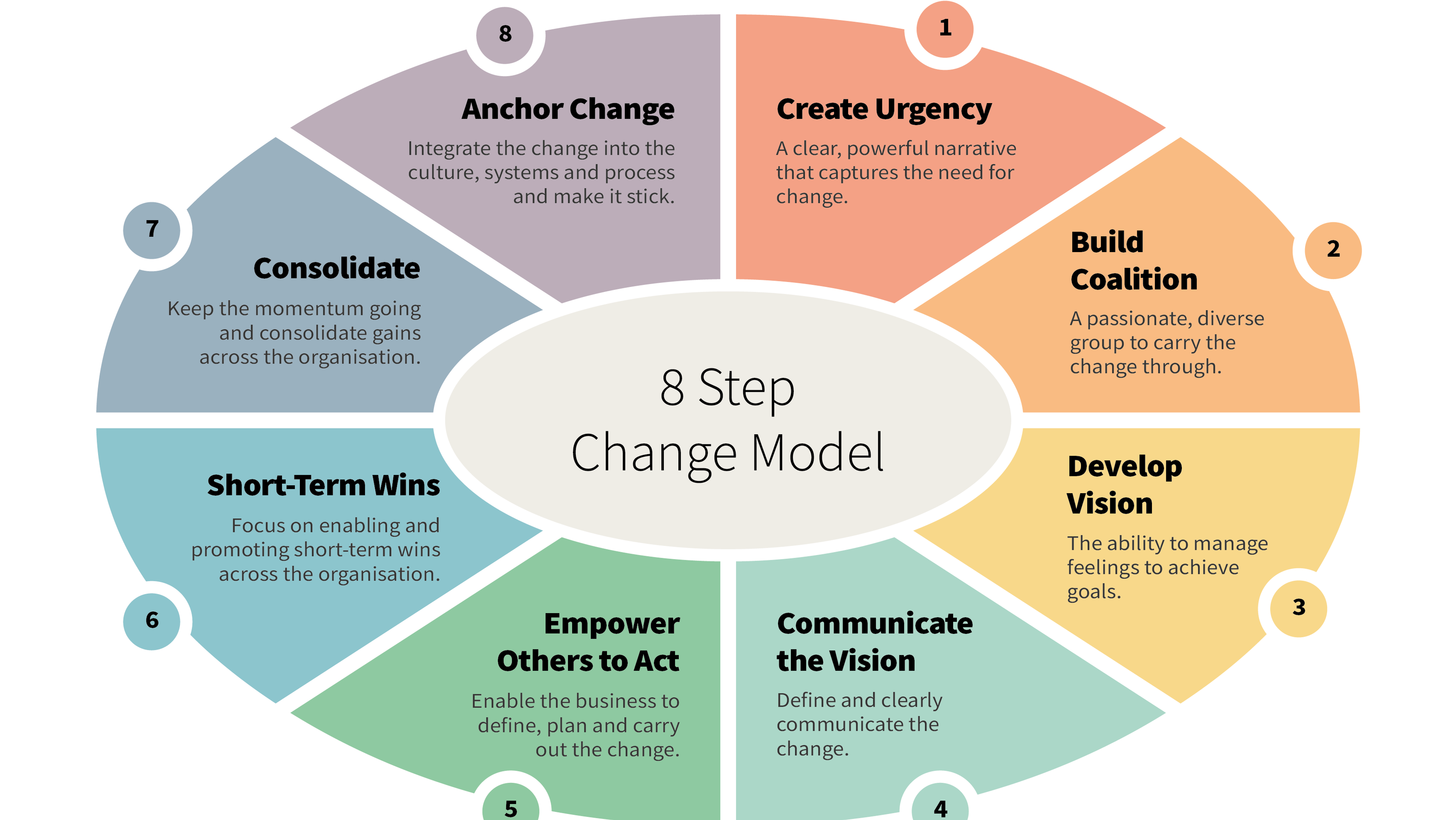
Kotter's 8 Step Change Model is a structured framework for leading organisational change, from building urgency through to embedding new ways of working. It gives leaders a clear sequence to follow when the change is big and the stakes are high.
How to assess whether your organisation is genuinely ready for change - looking at the whole system, not just the surface. Covers what to examine, how to gather honest insight, and how to use what you find to build a change plan that works with your organisation rather than against it.

The traditional approach to building a case for change relies on urgency and burning platforms. But urgency wears off, and fear creates resistance. This article explores a different approach - building a case for change that's rooted in honesty, shared understanding, and a genuine picture of what's possible.
James Freeman-Gray is the founder of Mutomorro. He's an organisational development practitioner who has spent over twenty years working with leaders across public, private and nonprofit sectors - helping organisations pull together around a common purpose, joined up in how they work. More about who we are and what it's like to work with us.
ORCA gives you a structured way to check whether the ground is ready before a change begins. I use it when leadership teams are confident about what they want to change but haven't tested whether the evidence holds up, whether the context is right, or whether the facilitation conditions are in place. The three-dimensional assessment often surfaces gaps that would otherwise only become visible mid-implementation - and by then they're much harder to address.
Last reviewed: June 2026
Ready to use ORCA?
Download the free template - includes practical guidance for workshops and team sessions.
Get the free template
Want to put these ideas into practice?
Whether you're navigating a merger, rethinking how you're structured, or trying to shift a culture that isn't working - underneath, it's the same job: getting the whole organisation pulling in the same direction. Start with a conversation.