Process Mapping - Free Template
A three-page PDF toolkit for mapping and improving how work flows through your organisation. Includes a visual overview of the three-layer mapping approach, a summary card with practical tips and common pitfalls, and a guide to connecting process improvement with broader operational effectiveness work.
Based on our full guide to Process Mapping.
Get this PDF template
Fill in your details and download the PDF straight away.
What's in this Process Mapping template
The toolkit gives you everything you need to start mapping processes with your team.
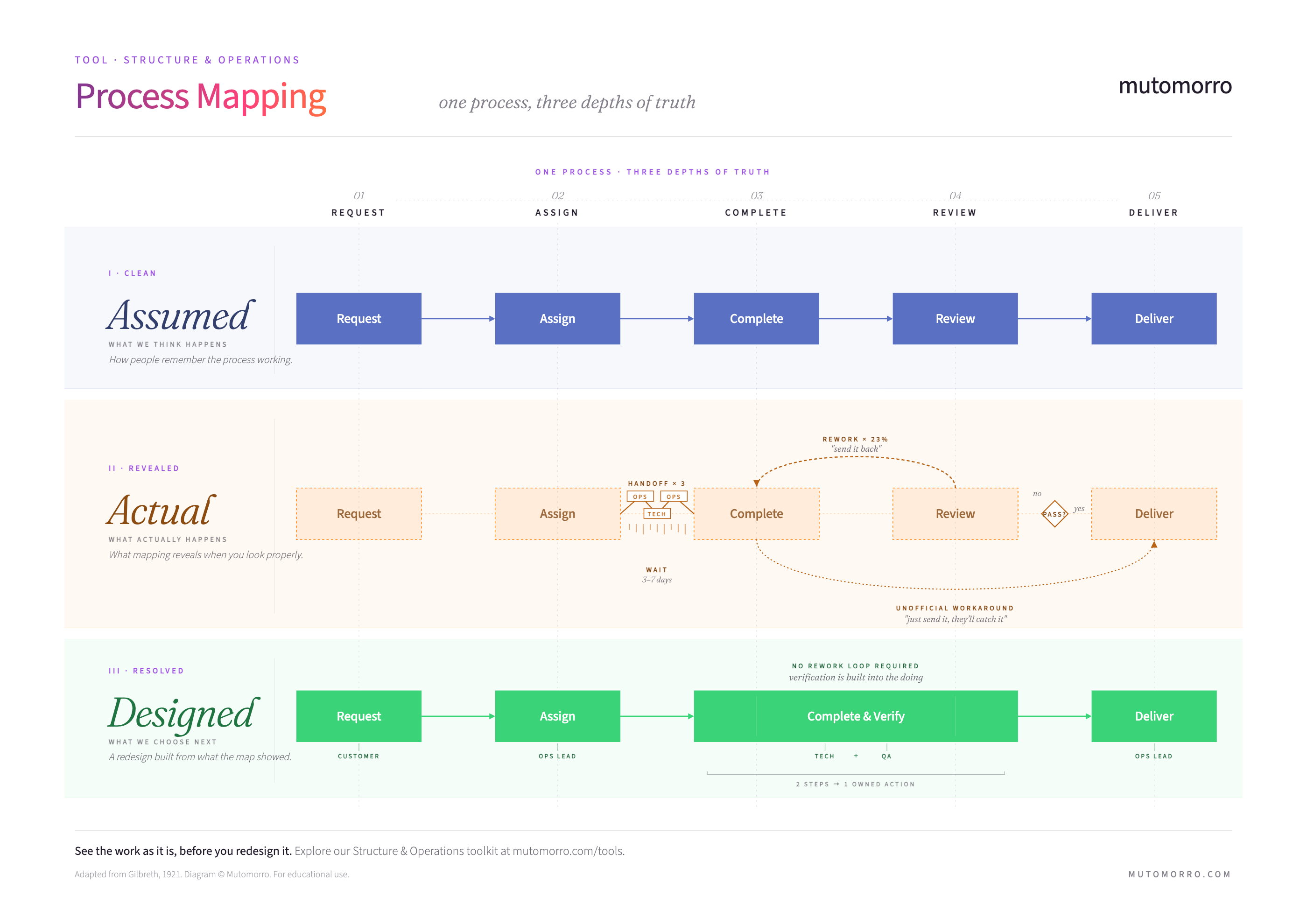
Page 1 is the Process Mapping diagram - a visual overview showing the same process at three depths: the assumed flow (what people believe happens), the actual flow (what mapping reveals), and the designed flow (what you build from what you've learned). Use it as a reference point when facilitating mapping sessions or introducing the approach to your team.
Page 2 is a summary card covering what process mapping is, when to use it, and how to get the most from the three-layer approach. It includes four practical tips for running effective mapping sessions and four common pitfalls to watch for.
Page 3 connects process mapping to Mutomorro's operational effectiveness work - how making processes visible fits within a broader approach to improving how your organisation operates.
Tips for using it
- Start with the assumed flow, not the actual. Getting the team's shared picture on the table first creates a safe baseline. The gaps between assumed and actual are where the insight lives.
- Use real examples, not hypotheticals. Walk through two or three recent instances of the process. "What happened last Tuesday?" reveals more than "what usually happens?"
- Include the people who do the work. The team running the process every day knows about the workarounds, delays, and informal decisions. Without them, you'll map the assumed flow twice.
- Name the owners. One of the most common findings is that nobody owns the process end to end. The designed flow should make ownership explicit at every stage.
Operational Effectiveness
When process mapping reveals patterns that go beyond a single workflow - where the issue is how teams coordinate, how decisions travel, or how the organisation learns from friction - Mutomorro's operational effectiveness work helps you design the conditions where processes flow naturally rather than fighting friction at every turn.

Organisational Alignment During Restructuring
When a global payments company prepared for independence, the challenge wasn't rebranding - it was building organisational coherence across six departments that had never needed to work as one.
Read the case study →