Continuous Improvement
Continuous improvement keeps your new ways of working fit and improving, and builds your own people's ability to run them. Your teams run the improvement cycles and the daily management routines themselves, and you can keep us on a light ongoing rhythm as a critical friend to your improvement work, at a cadence you set.

Continuous improvement keeps your operational ways of working fit and improving, and it works on six things: the improvement cycles your teams run toward the next target for how the work goes, the coaching routine that grows your own improvement coaches, the daily and weekly leader routines that hold the standard, the course-correction loop that catches drift early, the refresh of standard work as conditions change, and a periodic re-measure against your original baseline. Your own people run the practice, and the operational gains keep compounding.
The offer is a blend, scoped with you. The core is building the capability into your organisation: your own coaches, the improvement and coaching cycles, leader routines, and a standing internal network that carries the method. On top of that sits an optional lighter ongoing rhythm, where we return periodically to re-measure against your baseline, health-check the routines, and help you course-correct. Take the capability build and run it alone, keep us on a light rhythm, or do both, and shift that balance as your people take more on.
Toyota's employee suggestion system has run continuously since 1951 and gathers over a million improvement ideas a year, the large majority of them put into practice. It is the working benchmark for continuous improvement owned by an organisation's own people (Toyota Motor Corporation official global website (global.toyota)).
When this helps
Continuous improvement is where you turn to once a change is delivered and you want it to keep paying off. These are the situations we are most often asked into. If one sounds like yours, this is a good place to start.
The situation | How it helps |
|---|---|
You have rolled out new ways of working and want them to last | Puts a live improvement rhythm in place so the standard holds and keeps advancing, rather than settling at the level the rollout reached |
A past improvement effort faded once attention moved elsewhere | Builds the daily management routines and course-correction loop that catch drift early, so gains are held before the next one is added |
You want to own and run the improvement work in-house | Grows your own improvement coaches and leaders and a standing internal network, so the habit is taught and owned inside the organisation |
You want a light critical friend on your improvement work, not another programme | Gives you a periodic rhythm of re-measurement and health-checks at a cadence you set, so support stays proportionate to what you need |
Volumes, tools and demands are shifting and the standard needs to flex | Refreshes your documented ways of working as conditions change, so the standard stays current instead of ageing |
You inherited a delivered way of working that is quietly slipping back | Re-measures where it stands today, restarts the improvement cycles, and hands the practice to your people to run |
What keeping it fit involves
Six things make up the improvement practice, and your own people run each one:

Improvement cycles toward the next target
Your teams run short, structured experiment cycles toward a defined next target for how the work runs, so the ways of working keep advancing past the level the rollout reached.

Coaching that grows your own coaches
Your managers and team leads learn a short coaching routine and run it with their people, so the improvement habit is taught and owned inside the organisation and does not depend on us being in the room.

Leader routines and go-and-see cadence
Daily and weekly leader routines, visual management boards and regular go-and-see visits hold the new standard in place and surface slippage while it is still quick and cheap to correct.

Course-correction on every change
Each adjustment is checked against what you expected it to do and revised from what you learn, so small drifts show up early and the standard keeps getting sharper.

Refresh the standard as conditions shift
Your documented ways of working are updated as volumes, tools and demands change, so the standard stays current and the operational gains compound instead of ageing.

Re-measure against your baseline
On a light periodic rhythm we re-measure your ways of working against the original assessment baseline to show whether they are holding and where to focus next. It references that diagnostic rather than re-running it.

Why these six
These six are what turn a delivered change into a practice that keeps improving itself. The improvement cycles and the coaching routine make the habit teachable and owned, so scientific thinking becomes a daily routine your people run rather than something we bring. The leader routines and the go-and-see cadence hold the standard day to day and surface slippage early. The course-correction loop and the refresh of standard work keep each gain locked in before the next is added, so the standard rises rather than drifts. The periodic re-measure against your baseline tells you whether it is all holding and where to look next.
They follow the established continuous-improvement frameworks, from the improvement and coaching cycles to lean daily management and the internal community of practice that carries the method. We use them to make sure the practice is complete and owned by your people, not to run one branded model at you.
How it works
Continuous improvement produces one thing: a live improvement practice left running in your organisation, owned and run by your own people. It works in four modes.
- We scope how much you hold and how much we hold - We agree the blend with you. The core is building your internal capability so your people sustain and evolve the ways of working themselves. On top sits an optional lighter ongoing rhythm where we re-measure and health-check periodically. You decide the balance, and it shifts over time as your people take more on.
- We build the capability into your people - We grow your own improvement coaches and team leads, set up the improvement and coaching routines, and stand up an internal network that shares what is working across teams. The owner, the routines and the loops all live inside your organisation.
- We set a light rhythm you run - We put in place the daily and weekly leader routines, the course-correction loop and a periodic re-measure against your original baseline, so your people can see whether the standard is holding and act on it without waiting for us.
- We step back, and stay reachable on your terms - Once the practice is running, we hand it fully to your people. We remain available as a critical friend at whatever cadence you choose, whether that is a periodic check-in, an occasional health-check, or nothing at all.
The thinking behind the method
Sustaining operational gains is hard, and most organisations lose them once attention moves on. What holds them is not another programme but a habit run by the organisation's own people, so the deliberate choice here is to build the capability into your teams rather than keep delivering improvement to you. Your coaches run the cycles, your leaders hold the standard through their daily routines, and an internal network keeps the method alive across teams.
The optional ongoing rhythm is there to keep that practice honest, not to make you dependent on it. When we return, we re-measure against your baseline and health-check the routines, then hand the next round of improvement straight back to your people. The aim is a practice that runs and improves without us in the room, with our involvement staying as light as you want it to be.
What you get
By the end, you have four things:

- Ways of working that stay fit and keep improving - the standard from the rollout is held day to day and advances, so the operational gains compound rather than decay.
- Your own people owning and running it - improvement coaches, team leads and an internal network who run the cycles, keep standard work current and solve drift themselves, without external support in the room.
- A light rhythm and the loops in place - leader routines, a course-correction loop and a periodic re-measure against your baseline, so your people can see whether the standard is holding and where to improve next.
- The option of us on call - a critical friend to your improvement work at the cadence you choose, or none at all, scoped with you and never a heavy retainer.
Owned by you, supported by us, as much or as little as you need.
When we step back - and staying on call
This is the last stage in the arc, so it closes the loop. Once the practice is running, we hand it fully to your own coaches and leaders, who own the cycles, the daily routines and the standard from there. We stay reachable as a critical friend at whatever cadence you set, whether that is a periodic re-measure, an occasional health-check, or nothing until you ask.
The periodic re-measure against your baseline is also how you know when a lighter touch is no longer enough. When the world moves far enough that the ways of working need a bigger reset rather than a course-correction, that re-measure points back to the diagnostic, and the four-stage cycle begins again from a fresh read of where you now stand.
Where this sits
Continuous improvement is the final stage in how we approach operational effectiveness. It re-measures against the baseline from the Operational Effectiveness Assessment and sustains the ways of working delivered by the Ways of Working Rollout, keeping the whole four-stage investment fit and improving instead of fading once the programme ends. When a re-measure shows the world has shifted enough to need a bigger reset, it loops back to the diagnostic to start the cycle again. It also stands on its own: if you have a delivered or inherited way of working that is quietly decaying, this is where to bring it.
Common questions
How is this different from the Operational Effectiveness Assessment?
The assessment reads your ways of working from scratch and sets a baseline: what is working, what is getting in the way, and why. Continuous improvement re-measures against that baseline on a light periodic rhythm to show whether the ways of working are holding and where to focus next. It re-measures, it does not re-assess. If you have no baseline yet, the assessment is where to start.
How is this different from the Ways of Working Rollout?
The rollout delivered the change across the organisation as a programme. Continuous improvement sustains and evolves what the rollout put in place, as an ongoing capability plus a light rhythm. It never re-sells delivery. The rollout gets the new ways of working in; this keeps them fit and improving once they are.
Do we have to keep you on retainer?
No. The core of the offer is building your own improvement capability, and you can take that and run it entirely yourselves. The ongoing rhythm is optional, scoped with you, and set to whatever cadence you want. It is never a heavy retainer, and you are never required to keep us on.
What will our own people be able to do?
Your coaches and team leads will run the improvement and coaching cycles, hold the standard through their daily and weekly routines, keep standard work and visual management current, and surface and solve drift themselves. A standing internal network carries the method across teams, so the ways of working keep improving without external support in the room.
Isn't this just continuous improvement we could run ourselves?
Running it yourselves is exactly the point, and building that ability is what the offer delivers. What we add is setting the practice up so it holds: growing your coaches, putting the cycles and daily routines in place, and giving you a baseline to re-measure against so drift shows up early. Many organisations mean to improve continuously and lose it once attention moves on. This makes it a practice your people own rather than a good intention.
How much of this can we run ourselves?
As much as you want. Some clients take the full capability build and run everything in-house, keeping us reachable only if they choose. Others keep a light periodic rhythm going, where we re-measure and health-check and then hand the next round back to them. You set the balance, and it usually shifts toward your people over time as they take more on.
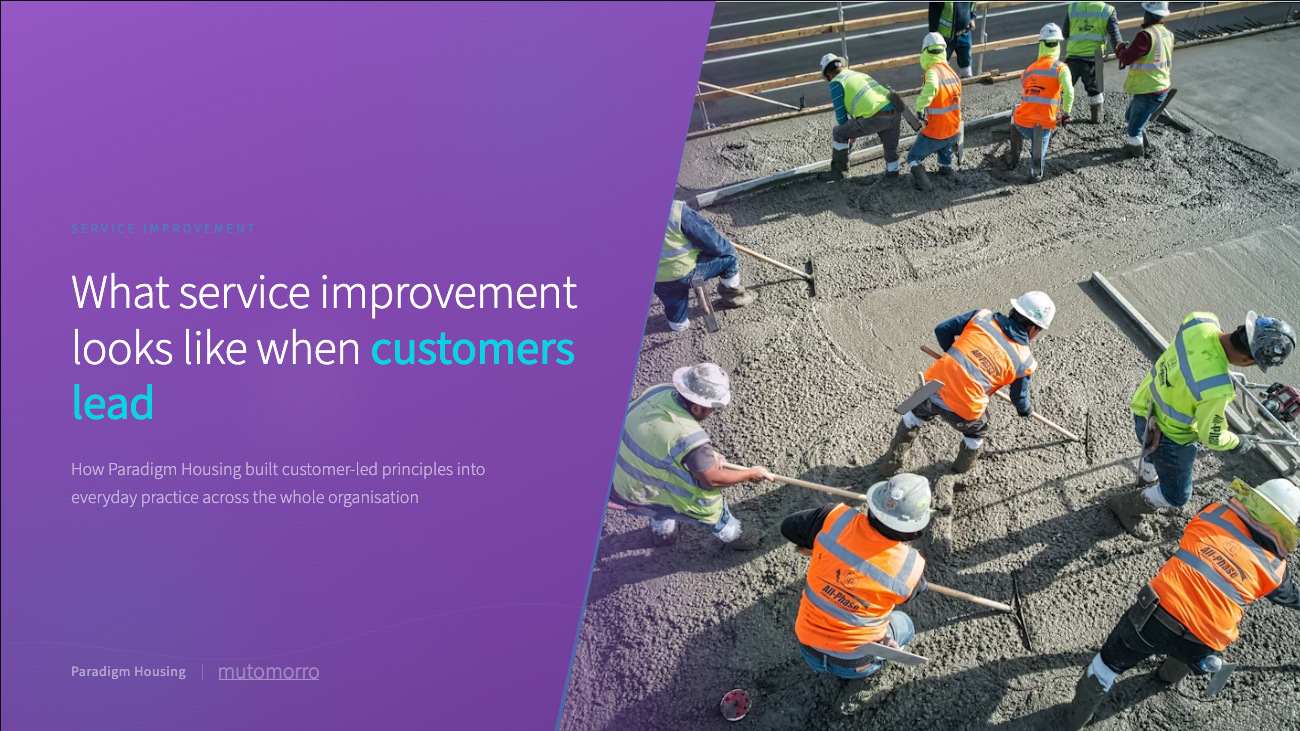
Service improvement led by customers and teams, not handed down by consultants
A growing housing association where staff could recite the values but customers experienced something different - and previous improvement efforts kept addressing symptoms rather than causes. Getting every team working to one standard of service, rather than handing customers between them, was the real job.
Read case study →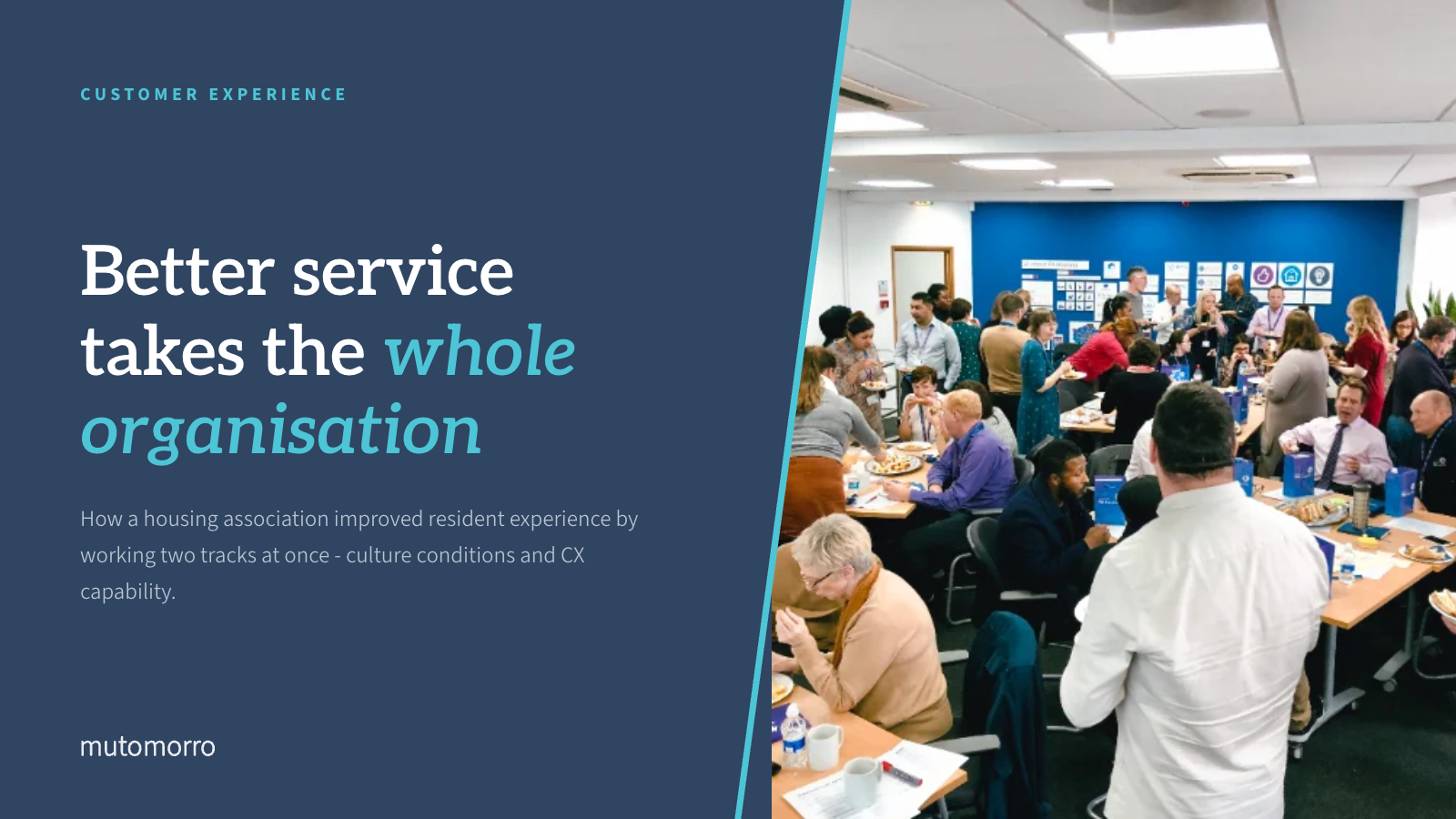
Customer experience shaped by how the whole organisation works, not just the frontline
A housing association with around 9,000 homes had invested in journey mapping, customer profiles and resident research - but the data pointed to something the CX toolkit couldn't fix alone. Culture work without CX capability would produce good intentions and no change. CX capability without the culture shift would produce better-mapped journeys that still fell through the same gaps. They needed both.
Read case study →Most operational improvement focuses on the visible system - processes, workflows, tools. We work with the conditions underneath that determine whether it functions well.
A clear read of how work actually flows from request to done - and where effort leaks between the steps.
Ways of working design gives you a future-state value stream design: a clear picture of how work will flow from request to delivery, with the queues removed, the handoffs redrawn, the decisions assigned and the cadence set - backed by a map of how the work flows today and a plan to get from one to the other. We design it with the people who run the work, so the result is genuinely theirs.
Ways of Working Rollout takes your Ways of Working design and makes it real across the organisation: standardised processes in daily use, clear roles and decision rights, an installed daily and weekly management system, and performance measures every team acts on. It is the programme that gets the new way of working running, team by team, until it holds without us in the room.
Kaizen is a Japanese continuous improvement philosophy built on the idea that small, ongoing changes add up to significant results over time. The Kaizen Cycle gives teams a structured way to identify improvements, test them, and build them into everyday work.
The PDCA Cycle (Plan, Do, Check, Act) is a continuous improvement framework for testing and refining processes. It creates a repeating loop of planning a change, trying it, checking whether it worked, and adjusting before the next round.
DMAIC (Define, Measure, Analyse, Improve, Control) is a structured problem-solving method from the Six Sigma toolkit. It gives teams a clear five-step process for improving existing processes using data and evidence.
The 8 Wastes of Lean give you eight categories for finding where effort, time and resources leak from a process. Use the DOWNTIME acronym to work through each waste type systematically and build a clear picture of what to improve.
A Gemba Walk is a Lean practice where leaders go to the place where work actually happens to observe, listen, and understand. It bridges the gap between how leaders think work gets done and how it really gets done.
The 5 Whys is a simple root-cause analysis technique that drills into problems by asking "why?" repeatedly. It helps teams get past surface-level symptoms to find the real cause of an issue.
Every organisation has friction - the unnecessary effort, the needless complexity, the things that make simple work harder than it should be. This article explores how to find it, understand where it comes from, and reduce it without creating new problems in the process.
Most organisations know they should measure their impact. Fewer know how to do it in a way that's genuinely useful rather than just generating reports. This article explores how to build an impact measurement framework that helps you understand what's working, learn from what isn't, and make better decisions.