
Your culture needs re-energising
Every organisation has times when things feel tired or practice has drifted. We help you revitalise without losing what makes you you.
Usually starts withCulture Assessment
Most people have been through a culture change that arrived as an announcement - new values, a behaviour framework, a change to how performance is judged. We’ve found culture change works better when you start somewhere else.
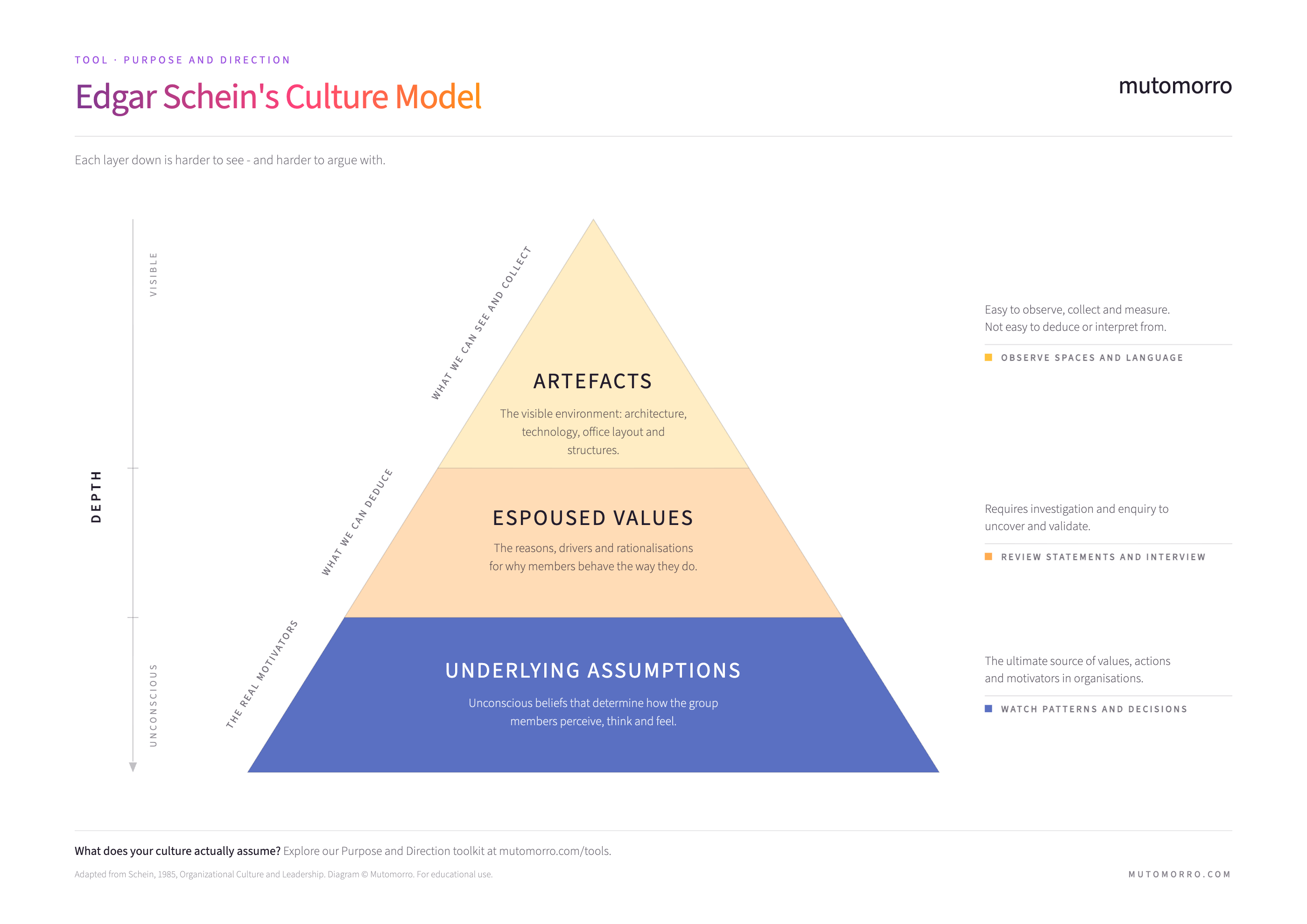
We focus on the areas that encourage unity without imposing uniformity. Common ground the organisation can share, which drives decisions and priorities. Ways of working that make coming together lower effort - handovers, decisions, how services get designed. Environments that encourage the behaviours you want to see, including leaders who visibly work that way themselves.
Making culture practical through a set of guiding questions, principles and shared language - moving beyond abstract values to practical tools. Simple enough to remember, sharp enough to guide work and decisions - so every team can point the same way without being told the route.
Principles only become culture when they change what people do. We help you develop shared habits and practices that create unity without forcing uniformity. Adaptable enough so teams can translate them into their own work - practical enough so they work on a Wednesday morning.
Cultures need the right environments to flourish. What gets rewarded, how decisions travel, what leaders model and what work feels like. We help leaders take the lead in developing environments that amplify their desired culture and make it easy and obvious for staff to engage with.
Select any part of the model to see how it works.
“My team absolutely loved the sessions and returned full of energy and enthusiasm. Since the sessions, there has been an impromptu daily discussion about [the work].”
Whether you’re exploring your current culture or reimagining a new one that sticks, we work with our clients to build practical, sustainable culture change that shifts how work works.
We’ve been supporting clients to reimagine their cultures for over 20 years. Helping them retain what makes them special while resolving the parts that detract from their potential. Below are a few examples…
Every organisation has times when things feel tired or practice has drifted. We help you revitalise without losing what makes you you.
Usually starts withCulture Assessment
As a new leader it’s helpful to get the lay of the land, and build a culture change plan that brings everyone along with you.
Usually starts withCulture Assessment or Target Culture Design
Siloed departments, wasted effort, cross-purposes. We help you bring your organisation together around a common culture and way of working.
Usually starts withTarget Culture Design
Teams that have grown apart, each with their own habits. We help you build a shared container around them, without flattening what makes each one good.
Usually starts withTarget Culture Design or Culture Change Programme
Two histories, two sets of habits, and a merger that only really lands when people start working as one place. We help you build the culture that makes it hold.
Usually starts withPost-Merger Integration
Wherever you are, our focus is the same: creating organisational culture that pulls in the same direction.
Let’s talk about what this could look like for your organisation.















Every organisation is different, so every culture change journey is too. Our culture change consultancy typically moves through four connected areas - understanding where you are now, designing practical changes with your people, making them real, and building your capability to keep developing independently.
These are not rigid stages. Some organisations need all four; others already understand their culture well and want to move straight to designing changes. The areas build on each other, but flex around what you actually need.
Our culture assessments help you build an honest picture of where you are now - the patterns, strengths, and dynamics that shape daily working life. So you can see what's healthy, what's holding you back, and where the real leverage sits. The best insights come from involving the whole organisation, so we make sure everyone has a voice.

What you get
A clear picture of your organisational culture with agreed priorities for where change will have the greatest impact - and genuine shared understanding across your leadership team about what is really going on and where to focus energy.
Culture change works when the people who live with it every day help design it. We run collaborative sessions where your teams work out what needs to shift and shape changes that fit your context - real improvements to how the work happens day to day: how decisions flow, how teams share what they know, how purpose connects to the work. The best ideas come from your people, so our job is to bring the structure and facilitation that draw them out.

What you get
Practical, context-specific changes designed by the people who will make them work - with genuine ownership rather than top-down imposition.
Good ideas don't change organisations - new habits do. This is where most culture change stalls: it designs well, then struggles to get from plan to practice. We stay alongside your teams as the changes go live, giving support, challenge and a steady hand when it gets complicated - helping you work through resistance, adjust course and keep momentum. Lots of small shifts across the organisation make change last in a way a big, one-off programme rarely does.

What you get
Change that becomes part of daily reality, not a slide in a strategy document.
Our goal is to make ourselves unnecessary. Lasting culture change means your organisation can keep developing it on its own, without consultants to keep things on track. So we build your leaders' and teams' ability to read what's happening in your culture and keep shaping it on your own terms - growing the internal facilitation skills and the regular habits that keep culture developing long after we've gone.

What you get
The capability to keep developing your own culture - growing stronger over time, led by your own people.
Collaborative, not imposed
Solutions come from your people's knowledge. We bring the structure and facilitation.
Systemic, not symptomatic
We work with the conditions that create culture, not the surface-level symptoms.
Embedded, not delivered
We work alongside your teams over months, not in a boardroom for a week.
Built to last, not to depend
Every stage transfers capability. You keep going without us.
Our culture change consultancy aims at one outcome: everyone pulling together - unity, not uniformity. It works with the conditions that shape how your organisation functions - not a programme run alongside the work, but a change to the environment culture grows from.
It works like climate - you can't change the weather by talking about it, but you can change the conditions that create it.
Trying to change everything at once is how change stalls. We find the few conditions where one shift moves several others.
The environment starts to support the new way of working - and because you understand the conditions, you keep developing them long after we've gone.
Our approach to culture change grows from something broader: a conviction that organisations work more like living systems than machines. Culture isn't a thing you install or a set of values you announce - it emerges from how the whole organisation works, the patterns people fall into when no one's watching. Change the patterns and the culture follows.
It's a way of seeing, and it shapes how we approach culture change - not as an isolated fix, but as something shaped by the whole organisation, and shaping it in turn. Our philosophy page is where the fuller picture comes together.
Most culture change programmes focus on the visible layer - values statements, engagement campaigns, leadership messaging. These aren't wrong, but they're working on the surface while leaving the underlying conditions untouched. If decisions still get made the same way, if knowledge still doesn't flow between teams, if recognition still rewards individual performance over collaboration - the underlying patterns will reassert themselves once the programme energy fades.
Lasting culture change happens when you work with the conditions that create culture, not with culture itself. That means redesigning how your organisation actually functions - practically, specifically, and with the people who live with it every day. If you're focused specifically on how people experience the organisation day to day, our employee experience consultancy works with those conditions directly.
It depends on the scope, the starting point, and how much is genuinely ready to shift. A typical engagement runs between 6 and 18 months, with visible shifts in patterns and practices within the first few months and deeper systemic changes embedding over the longer term.
We're honest about this: meaningful change isn't quick, and anyone promising a culture transformation in 90 days is selling something different from what we offer. What we can do is help you see progress early - identifying quick wins alongside deeper structural work so momentum builds from the start.
We track change at three levels. First, leading indicators - are the practical conditions shifting? Are decisions being made at a different level? Is knowledge flowing across teams that previously worked in silos? These are concrete and observable within weeks.
Second, we use our ecosystem health diagnostic to take periodic readings across the eight dimensions of organisational health, showing where conditions have shifted and where they haven't yet. Third, we watch for emergent signals - the things nobody designed but which show the culture is genuinely different. Teams requesting their own learning sessions. People solving problems across boundaries without being asked. These are the signals that tell you something real has changed.
This is the question we think about more than any other. From day one, every stage of our work includes capability transfer - we're building your organisation's ability to read its own patterns, design its own interventions, and sustain its own cultural health. By the time we step back, internal facilitators are trained, diagnostic tools are handed over, and the practices are running without us.
We also plan a light-touch review several months after handover to check what's sustained, what's evolved, and whether anything needs attention. The honest answer is that well-embedded change does sustain - because you've changed the conditions, not just the conversation. If you want to take this further and build a continuous practice of reading and adjusting those conditions, that's where our organisational development consultancy picks up.
Yes. Our strongest track record is in social housing, charities, and public sector organisations - these are sectors where culture work is driven by genuine purpose rather than just performance targets. But the patterns we work with are remarkably consistent across sectors. How decisions get made, how trust builds, how knowledge flows - these dynamics play out in every organisation, regardless of industry.
What matters more than sector is fit. We work best with leaders who have a genuine ambition to create something better for their people and their communities, and who want to build lasting capability rather than buy a short-term fix. If building your collective capability is the primary need - not an add-on to culture change work - our capacity building service focuses on creating the conditions for regenerative growth.
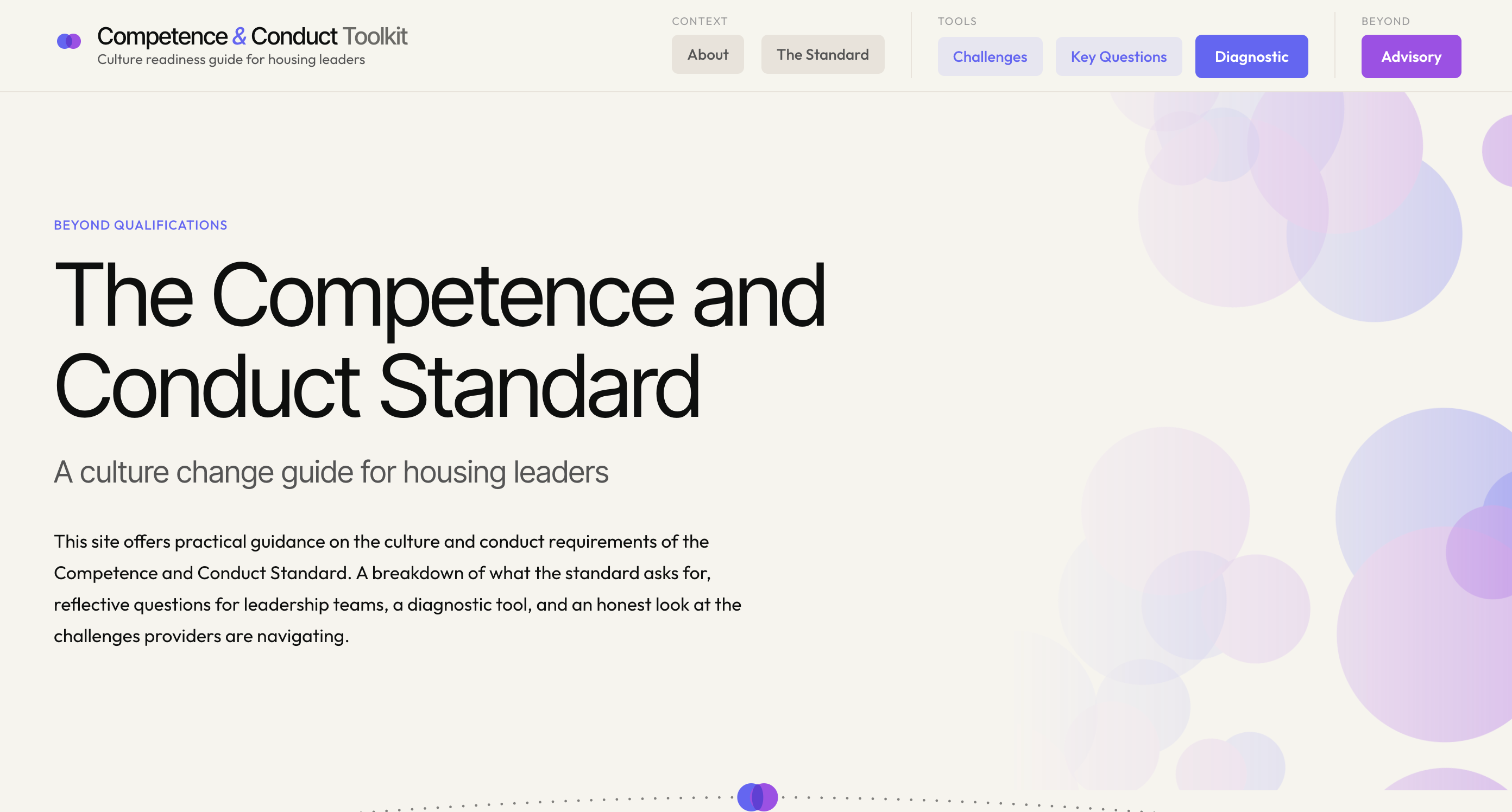
The Competence and Conduct Standard applies from October 2026. The qualification requirements are well documented elsewhere. The culture and behaviour side - how your organisation evidences conduct, gives residents real influence, and shows that training leads to better outcomes - is the harder leadership work.
We built a free toolkit for housing leadership teams preparing for this side of the standard. It includes a breakdown of the culture requirements, six practical challenges providers are working through, reflective questions for leadership teams, and a diagnostic you can complete in five minutes.
Most of what stops a good plan is not the plan. It is the join between it and the organisation - who decides what, how work moves between teams, what people believe is really being asked of them. That is the part we work on, and it is what makes a change hold once we have gone.
Every organisation is different, so we always start with a conversation. No pitch, no obligation - just an honest discussion about where you are and whether our approach feels right.