Customer-Led Improvement
Customer-Led Improvement keeps your delivered customer journey fit and improving, driven by what customers are telling you. It builds your own team's ability to run the closed loop: capture the signals, close the loop with each customer, and fix the root causes at source. You can keep us on a light ongoing rhythm at the cadence you choose, or run it all yourselves.

Customer-Led Improvement keeps your delivered customer journey fit and improving, and we keep seven things running: closing the loop with each customer who signals, fixing the root causes behind recurring signals, reading the journey against the moments the design set out to improve, a live feed of customer voice across the touchpoints that matter, a standing huddle that turns signals into owned fixes, a refresh of the journey as customer expectations move, and the handover that leaves the loop running in your team's hands. What you get is an experience that reads its own signals and keeps improving on this month's evidence.
The core of the work is building this capability into your own people, so your team runs the closed loop without us. Alongside that, you can keep us on a light ongoing rhythm, where we return on a set cadence to re-measure against the baseline, health-check the loop and help course-correct. Take the capability build and run it alone, keep us on the light rhythm, or both, and shift that balance as your people take more on.
Leading Net Promoter organisations, including Charles Schwab and Apple's retail division, work to contact every customer who gives a negative rating within 24 hours. Closing the loop that fast is a discipline your own team can run (Bain & Company, netpromotersystem.com).
When this helps
Customer-Led Improvement is where a delivered customer journey goes to stay fit. These are the situations we are most often asked into. If one sounds like yours, this is a good place to start.
The situation | How it helps |
|---|---|
You have rolled out a new customer journey and want it to keep improving | Puts a running closed loop around the delivered journey, so customer signals drive steady improvement instead of the design settling and slowly ageing |
A past customer-experience push faded once attention moved elsewhere | Builds the loop and the owners that keep improvement running, so listening becomes change on a standing rhythm rather than a burst that fades |
You want your own team to own the customer loop, not depend on us | Builds the capability into your people, so they capture signals, close the loop with customers and route root causes themselves |
You want a light critical friend on the loop, not another big programme | Keeps us on a set cadence to re-measure and course-correct, while your team runs the day-to-day loop |
Customer expectations and channels are shifting and the journey needs to flex | Refreshes the journey blueprint as segments, channels and expectations move, so the experience keeps pace with the market |
You have inherited a customer journey that is quietly slipping | Re-measures the journey against its baseline, finds where it is drifting, and puts a running loop around it to bring it back and keep it fit |
What keeping the journey fit involves
We keep seven things running, and build each one so your team can run it:

Close the loop with every customer
Resolve an individual customer's signal quickly, then follow up so they know they were heard. This keeps trust warm one relationship at a time and gives your people a direct line to the customers they serve.

Fix the root cause, not just the case
Route recurring signals to the teams who own the product, process or policy behind them, so the same complaint stops being generated. This turns feedback into structural improvement rather than a run of one-off fixes.

Read the journey against its target moments
Track NPS, CSAT, CES and journey KPIs at the moments the design set out to improve. You see in the numbers whether the experience is holding or slipping before customers vote with their spending.

Keep a live feed of customer voice
Capture signals continuously across the touchpoints that matter, from surveys to service contacts to behaviour. Improvement then runs on this month's evidence rather than last year's map.

Turn signals into action in a standing huddle
Run a regular huddle where the team reviews live signals, prioritises fixes and assigns owners. Listening reliably becomes change, and nothing sits unactioned.

Refresh the journey as expectations move
Update the journey blueprint when new segments, channels or customer expectations emerge. The design keeps pace with the market rather than ageing in place.

Hand the loop to your team
Build your people's ability to run the whole rhythm themselves. We stay available on a light cadence to re-measure against the baseline and give a second read when you want one.

Why these seven
These seven are the parts that keep a customer journey improving on its own. The inner loop closes with each customer so trust stays warm; the outer loop fixes the root causes so the same signals stop being generated. Reading the journey against its target moments tells you whether the experience is holding, and the live feed keeps that reading current. The huddle is what turns all of it into action, and the refresh keeps the journey matched to how customers are changing.
They follow the established closed-loop and Voice-of-the-Customer frameworks, so the loop covers listening, individual resolution, systemic fixes and the metrics that tell you it is working. This is customer-facing work: it closes the loop with your customers, not with the frontline running the service. We use the frameworks to keep the loop complete, not to run a model at you.
How it works
The work produces one thing: your own team running the closed loop that keeps the customer journey improving. It works by building that capability into your people rather than running the loop for them. We scope how much you hold and how much we hold, and that balance can shift as your team takes more on. It works in four modes.
- We scope how much you hold and how much we hold - We agree the split up front. The core is building the loop into your people; the optional half is a lighter ongoing rhythm where we return on a set cadence. You decide the balance, and it can shift over time as your team takes more on.
- We build the loop into your people - We set the owner, the improvement huddle and the routines that run the loop day to day. Your team learns to capture signals, close the loop with customers, spot recurring themes and route root causes, so the engine is theirs to run.
- We set a light rhythm you run - We put a standing cadence in place: regular huddles on live signals, and a periodic health-check that re-measures NPS, CSAT, CES and journey KPIs against the baseline the audit and design set. You run it, and it shows you early where the journey is drifting.
- We step back, and stay reachable on your terms - Once your team is running the loop, we step out of the day to day. You can bring us back on a set cadence to re-measure and course-correct, or call us only when a bigger question comes up. The level of contact is yours to set.
The thinking behind the method
We build the loop into your people rather than run it for you because a customer-experience programme that depends on outsiders fades the moment they leave. The rollout delivered the journey; what keeps it improving is a running discipline that captures signals, closes the loop and fixes root causes week after week. That only lasts if your own people own it.
So the deliverable is a capability, not a report. Your team holds the listening feed, the metrics, the huddle and the prioritisation. We bring the outside pattern and the frameworks that keep the loop complete, and we can stay on a light cadence as a second read. But the engine runs on your people, which is what makes the improvement durable rather than borrowed.
What you get
By the end, you have four things:

- A customer journey that stays fit and keeps improving - driven by real customer signals, closing the loop and fixing root causes at source rather than settling once the rollout ends.
- Your own team running the loop - the owner, the huddle and the routines to capture signals, resolve them and route root causes, all held by your people rather than us.
- A light rhythm and the feedback loops in place - a standing cadence that re-measures against the baseline and turns customer voice into owned, prioritised fixes.
- Us on call at the cadence you choose - a second read on a set rhythm for the periodic re-measure and course-correction, as much or as little as you need.
The loop is owned and run by your people, and supported by us on the cadence you choose - as much or as little as you need.
When we step back - and staying on call
This is the final stage of the work, so we hand the loop fully to your people. By this point your team is already running it, capturing signals, closing the loop with customers, fixing root causes and reading the journey against its baseline, so stepping back confirms something they already do rather than dropping it on them cold.
From there you set the contact. Some teams run the loop entirely alone; others keep us on a light cadence for the periodic re-measure and a second read on where the journey is drifting. And when customer expectations or the market move enough that the journey needs more than a refresh, the re-measurement loops back to the Customer Experience Audit to diagnose the shape afresh and start the cycle again.
Where this sits
Customer-Led Improvement is the final stage of how we approach customer experience. It sustains the journey delivered by the Customer Journey Rollout, and it re-measures against the baseline set by the Customer Experience Audit. It keeps the whole four-stage investment fit, and when a bigger reset is needed it loops back to the audit to re-diagnose and begin the cycle again. It also stands on its own: if you have a delivered or inherited customer journey that is quietly decaying, you can bring it here to be re-measured, closed-loop and set improving again.
Common questions
How is this different from the Customer Experience Audit?
The audit assesses your customer experience from scratch and sets a baseline: the NPS, CSAT, CES and journey KPIs to improve against. Customer-Led Improvement re-measures against that baseline on a light cadence to see whether the journey is holding and to catch drift early. It is a re-measure, not a fresh assessment. If the market has moved enough that a full reassessment is warranted, that is when the loop hands back to the audit.
How is this different from the Customer Journey Rollout?
The rollout delivered the redesigned journey across the organisation as a programme. Customer-Led Improvement sustains and evolves what the rollout delivered. It does not re-deliver the change; it puts a running closed loop around it so the journey keeps improving on current customer evidence and your own team owns it.
Do we have to keep you on retainer?
No. The core of the work is building the loop into your people so they run it themselves. The ongoing rhythm with us is optional and scoped with you: a light cadence for the periodic re-measure and course-correction, not a heavy retainer. Take the capability build and run alone, keep us on a light rhythm, or both, and change the balance whenever you want.
What will our own people be able to do?
Run the whole closed loop without us. Your CX team captures customer signals across touchpoints, resolves them at the individual level and follows up, spots the recurring themes, routes root causes to the teams who own the fix, and reads journey KPIs against the design's baseline. They own the listening feed, the metrics, the huddle and the prioritisation, which is the running engine rather than a report.
Isn't this just sending out more customer surveys?
No. Surveys are one source of signal, and on their own they gather feedback that no one acts on. Customer-Led Improvement is the closed loop around the signal: it resolves each customer's issue and follows up, routes recurring themes to root-cause fixes, and reviews it all in a standing huddle with owners and deadlines. Listening is only the start; the value is in reliably turning it into change.
How much of this can we run ourselves?
All of it, and that is the aim. We build the loop so your team owns the listening feed, the metrics, the huddle and the root-cause routing. Most clients run the day-to-day loop themselves from early on and keep us only for the periodic re-measure. How much you hold is your call, and it usually grows as your people take more on.
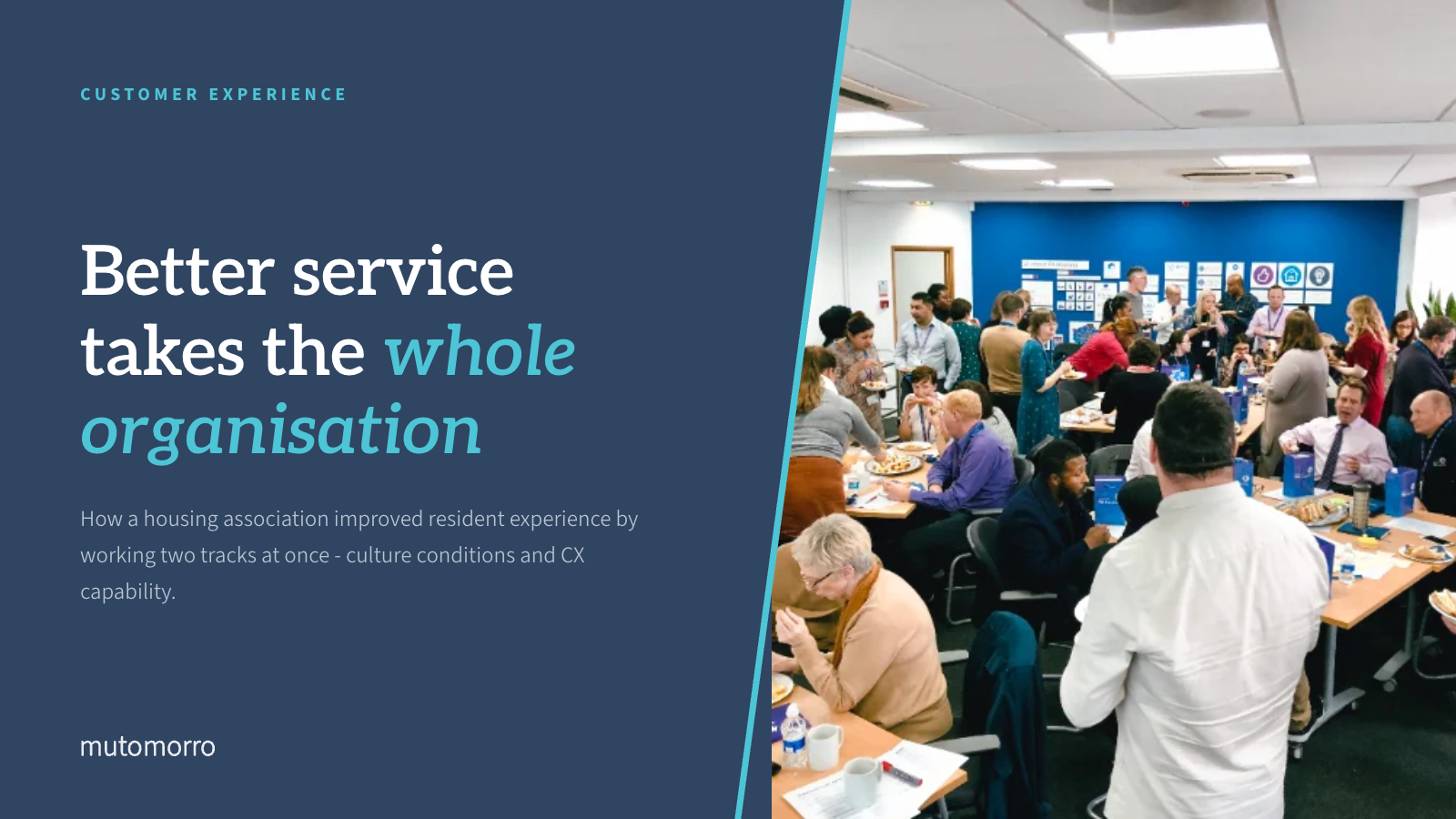
Touchpoint work only goes so far. We help you understand the experience people have on the outside - and shape the internal conditions that produce it. The connection between the two is where the real leverage is.
Most operational improvement focuses on the visible system - processes, workflows, tools. We work with the conditions underneath that determine whether it functions well.
Most service design stops at user research and journey maps. We work both sides - designing the service and shaping the organisational conditions that determine whether it actually gets delivered.
The PDCA Cycle (Plan, Do, Check, Act) is a continuous improvement framework for testing and refining processes. It creates a repeating loop of planning a change, trying it, checking whether it worked, and adjusting before the next round.
Kaizen is a Japanese continuous improvement philosophy built on the idea that small, ongoing changes add up to significant results over time. The Kaizen Cycle gives teams a structured way to identify improvements, test them, and build them into everyday work.
A Gemba Walk is a Lean practice where leaders go to the place where work actually happens to observe, listen, and understand. It bridges the gap between how leaders think work gets done and how it really gets done.
Contextual inquiry is a user research method where you observe and interview people in their actual work environment while they perform real tasks. It uncovers insights about real behaviour and needs that surveys and interviews in meeting rooms simply can't reach.
An empathy map is a collaborative visualisation tool that captures what we know about a user's behaviours, thoughts, feelings, and motivations, helping teams develop deeper understanding and more human-centred solutions.
Every organisation has friction - the unnecessary effort, the needless complexity, the things that make simple work harder than it should be. This article explores how to find it, understand where it comes from, and reduce it without creating new problems in the process.
The skills that make someone good at service design - empathy, experience mapping, designing conditions - are the same skills leaders need to create environments where people do their best work. What changes when that lens runs all the way through the organisation.