Continuous Improvement Training
Getting better shouldn’t depend on a big transformation programme. We help your teams build the habit of improving the work as they go - practical training, built around your real processes.

Why continuous improvement training matters
Your organisation solves problems. The more useful question is whether it gets better. Solving problems is reactive - something goes wrong, you fix it, you move on. Getting better is the habit of looking for what could work before it breaks, and building that into how the team works every day.
That habit doesn’t arrive with a transformation initiative and a deadline. It’s built in the ordinary run of the week - noticing what’s slow, testing a change, keeping what works. This training gives your teams the tools to spot the opportunities, the methods to act on them, and a light rhythm that keeps improvement going without piling on bureaucracy.
How our continuous improvement training works
Every course here runs the same way - in-house, shaped to you, built around your real work.
In-house, for your group. In person at your place or online. We don’t run open courses with seats to fill; we bring the training to you.
Shaped before we arrive. Every course starts with a conversation: which process or workflow, who’s involved, what’s already been tried? The day your people get works on your actual challenges - not a textbook scenario from a factory none of you have set foot in.
Built for the people doing the work. Operations, service and project teams, team leaders and improvement leads - the people closest to where the work actually flows. These courses work best when people from across the same process or workflow attend together, because the biggest improvements often sit at the boundaries between teams.
The courses
Continuous improvement
Your organisation solves problems - but does it get better? This practical day teaches your team to build the habit of improving as they go: not a one-off programme with a deadline, but a way of working where noticing what could be better, and doing something about it, is just normal. You’ll learn the core principles and tools, apply them to real challenges from your own team, and leave with a plan for making improvement part of the week. It’s for teams who want to get better at getting better - operations, service and project teams, and the team leaders whose habits set the tone.
What you’ll work on
The day is built around learning by doing - real challenges from your own team, worked through with proven improvement approaches. Three areas structure it.
Seeing improvement opportunities. The first skill is noticing. What could work better? Where’s effort being wasted? What frustrates your team or the people you serve? You’ll learn simple techniques for surfacing opportunities - team retrospectives, process observation, customer feedback - so spotting them becomes a daily habit rather than a special event.
Using improvement tools. There are well-tested tools for turning observations into action. You’ll use the Kaizen cycle for small, rapid improvements, PDCA for testing a change before you scale it, and DMAIC for larger, data-driven problems - each applied to a real issue during the day, not taught as an abstract framework.
Building improvement into your rhythm. One improvement is good; a team that improves continuously is a different thing altogether. You’ll design a practical rhythm - regular check-ins, an improvement board, a learning review - that keeps it going week after week without adding bureaucracy. The best continuous improvement is lightweight and energising, not heavy.
How the day works
Short input on improvement principles, hands-on exercises where you apply them, and reflection on what’s working. You’ll work in small groups, sharing challenges and solutions with other teams. The facilitator brings a range of recognised improvement approaches, adapted to fit your context.
What you’ll take away
Practical improvement tools you can use straight away. A completed improvement project on a real challenge from your team. A plan for building improvement into your team’s regular rhythm. And a shared language that makes improvement feel like a natural part of the work, not something extra on top.
What makes this different
A lot of continuous improvement training comes from a manufacturing background and can feel like it belongs in a factory rather than an office, a school or a public service. This is designed for any organisation - the principles are universal, the examples and exercises are tailored to your world, and the language is plain throughout. We also connect improvement to the bigger picture: it isn’t only about fixing processes, it’s about becoming an organisation that keeps getting better as a way of working - and when that becomes part of the culture, the benefits compound.
Lean process design
Processes grow over time. What started simple collects extra steps, approvals and handoffs - each added for a good reason once, but together they make everything slower than it needs to be. This hands-on day teaches your team to strip a process back: remove the steps that don’t add value, simplify the ones that do, and design something that flows. You’ll take a real process from your organisation and redesign it using lean principles. No prior knowledge of lean needed - the principles are straightforward and the day is practical. It works best when people from across a process attend together.
What you’ll work on
You’ll spend the day on a real process that matters to your organisation, applying lean thinking to something you deal with every day. Three core areas.
Understanding value. Lean starts with a simple question: what does the person at the end of this process actually need? Every step that helps deliver that is value; everything else is waste. You’ll learn to look at your process through that lens - often surprisingly different from how it feels in the middle of it.
Spotting waste. Lean names specific types of waste that slow things down - waiting, rework, unnecessary movement, overprocessing and more. The 8 wastes of lean give you a framework for spotting them, and once you start seeing them you can’t unsee them. You’ll also look past the obvious symptoms to the patterns that create the waste in the first place.
Designing leaner processes. With waste identified, you’ll redesign the process to be simpler, faster and easier to follow - reducing batch sizes, shortening handoff chains, creating flow. The goal isn’t perfection on paper; it’s a realistic improved design your team can start using. A Gemba walk - going to where the work actually happens to watch it firsthand - is one of the most useful ways to ground the redesign in reality.
How the day works
Hands-on throughout. Short input on lean principles alternates with practical exercises applying them to your chosen process. You’ll work in small groups, learning from each other’s processes. We draw on recognised lean approaches - including the Kaizen cycle and value stream thinking - but adapt them to your context rather than following a rigid methodology. The goal is understanding, not certification.
What you’ll take away
A redesigned version of a real process, stripped of waste and ready to test. A practical understanding of lean principles you can apply to any process going forward. And the confidence to run lean improvement exercises with your own teams.
What makes this different
A lot of lean training leans on manufacturing examples and technical jargon. This is designed for any organisation - public sector, charity, corporate - in plain language; the principles are the same, the application is yours. We also take a systems view: a lean improvement that fixes one process without looking at how it connects to everything else can create problems elsewhere, so we help you see the wider picture and make improvements that hold across the whole system, not just in one corner.
Workflow optimisation
Work isn’t flowing the way it should. Things take too long, people chase approvals that shouldn’t be needed, information gets stuck between teams - everyone’s busy, but the output doesn’t match the effort going in. These are workflow problems, and they’re among the most common frustrations in any organisation. The good news is that most are fixable once you can see them clearly. This practical day teaches your team to find and fix them systematically: you’ll analyse a real workflow from your organisation, work out what’s slowing it down, and design specific improvements. It’s for the people responsible for how work flows - operations and service managers, team and project leaders, improvement leads - and works especially well when people from different parts of the same workflow attend together, because the biggest gains often sit at the boundaries.
What you’ll work on
You’ll work on a real workflow that’s causing problems - not a textbook scenario, something that matters to your team. Three practical challenges structure the day.
Diagnosing the bottlenecks. Most workflow problems have a small number of root causes creating a lot of friction. You’ll find the bottlenecks - the points where work piles up, slows down or gets stuck - by mapping the workflow as it actually operates (not how it’s documented) and using simple analytical techniques to spot the real constraints. Process mapping is the core tool here.
Understanding the causes. Bottlenecks exist for reasons - a capacity problem, a handoff problem, an approval step that made sense five years ago and no longer does. You’ll learn to dig into why a workflow breaks down, not just where, because the fix depends on the cause.
Designing improvements. With a clear diagnosis, you’ll redesign the workflow to remove bottlenecks, reduce friction and create smoother flow - simplifying approvals, improving handoffs, cutting waiting time, balancing workload. The improvements you design will be specific, practical and ready to test.
How the day works
Built around practical exercises. Short input on workflow analysis leads into hands-on work on your real workflow, with group discussion to share insights and challenge assumptions. You’ll work in small teams throughout. We bring together approaches from lean thinking, process mapping and systems analysis, choosing the right technique for each situation rather than following a single methodology. If process mapping is the skill your team most needs, our process mapping workshop goes deeper on it.
What you’ll take away
A clear diagnosis of what’s slowing your workflow down. A redesigned workflow with specific improvements. A plan for testing them. And practical skills for analysing and improving workflows that you can use again and again.
What makes this different
A lot of workflow improvement focuses on the workflow itself - the steps, the sequence, the timing. That matters, but it isn’t the whole picture: workflows sit inside an organisational system - how teams are structured, how decisions get made, how information moves between departments - and all of that shapes how work flows. We help you see and address the wider patterns, not just the immediate steps.
The improvement methods behind it - we use them all, tied to none
Continuous improvement has a deep toolkit - Kaizen, PDCA, DMAIC, the 8 wastes of lean, value stream thinking, Gemba walks. We use all of them, and publish free guides to each, because the useful question isn’t ‘which method is best?’ but ‘which one fits this problem, in this team, in this organisation?’
That’s what the fluency is for. We’re tied to no single methodology, so we can shape the training around your work rather than around a framework - and that same judgement is what your people build. The aim is understanding, not certification: you leave able to use the tools where you work, not with a badge that says you sat the course.
The guides are among the most-visited pages on this site. The training is where that thinking gets applied to your processes.
Bespoke continuous improvement training
The observation. The same course lands differently in different organisations - because the work is different, the pressures are different, and what’s already been tried is different.
What we do about it. So we design around your context. Before any course runs, we learn your processes, your workflows and your language, and shape the day to fit them. The methods stay; the work they’re applied to is yours.
What that makes possible. People who don’t just know the methods, but can use them where they work - on the real processes and workflows in front of them, in the organisation they’re actually in.
And if none of these courses is quite the shape you need, we design from scratch - that’s bespoke training.
Part of a bigger picture
Training is one part of how we work with organisations on improvement - and it connects to a bigger idea. How well work flows isn’t only down to the process; it’s shaped by how the organisation is set up - where decisions get made, how teams are structured, how much room people have to change the way they work. Training builds your people’s skill to improve the work in front of them; the conditions around them decide how far that skill can reach. That thinking runs through everything we do - there’s more on it in our philosophy.
And if what you need is partners in the work itself, not just the capability to do it, our operational effectiveness consultancy works alongside teams to improve how the whole organisation delivers.
Continuous improvement training FAQs
How is the course shaped to our organisation?
Every course starts with a conversation about your work - which process or workflow, who’s involved, what’s already been tried. We adapt the examples, exercises and emphasis so the day works on your actual challenges rather than a generic one. The methods are the ones described on this page; the work they’re applied to is yours.
Who delivers it, and where?
In person at your offices or a venue you choose, anywhere in the UK - or fully online, wherever your people are. The practitioner who shaped the course with you is the one who delivers it.
What group size works?
These courses run best with small groups, and especially well when people from across the same process or workflow are in the room together. Tell us your group and we’ll advise; if it’s larger, we can usually adapt the format or run more than one cohort.
Do participants get a certificate?
The aim here is understanding, not certification - your people leave able to run an improvement cycle, strip waste from a process or unblock a workflow, not with letters after their name. If formal certification is what you need, an accredited provider is the right route.
Can you combine courses into a programme?
Yes - and they’re built to connect. A common pattern runs them in sequence: continuous improvement to build the habit, lean process design to strip a key process back, then workflow optimisation to fix how work flows between teams - one consistent thread across all three. We’ll help you work out which combination fits. And if mapping a single process end to end is where you want to start, our process mapping workshop does exactly that - a focused day on one real process.
What if we want help with the work itself, not just training?
That’s our operational effectiveness consultancy - working alongside your teams to improve how the organisation delivers, rather than building your people’s capability to do it. Plenty of organisations use both: consultancy for the heavy lifting, training so the capability stays when we step back.
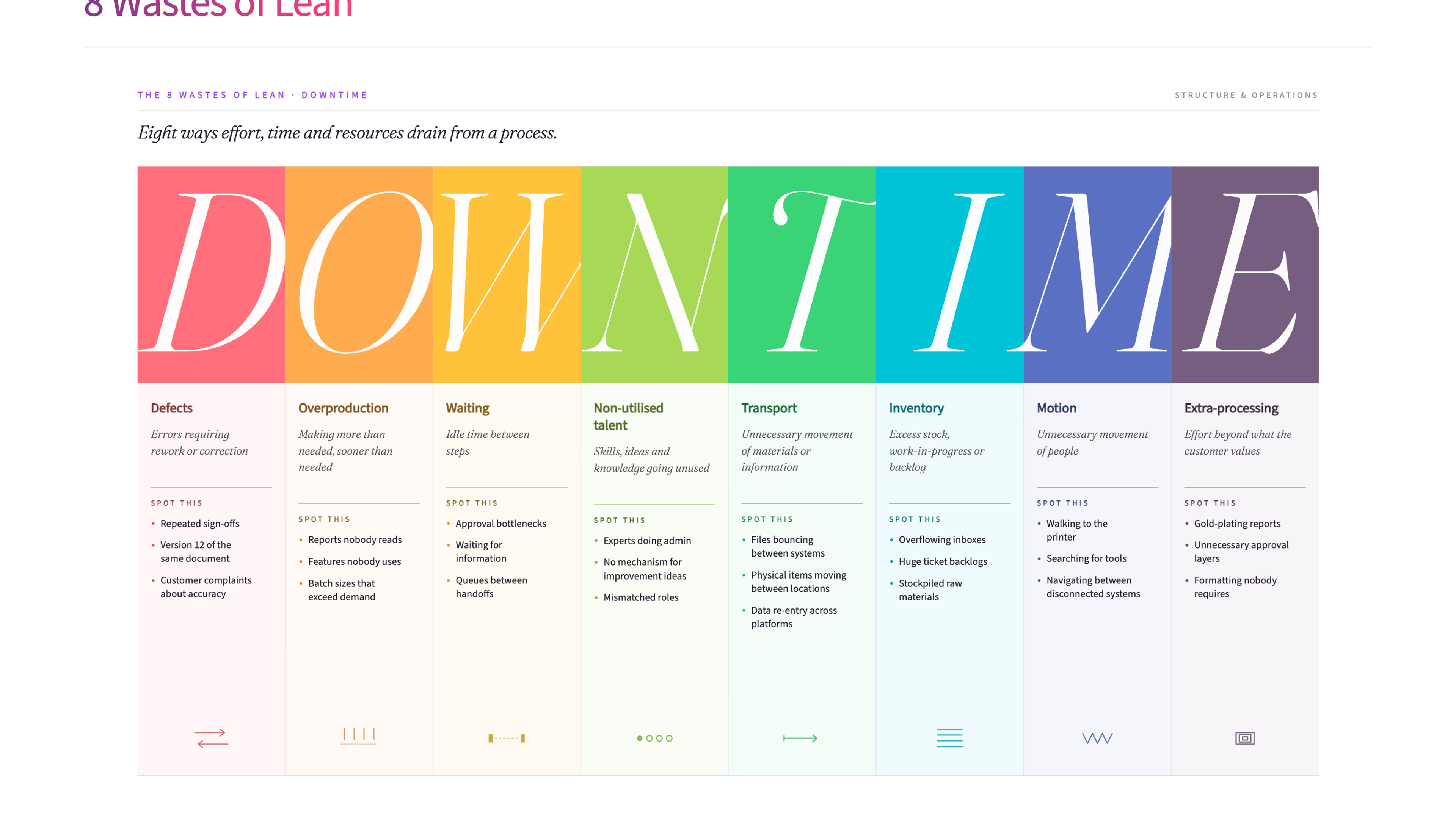
The 8 Wastes of Lean give you eight categories for finding where effort, time and resources leak from a process. Use the DOWNTIME acronym to work through each waste type systematically and build a clear picture of what to improve.
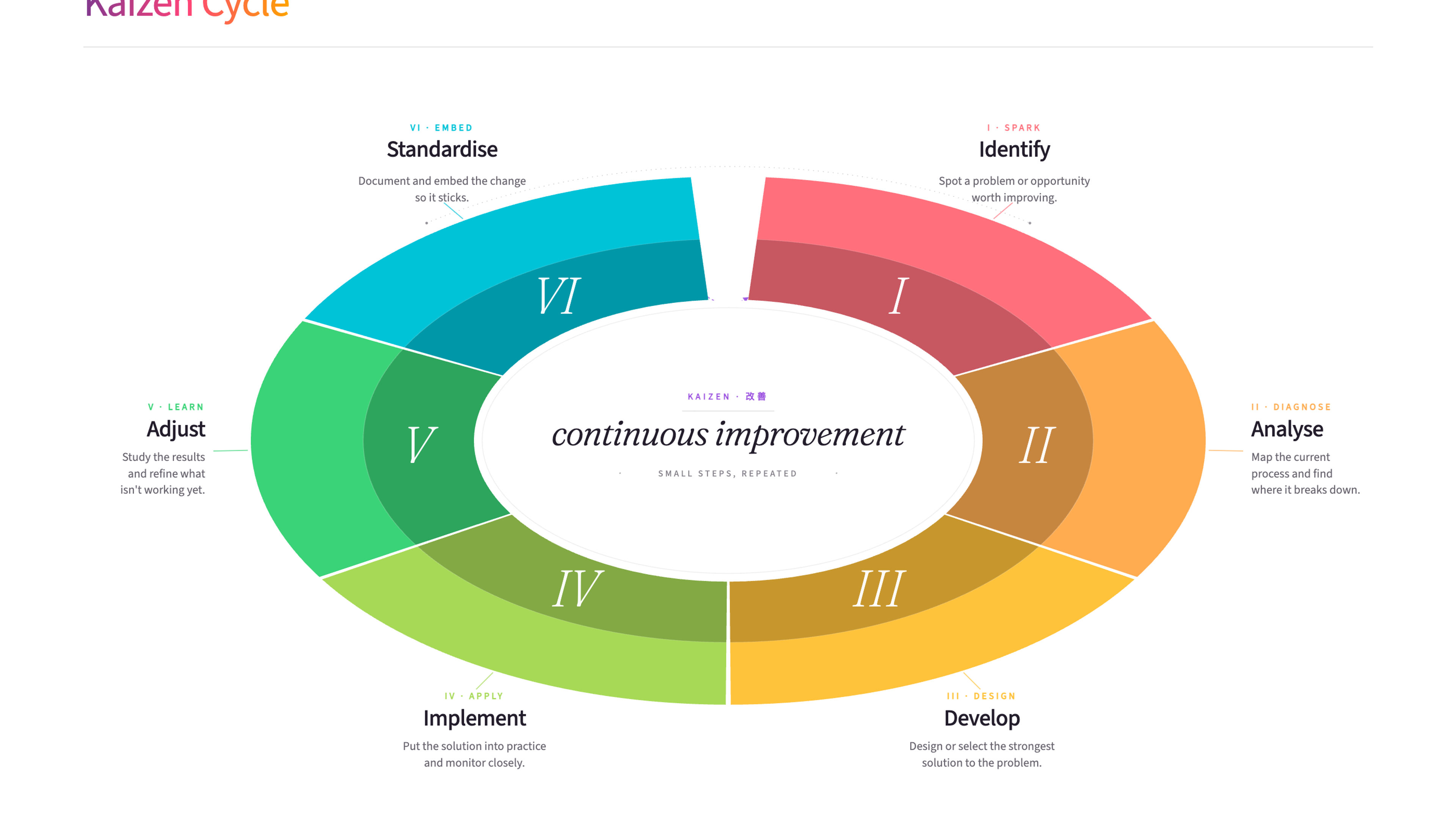
Kaizen is a Japanese continuous improvement philosophy built on the idea that small, ongoing changes add up to significant results over time. The Kaizen Cycle gives teams a structured way to identify improvements, test them, and build them into everyday work.
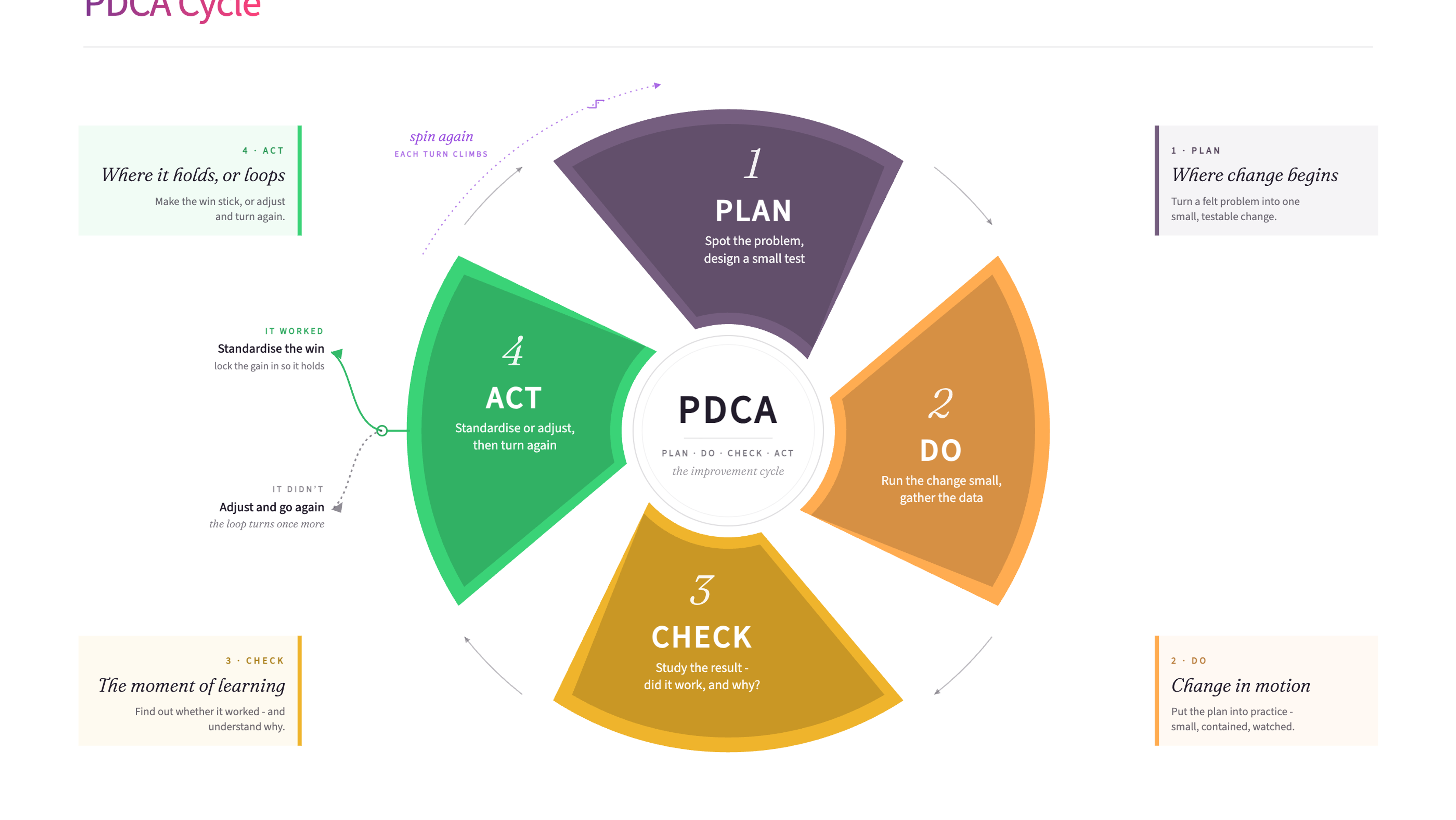
The PDCA Cycle (Plan, Do, Check, Act) is a continuous improvement framework for testing and refining processes. It creates a repeating loop of planning a change, trying it, checking whether it worked, and adjusting before the next round.
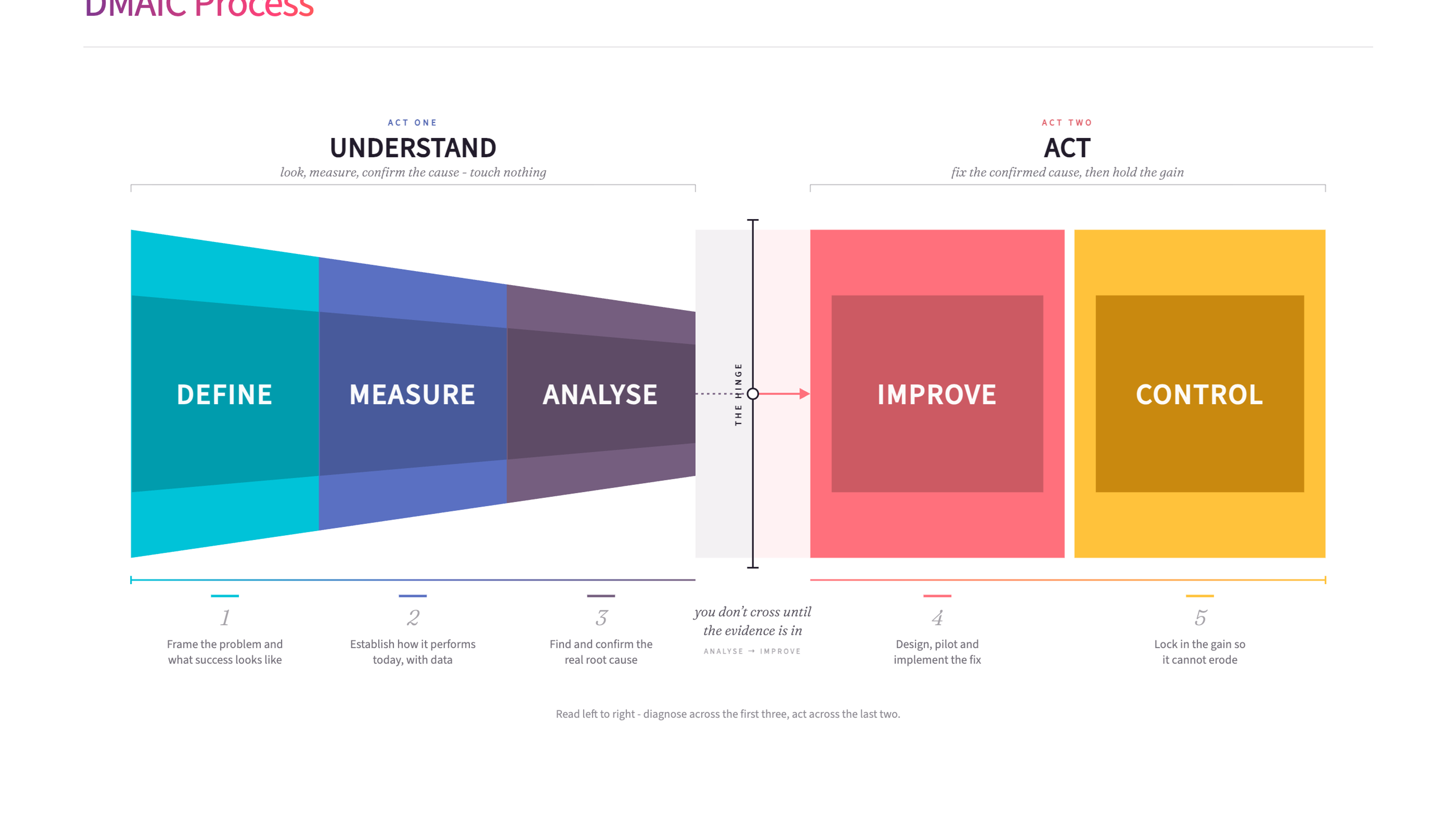
DMAIC (Define, Measure, Analyse, Improve, Control) is a structured problem-solving method from the Six Sigma toolkit. It gives teams a clear five-step process for improving existing processes using data and evidence.
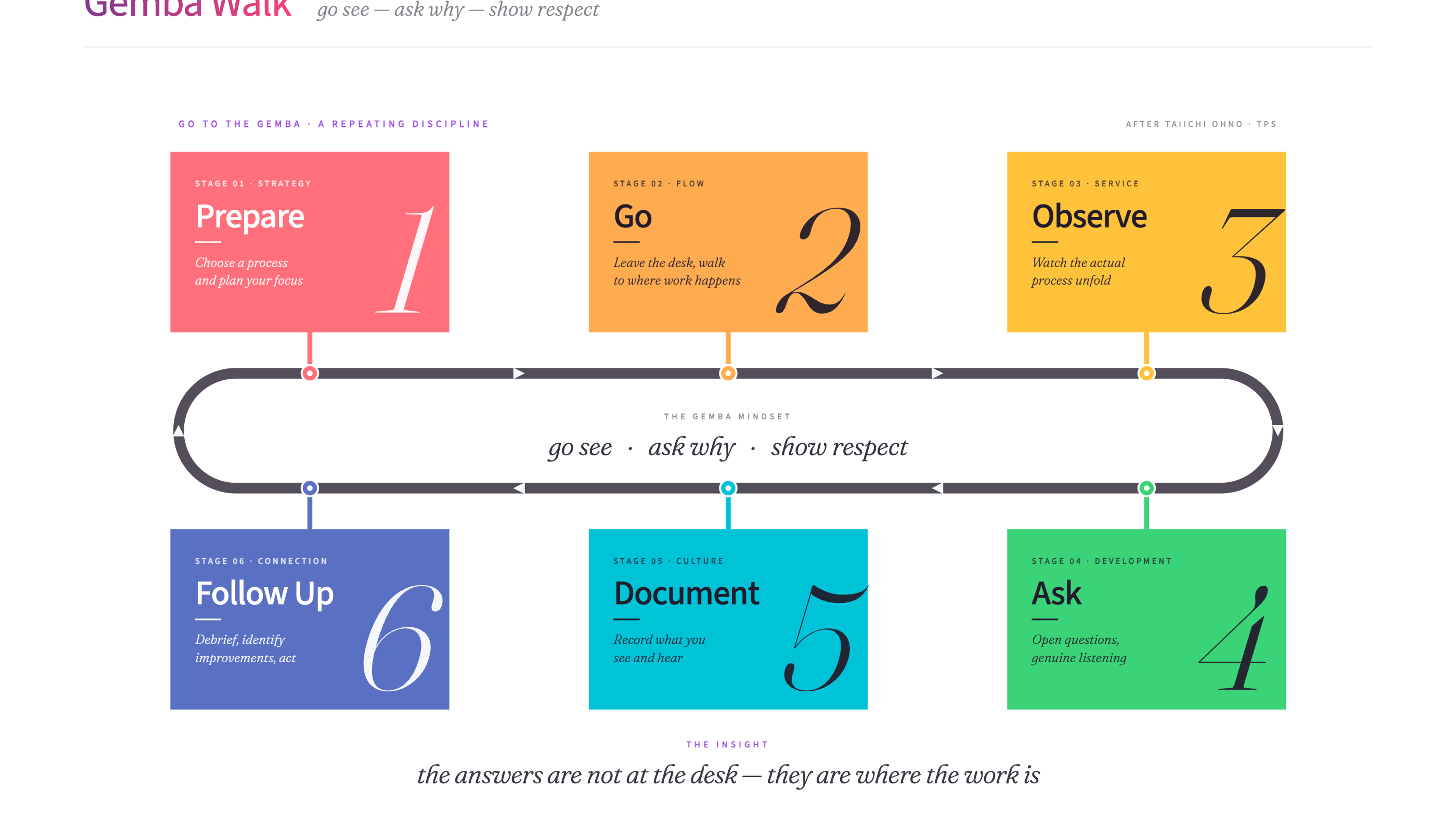
A Gemba Walk is a Lean practice where leaders go to the place where work actually happens to observe, listen, and understand. It bridges the gap between how leaders think work gets done and how it really gets done.
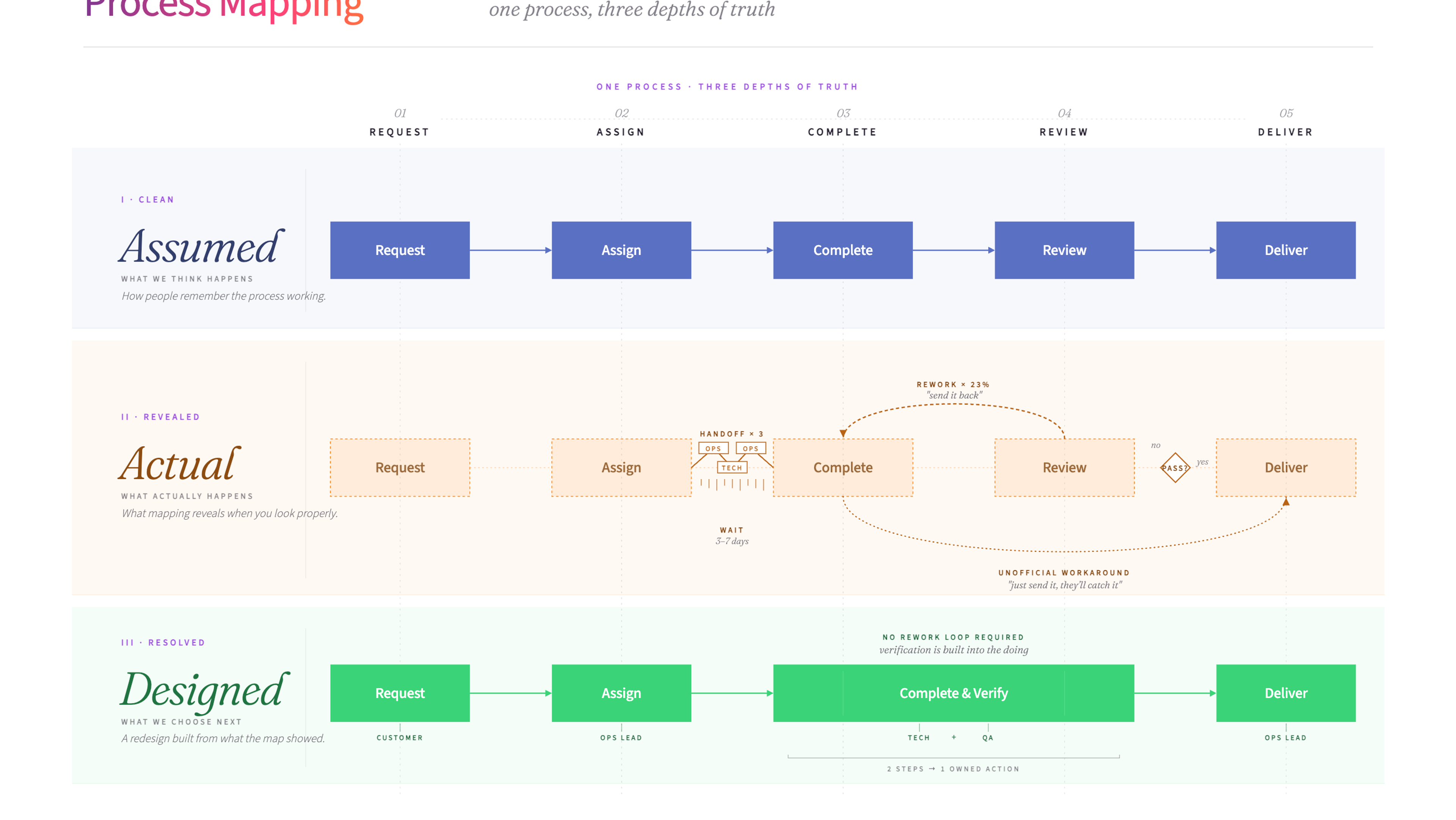
Process mapping is a visual method for documenting how a process works from start to finish. It helps teams see the full picture - every step, decision point, and handoff - so they can spot problems and design improvements.

Every organisation has friction - the unnecessary effort, the needless complexity, the things that make simple work harder than it should be. This article explores how to find it, understand where it comes from, and reduce it without creating new problems in the process.

Most organisations know they should measure their impact. Fewer know how to do it in a way that's genuinely useful rather than just generating reports. This article explores how to build an impact measurement framework that helps you understand what's working, learn from what isn't, and make better decisions.