Customer Experience Training
Better services start with seeing them through your customers’ eyes. We help your teams learn to do that - and redesign around what they find - with training built on your real services.

Why customer experience training matters
Most organisations design their services from the inside out. They start with what they offer, how they’re set up, and what’s easy to deliver - then assume people want it that way. But the experience belongs to the person on the receiving end, and what they value isn’t always what the organisation assumes.
That gap - between how a service looks on paper and how it feels to use - is where customer experience work lives. Closing it doesn’t usually take a bigger budget or a new system. It takes the skill to see your service from the outside in, the honesty to spot where it’s making people work too hard, and a practical way to redesign around what actually matters. That’s what this training builds.
How our customer experience training works
Every course here runs the same way - in-house, shaped to you, built around your real services.
In-house, for your group. In person at your place or online. We don’t run open courses with seats to fill; we bring the training to you.
Shaped before we arrive. Every course starts with a conversation: which service, who it’s for, what’s already been tried? The day your people get works on your actual services and your real users - not a case study about an organisation none of you have met.
Built for the people who shape the experience. Service and customer experience teams, operations and digital teams, product and policy teams - and the leaders who want their organisation to think from the outside in. These courses work best with a cross-functional group in the room, because the most useful insights come from seeing how different parts of the organisation shape the same journey.
The courses
Customer journey mapping
You have process maps, policy documents and a team that cares about getting it right, so you know how your service works. The open question is whether you know what it feels like to be on the receiving end. This hands-on day teaches your team to map a real customer journey from the outside in - following someone’s actual experience from first contact to final outcome, and seeing every moment of friction, confusion, delay and delight along the way. It’s for service managers, customer experience and service design teams, operations and policy teams - anyone who wants to improve how their organisation serves people. It works best with a cross-functional group in the room.
What you’ll work on
You’ll map a real journey from your organisation - not a generic template - and end the day with a clear picture of what someone actually experiences using your service, and a plan for improving it. The day builds three practical skills.
Mapping the real experience. You’ll map a journey from the user’s perspective, not the organisation’s - capturing what people actually do, think and feel at each stage, rather than what the process says should happen. Real research and feedback keep the map grounded in evidence; building audience personas first helps you get clear on who you’re mapping for.
Finding the moments that matter. Not every part of a journey carries equal weight. A confusing first step, a long wait with no update, a handoff where someone has to repeat everything - a few moments shape how people feel about the whole service. You’ll learn to spot these and understand why they have such an outsized effect.
Designing improvements. A map on the wall isn’t the goal; a better service is. You’ll use your map to pinpoint specific changes - to processes, communications, handoffs or touchpoints - that make the biggest difference, practical and ready to test. Service blueprints extend the map to show how the experience connects to the processes behind the scenes.
How the day works
Visual and collaborative. You’ll work in teams, building journey maps on the wall with sticky notes and markers. A short input from the facilitator introduces each technique, then you apply it straight away to your real journey. We keep groups small, so everyone contributes and every team gets attention.
What you’ll take away
A completed journey map for a real service. A prioritised list of improvements. The skills to run journey mapping with your own teams in future. And a different way of seeing your service - from the outside in rather than the inside out.
What makes this different
The mapping is a means, not the point. A lot of journey mapping training stops at the technique - the post-its, the swimlanes, the templates; we focus on what the map reveals and what you do about it. We also connect the journey to the organisational system that delivers the service: most journey problems come from how the organisation is set up, not from anyone’s bad intentions, so lasting improvement means understanding - and sometimes changing - the system behind the map.
Design thinking
You’ve got a problem that won’t shift - a service that isn’t working, a process that frustrates people, a product that isn’t landing - and the usual approaches (meetings, reports, incremental tweaks) haven’t touched the root of it. Design thinking offers a different starting point: instead of beginning with what the organisation wants to deliver, you begin with what the people you serve actually need, then design around that. This practical, creative day teaches your team to use design thinking on a real challenge, working through the full cycle. It’s for anyone who solves problems that affect people - service, product, policy, operations and customer experience teams, and leaders who want their organisation to think differently. No design background needed.
What you’ll work on
You’ll work on a real challenge from your organisation - a service, process or experience that needs improving - and move through the full design thinking cycle.
Understanding the people. Good design starts with empathy. You’ll learn techniques for understanding the real experience of the people your work affects - not what you assume they need, not what a survey says, but what they actually experience and struggle with. The empathy map and contextual inquiry (getting into the user’s own environment to watch and listen) make that picture concrete. This is often the most eye-opening part of the day.
Defining the real problem. It’s tempting to jump to solutions. Design thinking slows you down at the right moment, helping you define the problem properly - reframing it from the user’s perspective with a clear problem statement, which often reveals the real problem is different from the one you started with.
Generating and testing ideas. With a clear problem, you’ll generate a wide range of solutions - pushing past the obvious first ideas - then build rough, rapid prototypes and test them. Quick versions that let you learn cheaply whether an idea works before you invest in building it properly.
How the day works
A creative, energetic day. You’ll move between research, group ideation, rapid prototyping and user testing. The pace is deliberately quick - design thinking works best when you think with your hands and test ideas fast rather than deliberating endlessly. Groups stay small and the atmosphere collaborative.
What you’ll take away
A tested prototype for a real challenge. A clear understanding of the design thinking process. Practical skills you can apply to any problem where understanding people matters. And a shared language and approach that helps your team tackle future challenges more creatively together.
What makes this different
A lot of design thinking training treats it as a set of steps to follow; we treat it as a way of seeing - the empathy phase isn’t a box to tick, it’s the foundation everything else rests on. We also connect design thinking to the organisational system that has to deliver whatever gets designed: a brilliant idea your organisation can’t sustain isn’t a solution, it’s a frustration. The aim is to design things that work in practice, not just in a workshop - and, over time, to make this way of thinking part of how the whole organisation approaches problems.
Reducing customer effort
Your customers are working too hard - and usually not because the service is bad, but because somewhere in the system things are more complicated than they need to be. Forms that ask for the same information twice, processes that make people chase progress, handoffs where context gets lost and someone has to start again. Every unnecessary step is effort your organisation is creating - and research consistently shows that reducing effort does more for loyalty than trying to delight people. This practical day teaches your team to find and remove that effort: you’ll analyse real services from your organisation, identify where effort is highest, and design specific changes to reduce it. It’s for the people responsible for how customers and service users experience your organisation - customer experience and service teams, operations and digital teams, and the leaders who want their services to be genuinely easier to use.
What you’ll work on
You’ll work on real services and processes from your own organisation, using a structured approach to find and fix the effort your customers or service users face. The day covers three areas.
Seeing effort from the outside. The effort that matters is what the customer experiences, not what the organisation measures. You’ll learn to spot it from the user’s side - where they get stuck, where they give up, where they feel the friction - which often reveals problems internal metrics miss entirely. An empathy map helps you capture what people are thinking and feeling at the moments of highest effort.
Understanding why effort exists. Most unnecessary effort isn’t deliberate - it’s processes built around organisational needs rather than user needs, systems that don’t talk to each other, or policies that made sense once and never got revisited. You’ll trace effort back to its root causes, because reducing it means changing the system, not just adding a friendlier front end. Process mapping helps you see the full workflow behind a service, so you can spot where the effort is really created.
Designing lower-effort experiences. With a clear picture of where effort is highest and why, you’ll redesign specific parts of your service to make things easier - simplifying processes, reducing handoffs, improving communications, removing steps that create effort without adding value. The changes you design will be specific and testable.
How the day works
A mix of analysis and design. You’ll alternate between structured exercises that identify and diagnose effort and creative sessions that design improvements, working in small teams - ideally with colleagues from different parts of the same service, so you see the full picture rather than one slice of it.
What you’ll take away
A clear map of where effort is highest in your service. A set of specific changes designed to reduce it. Practical tools for measuring and managing customer effort going forward. And a different lens for evaluating your services - one that starts with what the person on the other end actually experiences.
What makes this different
A lot of customer experience training focuses on satisfaction or delight; this focuses on effort - the thing research shows actually drives loyalty and retention. Making things easy isn’t glamorous, but it’s what works. We also look past the touchpoints to the operational system behind them: if your contact centre is handling calls that shouldn’t need to happen, the fix isn’t better call handling, it’s redesigning the process that generates them. There’s more on how internal friction creates external effort in our guide to reducing organisational friction. Its natural companion is the defining-value session below, which asks where your effort is best spent in the first place.
Defining value in service delivery
Your organisation delivers services - but do you know what the people you serve actually value? Not what you assume they should value, not what the strategy says, but what they genuinely care about: the things that make them think “this is worth my time, my money, my trust.” Value is defined by the person receiving the service, not the one delivering it - and when you really understand that distinction, it changes how you design everything. This practical day helps your team get clear on what value means to the people you serve and use it to make your services genuinely better, working on real services from your own organisation. It’s for anyone involved in designing or delivering services - service design, operations, customer experience and product teams, and the leaders who want their organisation more focused on what actually matters to the people it serves. It’s especially useful where a lot of effort doesn’t seem to be translating into better outcomes.
What you’ll work on
You’ll spend the day exploring what value means in the context of your specific services - and using that to find where you’re delivering value well, where you’re falling short, and where you’re spending effort on things that don’t matter to the people you serve. The day covers three areas.
Understanding value from the outside in. You’ll learn to see value through your customers’ or service users’ eyes: what they actually need, what matters most, what they’d happily accept less of. Practical research keeps the picture grounded in evidence rather than assumption - and building audience personas helps you get clear on the different groups you serve and what value means to each. This often produces surprises, because what an organisation thinks people value and what they actually value are frequently different things.
Mapping value and waste. With a clear picture of what your users value, you’ll map your current services against it. Where are you delivering genuine value? Where are you creating waste - spending time and resource on things that don’t matter? Where are you under-delivering on the things that matter most? The result is a clear, honest picture of how well your services line up with what people actually need.
Redesigning around value. With that map in hand, you’ll redesign elements of your service to deliver more of what matters and less of what doesn’t - reallocating effort, simplifying processes, and focusing resource where it makes the biggest difference to the people you serve.
How the day works
The day combines research, analysis and design. You’ll alternate between exercises that build understanding of user value and exercises that apply it to your real services, working in teams - ideally with colleagues from different parts of the service delivery chain.
What you’ll take away
A clear understanding of what value means to the people you serve. A map of where your current services are aligned, and misaligned, with that value. Specific improvements designed to close the gap. And a practical framework for continuing to test and refine your understanding of value over time.
What makes this different
A lot of service improvement starts with efficiency - how do we do this faster or cheaper? This starts with value - how do we do more of what matters? That’s a fundamentally different starting point, and it often leads to different conclusions; sometimes the most efficient process isn’t the most valuable one. We also connect value to the wider system: what an organisation values internally (efficiency, compliance, control) and what its users value (ease, speed, reliability, humanity) are often in tension, and navigating that tension is where the real improvement happens - bound up with how your whole organisation is set up to deliver. It pairs naturally with the reducing-customer-effort session above, which removes the barriers that get in the way of the value you define here.
The methods behind it - we use them all, tied to none
Customer experience work has no shortage of methods - journey mapping, design thinking, empathy mapping, service blueprints, personas. We use all of them, and publish free guides to each, because the useful question isn’t ‘which method is best?’ but ‘which one answers the question in front of you, on this service, in this organisation?’
That’s what the fluency is for. We’re tied to no single method, so we can shape the training around your services rather than around a framework - and the same judgement is what your people build. What ties it together isn’t a brand or a certificate; it’s a way of seeing, from the outside in, and a habit of looking past the touchpoint to the system that produces it.
The guides are among the most-visited pages on this site. The training is where that thinking gets applied to your service.
Bespoke customer experience training
The observation. The same course lands differently in different organisations - because the service is different, the users are different, and what’s already been tried is different.
What we do about it. So we design around your context. Before any course runs, we learn your services, your users and your language, and shape the day to fit them. The methods stay; the service they’re applied to is yours.
What that makes possible. People who don’t just know the methods, but can use them where they work - on the real services in front of them, for the people their organisation actually serves.
And if none of these courses is quite the shape you need, we design from scratch - that’s bespoke training.
Part of a bigger picture
Training is one part of how we work with organisations on customer experience - and it connects to a bigger idea. A service is only ever as good as the system that delivers it: how teams are organised, where decisions get made, whether the people closest to the customer can act on what they see. Training builds your people’s skill to design from the outside in; the conditions around them decide how far that skill can reach. That thinking runs through everything we do - there’s more on it in our philosophy.
And if what you need is partners in the work itself, not just the capability to do it, our customer experience consultancy works alongside teams to redesign services around the people who use them.
Customer experience training FAQs
How is the course shaped to our organisation?
Every course starts with a conversation about your services - which ones, who they’re for, what’s already been tried. We adapt the examples, exercises and emphasis so the day works on your actual services rather than a generic one. The methods are the ones described on this page; the service they’re applied to is yours.
Who delivers it, and where?
In person at your offices or a venue you choose, anywhere in the UK - or fully online, wherever your people are. The practitioner who shaped the course with you is the one who delivers it.
What group size works?
These courses run best with small, cross-functional groups - people from different parts of the same service in the room together, so you see the whole picture rather than one slice of it. Tell us your group and we’ll advise; if it’s larger, we can usually adapt the format or run more than one cohort.
Do participants get a certificate?
These courses build capability rather than accreditation - you leave able to map a journey, run a design sprint or redesign a service, not with letters after your name. If formal certification is what your people need, an accredited provider is the right route.
Can you combine courses into a programme?
Yes - and it’s common. A typical pattern: journey mapping to see the service from the outside in, then design thinking or the value-and-effort day to act on what you find, run as a connected programme with a consistent thread. We’ll help you work out which combination fits.
What if we want help with the service itself, not just training?
That’s our customer experience consultancy - working alongside your teams to redesign services around the people who use them, rather than building your people’s capability to do it. Plenty of organisations use both: consultancy for the redesign, training so the capability stays when we step back.
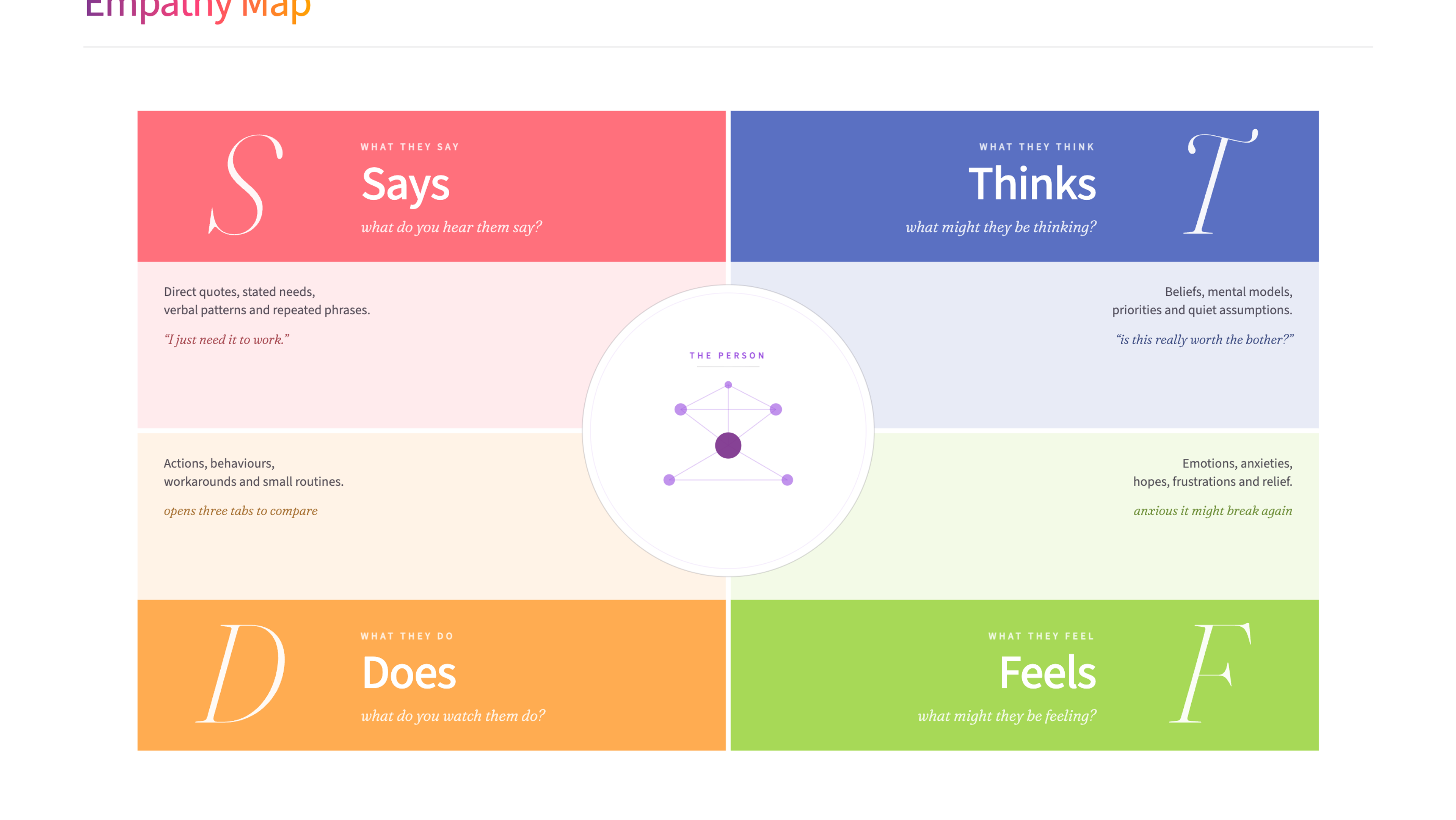
An empathy map is a collaborative visualisation tool that captures what we know about a user's behaviours, thoughts, feelings, and motivations, helping teams develop deeper understanding and more human-centred solutions.
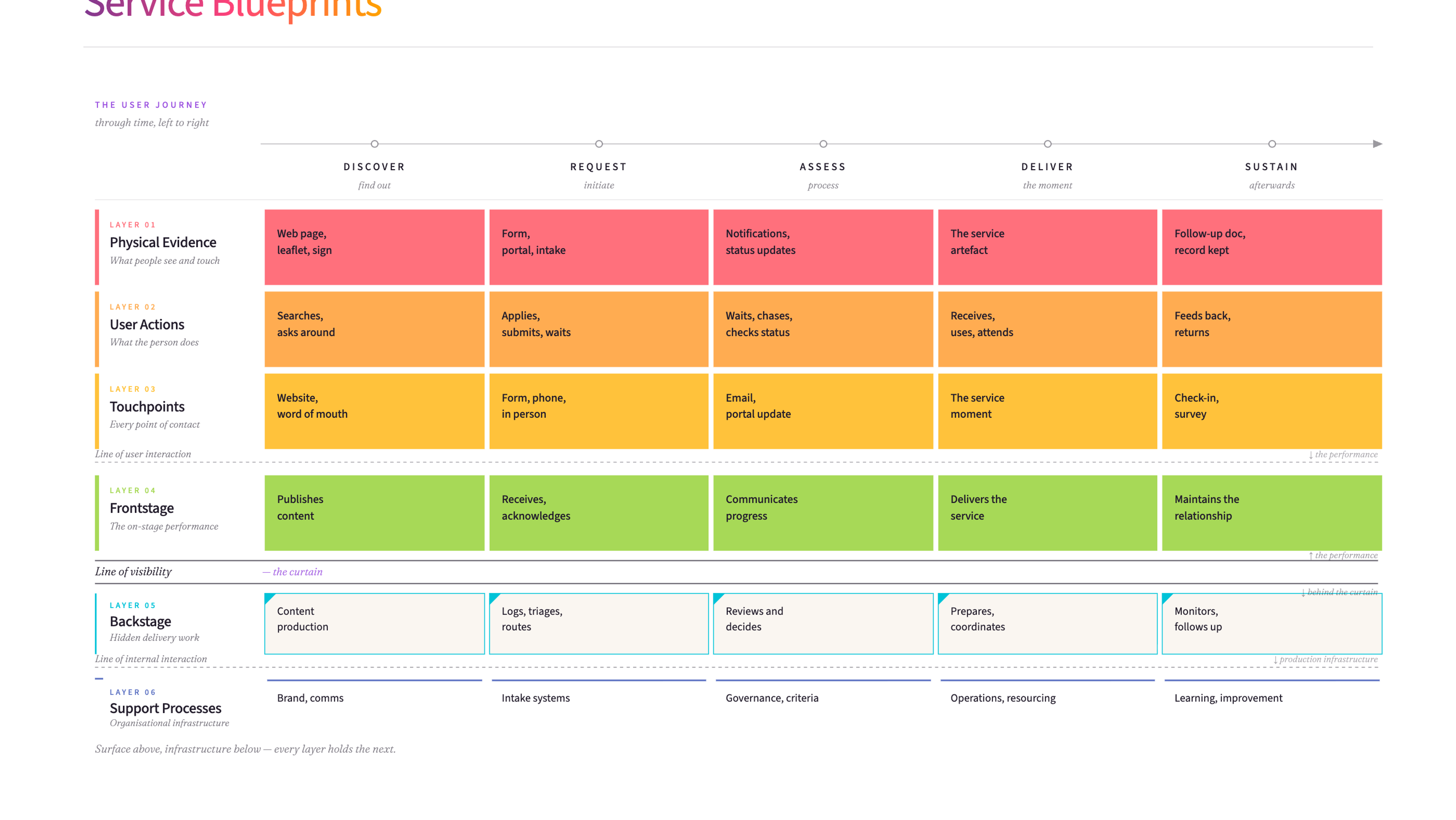
A service blueprint is a detailed map of how a service actually works - what the user sees and experiences on the front end, and everything happening behind the scenes to make it possible. It helps organisations redesign services by showing the full picture.
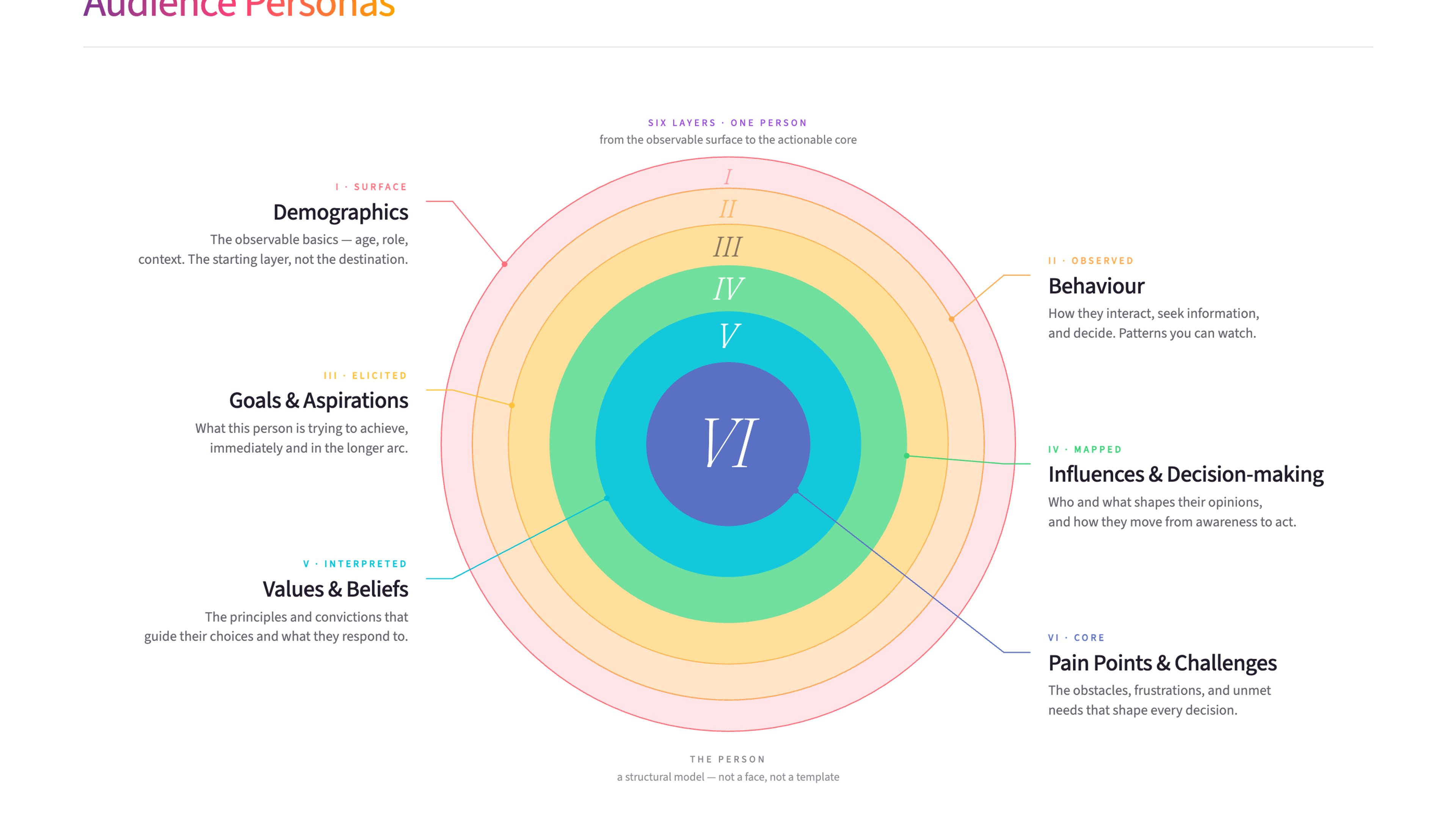
Audience personas are detailed profiles of the people you're trying to reach, built from real research into their needs, behaviours, and motivations. They help organisations design services and communications that actually resonate with the people who matter most.
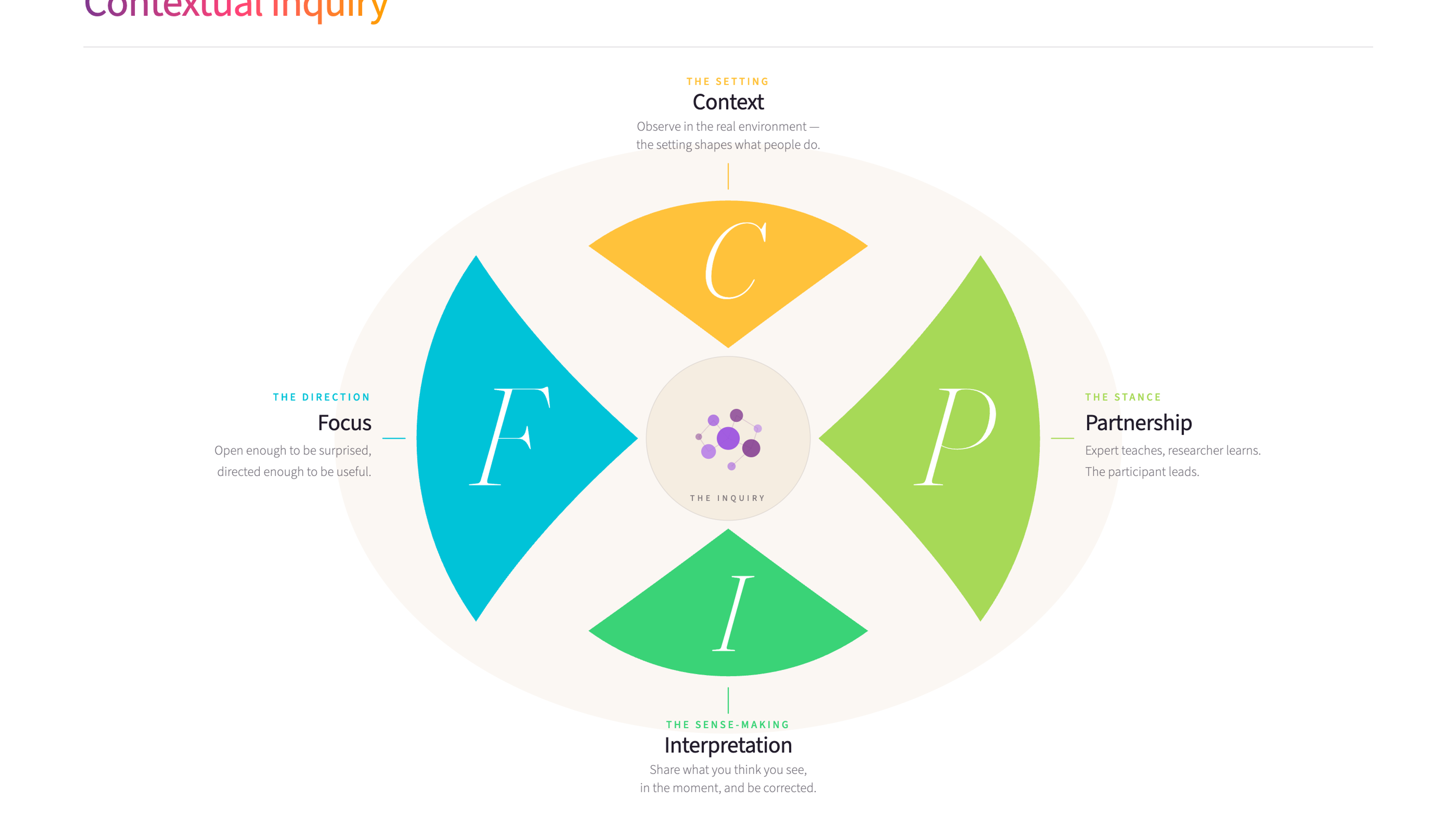
Contextual inquiry is a user research method where you observe and interview people in their actual work environment while they perform real tasks. It uncovers insights about real behaviour and needs that surveys and interviews in meeting rooms simply can't reach.
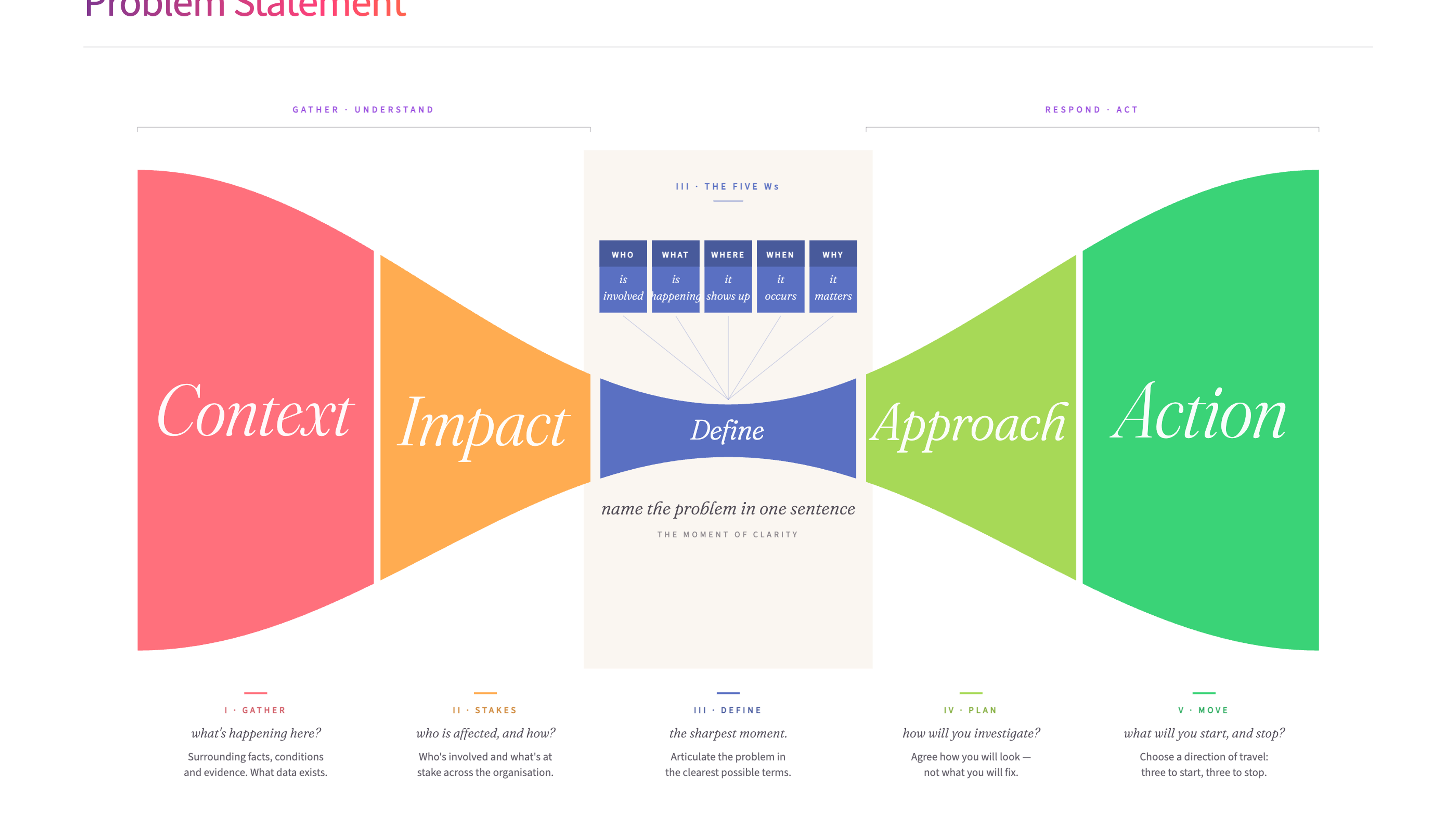
A problem statement is a clearly written summary of a problem you're facing, expressed in the simplest possible terms. It helps teams align around what they're actually trying to solve before jumping to solutions.

The skills that make someone good at service design - empathy, experience mapping, designing conditions - are the same skills leaders need to create environments where people do their best work. What changes when that lens runs all the way through the organisation.

Every organisation has friction - the unnecessary effort, the needless complexity, the things that make simple work harder than it should be. This article explores how to find it, understand where it comes from, and reduce it without creating new problems in the process.