Kotter's 8 Step Change Model
Kotter's 8 Step Change Model is a structured framework for leading organisational change, from building urgency through to embedding new ways of working. It gives leaders a clear sequence to follow when the change is big and the stakes are high.
Get the free template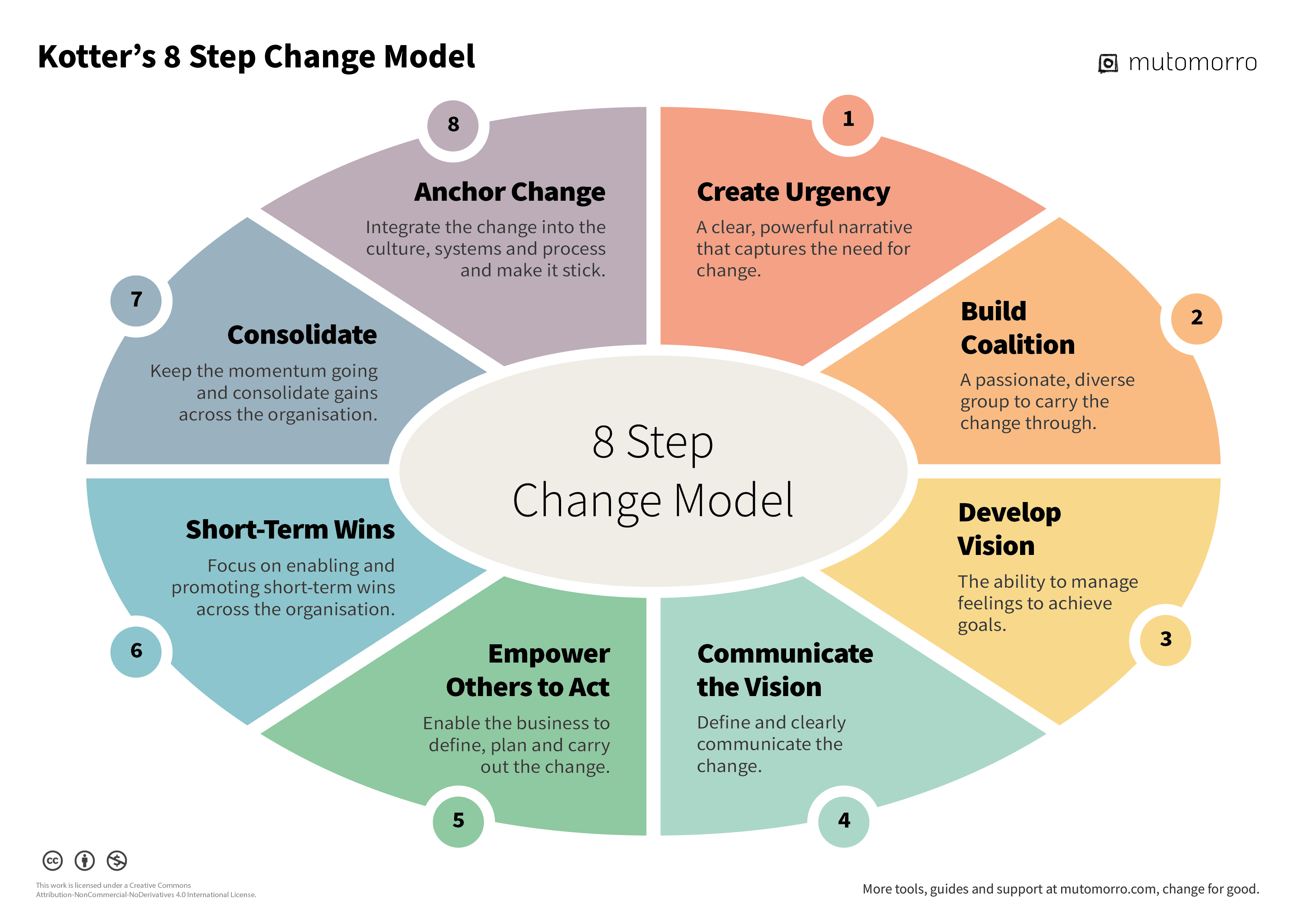
What is Kotter's 8 Step Change Model?
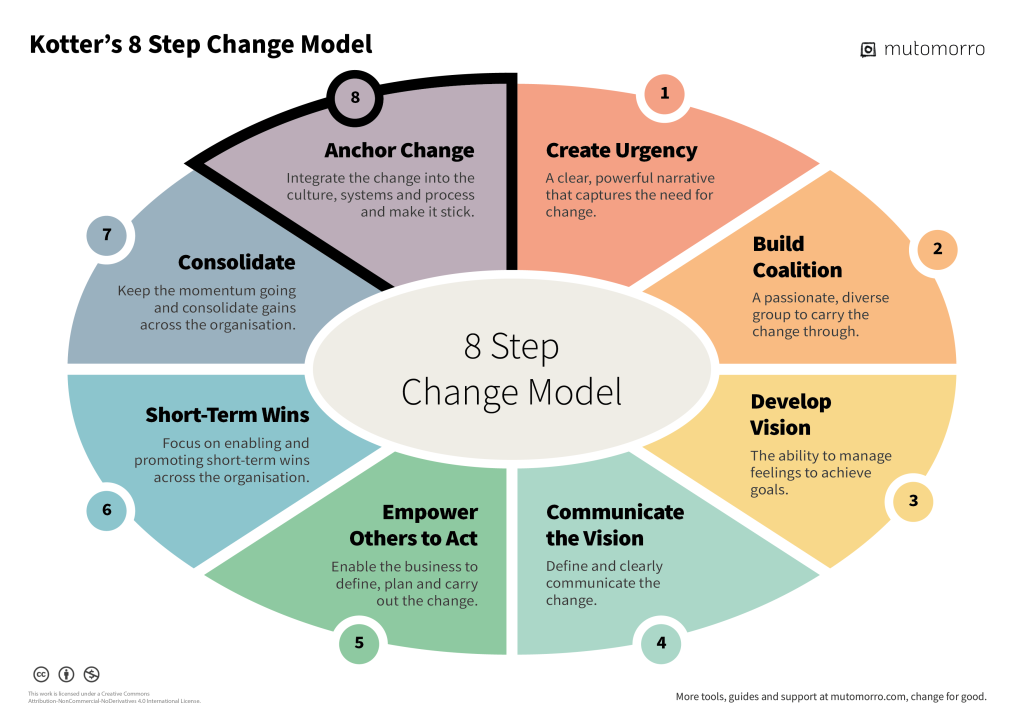
Kotter's 8 Step Change Model is a framework for leading large-scale organisational change as a deliberate campaign. It sets out eight steps in sequence - create a sense of urgency, build a guiding coalition, develop a vision and strategy, communicate the vision, empower others to act on it, create short-term wins, consolidate gains, and anchor the change in the culture - each step building the conditions the next one needs. The model was developed by John Kotter, a Harvard Business School professor, first in his 1995 Harvard Business Review article "Leading Change: Why Transformation Efforts Fail" and then in full in his 1996 book Leading Change; his firm, Kotter Inc, continues to develop it. It's written for the people leading a change rather than the people receiving it - the natural frame for implementing change in organisations when the change is big and the stakes are high.
This page gives you everything you need to put it to work: a free Kotter's 8 Step Change Model template (PDF), a walkthrough of all eight steps with a diagram for each, a full worked example of an eight-step campaign from start to finish, and a comparison with ADKAR, Lewin and Bridges so you can check you're holding the right model before you start.
The eight steps of Kotter's model: a detailed walkthrough
The model came out of watching transformations fail. Kotter's 1995 article is really a catalogue of the errors he kept seeing - urgency never established, no coalition behind the change, the vision missing or hoarded, victory declared far too soon - and the eight steps are those errors turned round into a sequence. Each step exists because he watched change efforts skip it and pay for it later.
It helps to see the shape of the sequence. The early steps build the will to change: urgency, a credible coalition, a vision worth the effort. The middle steps turn will into action: relentless communication, cleared barriers, visible wins. The late steps make it permanent. Most struggling change efforts are living with a skipped early step - which is why the honest question "which of these have we actually done?" is often the fastest diagnosis available.
Step 1: Create a sense of urgency
Urgency is the fuel for everything that follows: enough people believing the change matters, and matters now. Kotter frames it as the fight against complacency - the organisational habit of preferring the status quo - and in his later book A Sense of Urgency he's clear it isn't announced once but renewed continuously. His most useful prompt: bring the outside in - customer voices, external evidence, the organisation seen from beyond its own walls.
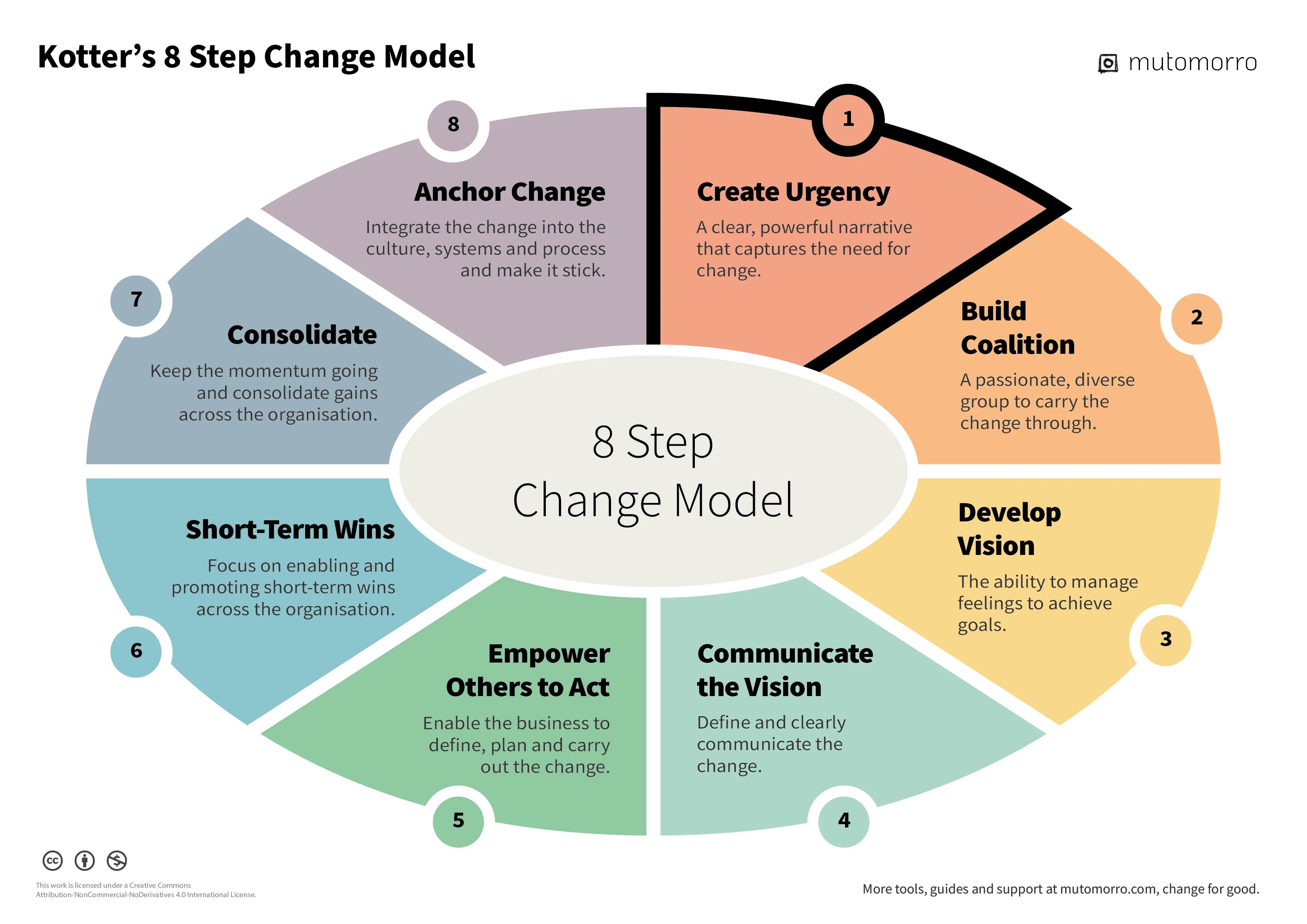
Where it goes wrong: urgency gets confused with fear. A manufactured "burning platform" produces compliance and anxiety, not commitment - and a slide deck of statistics produces neither, because people are moved by emotion, not data alone. The other failure is treating urgency as a launch event; it decays, and it needs feeding.
How to do it well: build an honest case for change - what's true today and why it can't hold, real stories from colleagues and customers, the volatile context around you, and what happens if nothing changes - then combine it into a change narrative people can retell in their own words. If your case only works with the slides up, it isn't ready.
Step 2: Create a Guiding Coalition
No single leader carries a big change. The second step is assembling a group with the authority, expertise and credibility to lead it - drawn from different levels and departments, not just the top table. The best coalitions pair positional power with the informal kind: the colleagues others actually watch to see whether this change is real. Front-line members working directly alongside executives is a particularly powerful mix - it keeps the campaign honest about the ground truth.
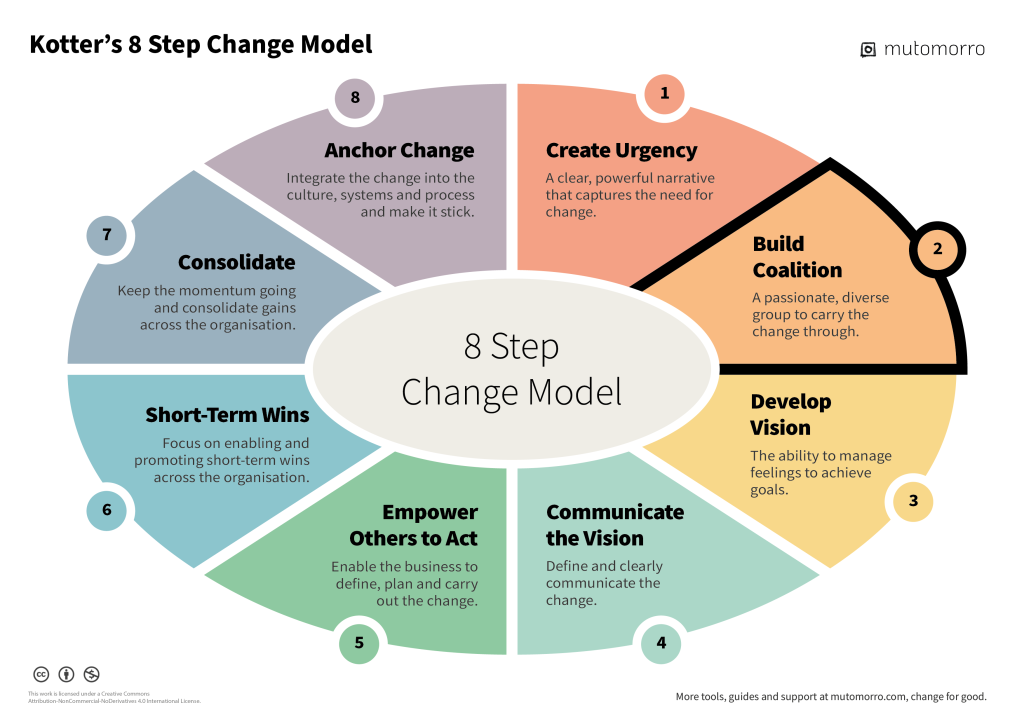
Where it goes wrong: the coalition is really a steering group - the usual senior suspects, appointed by rank. It has authority but no reach, and no shared conviction. The opposite failure is recruiting only the enthusiasts; a coalition without weight can't clear the barriers coming in Step 5.
How to do it well: choose for influence and credibility, not job title, and build in genuine diversity of perspective - including people directly affected by the change. Then make the group an actual team, not a meeting. The 6 Team Conditions framework is a useful check on whether it's set up to function.
Step 3: Developing a Vision and Strategy
The vision is a picture of the end state - what will be different, and what it will look and feel like to work there. Someone hearing it should be able to see why the effort is worth it and roughly what part they'd play. The strategy is the practical half - the plan for how the organisation gets there. The two need each other: vision without strategy is a poster; strategy without vision is a Gantt chart nobody's following.
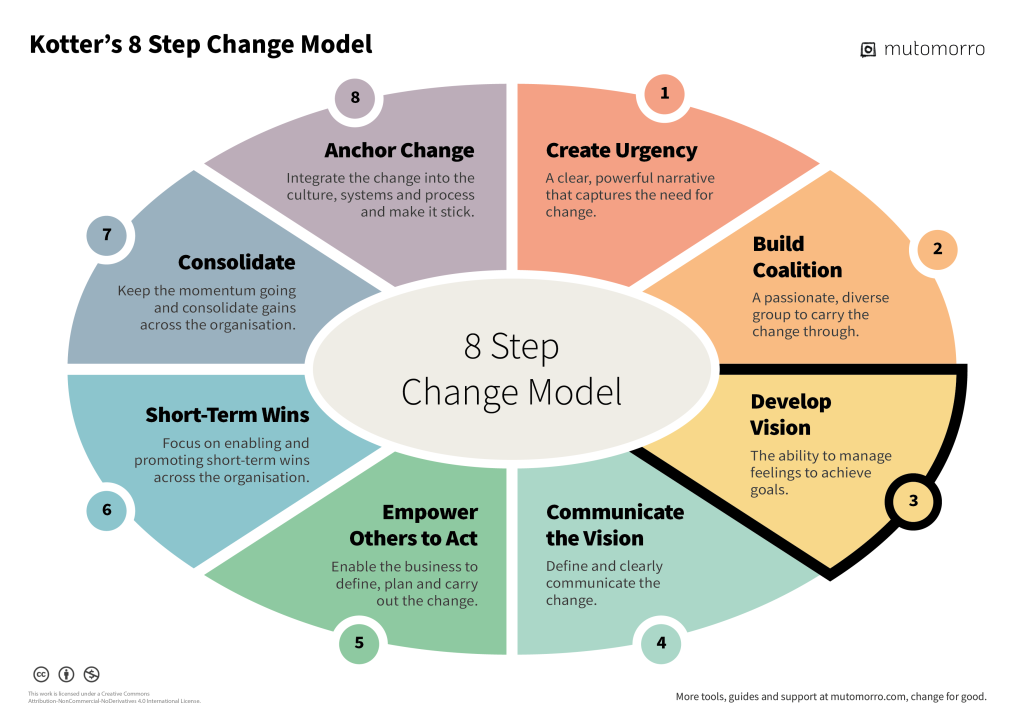
Where it goes wrong: the vision is designed behind closed doors and arrives polished into abstraction - the kind of statement that could belong to any organisation in any sector. Change efforts also stall here when the strategy ignores known obstacles because acknowledging them felt disloyal to the vision.
How to do it well: involve the coalition and the wider organisation in shaping it, then test it against real decisions - if it can't help two teams settle a genuine trade-off, it isn't specific enough yet. Keep it short enough to say plainly in a few minutes, and honest about what it will take.
Step 4: Communicating the Change Vision
A vision only works if the people expected to act on it hold it in their heads - which means communicating it far more than feels necessary. Kotter's blunt observation is that most change efforts under-communicate the vision by a huge margin: a launch event and a newsletter, against thousands of everyday messages pulling the other way. And the most powerful channel isn't a channel at all - it's what leaders visibly do next Monday. Behaviour that contradicts the vision communicates louder than anything said on stage.
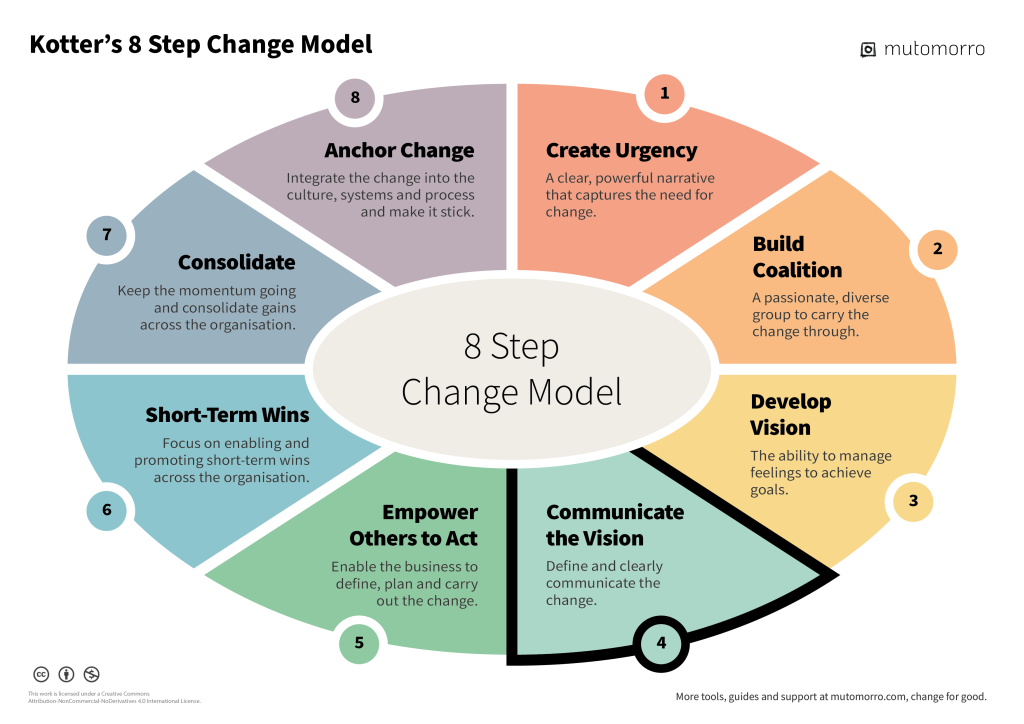
Where it goes wrong: communication is treated as broadcast - the same deck cascaded down the hierarchy, questions handled defensively, silence in between. Rumour fills every gap the official story leaves, and rumour is always more vivid.
How to do it well: use every channel you have, repeatedly, and make it dialogue rather than announcement - people need to ask their own questions of someone they trust, usually their own manager. Brief managers before their teams; they can't lead a conversation they're hearing for the first time. And let people hear the honest bits too - a vision that admits its costs is far more believable than one that doesn't.
Step 5: Empowering Others to Act on the Vision
By this point people know why and where. Step 5 asks whether they actually can act - and mostly that's a job of removal. Kotter's list of barriers is unglamorous and accurate: structures that make the new way awkward, systems that reward the old way, missing skills, and managers who quietly undercut the whole thing. Empowerment here isn't a slogan - it's clearing the path, then handing people real authority over how the change lands in their own area.
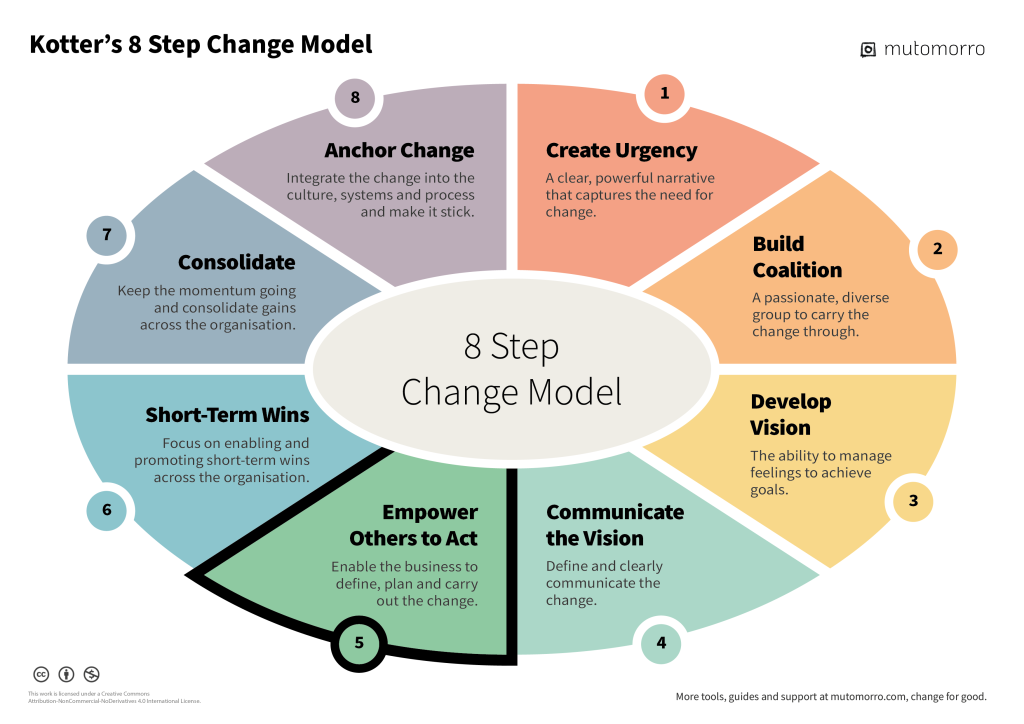
Where it goes wrong: people are exhorted to work differently while the appraisal system, the budget rules and their own line manager all still reward the old way. Willing people hit the same wall three times and stop trying - and the campaign reads their silence as buy-in.
How to do it well: hunt the blockers systematically - ask what makes the new way harder than the old way, and take the answers seriously. Give teams genuine ownership, with the training and resources to use it. And deal with blocking managers - fairly and privately first, but decisively; one undermining voice with power outweighs twenty supportive ones without it.
Step 6: Creating Short-term Wins
Big change runs on a long clock, and belief doesn't last that long without evidence. Step 6 is about deliberately creating visible wins in the first months - real improvements, unambiguously connected to the change, that people can see without a dashboard. Kotter's distinction is between creating wins and hoping for them: wins are planned, resourced and chosen for visibility, not gathered up afterwards to pad a board report.
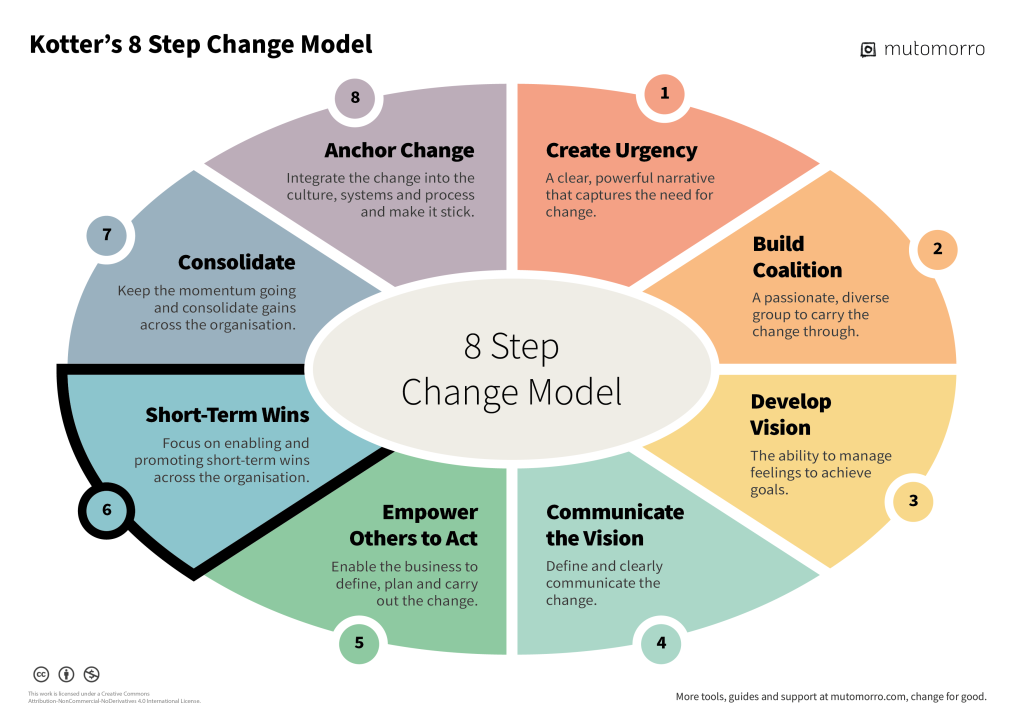
Where it goes wrong: everything is bet on a big result two years out, so the sceptics' "nothing's actually changed" hardens into the accepted story. Or the wins announced are ones nobody on the ground recognises as improvements - which spends credibility rather than building it.
How to do it well: choose a small number of early wins that matter to the people watching, not just to the programme. Deliver them properly, then recognise the people who made them happen - publicly and specifically. Each genuine win converts a few more sceptics into participants.
Step 7: Consolidating Gains and Producing More Change
This is the step for the most seductive mistake in change: declaring victory too soon. Early wins feel like the end of the story - and Kotter's warning is that treating them that way kills the effort, because the old ways are still intact underneath and regression follows quietly. Step 7 spends the credibility from early wins on the bigger, harder changes: the structures, systems and dependencies the campaign wasn't strong enough to touch at the start.
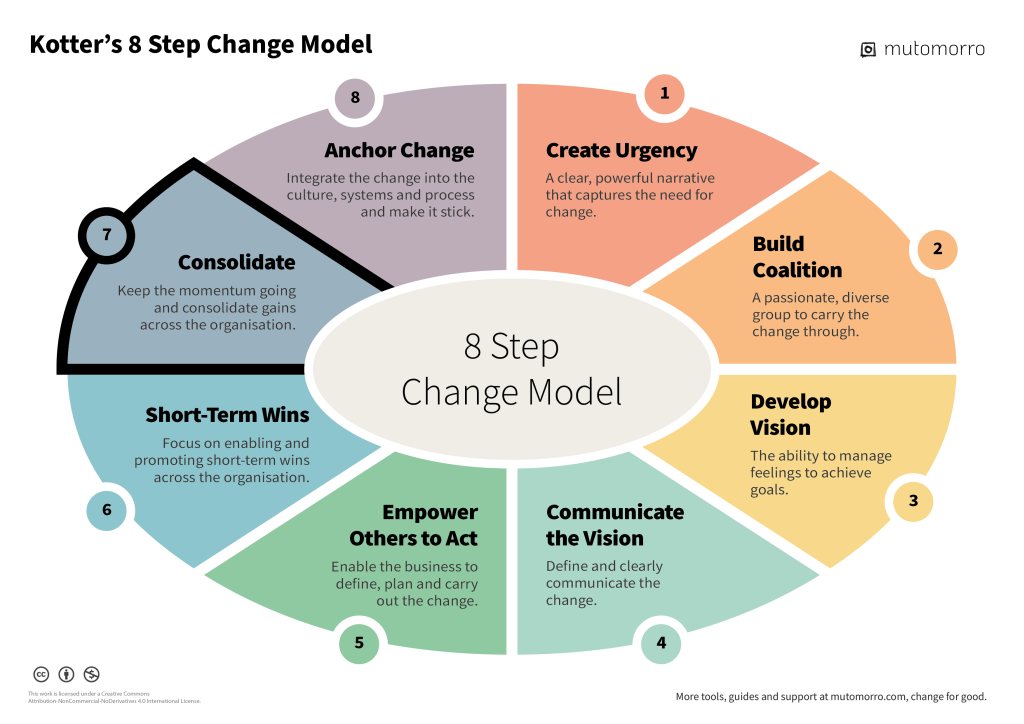
Where it goes wrong: the programme winds down at the first plateau - the team disbands, leadership attention moves to the next initiative, and eighteen months later it's hard to say what actually changed. Fatigue is the other trap: momentum needs fresh energy and fresh people, not the same exhausted few.
How to do it well: treat each win as licence to take on the next barrier, keep the change resourced past the point where it feels done, and refresh the coalition as people move on. The Kaizen Cycle gives structure to exactly this kind of continuous, incremental progress.
Step 8: Anchoring New Approaches in the Organisation's Culture
The last step makes the change permanent - and it comes last for a reason. Kotter's argument is that culture changes at the end of a transformation, not the beginning: new behaviours have to visibly work before "the way we do things here" will absorb them. Anchoring means connecting the results people care about to the new behaviours, then embedding those behaviours in the organisation's permanent machinery so they survive the departure of the people who championed them.
Where it goes wrong: the project closes at go-live and everyone assumes gravity has changed. It hasn't - the old culture is patient, and the first leadership change or genuinely busy quarter is a referendum on the new ways of working. If nothing structural holds them in place, they lose.
How to do it well: write the change into induction, promotion criteria, recognition and the everyday systems people touch, so the new way is also the easy way. Tell the stories that explain why it matters - culture travels in stories more than policies. And process mapping is a practical way to make the new ways of working visible and repeatable.
When Kotter's model works best (and when it doesn't)
It's worth being clear about what kind of model this is. Kotter's is a campaign playbook - top-down, sequential and momentum-driven, written from the leader's seat. That's not a criticism; it's the design. Its home ground is large-scale transformation: a merger, a restructure, a culture shift - high stakes, many stakeholders, a horizon of months or years, and someone who genuinely has to orchestrate urgency, coalition and momentum for a whole organisation.
Its limits follow from the same shape. It has no individual diagnostic: it tells you what the campaign should be doing, not whether any particular person or team is actually moving - which is why it pairs so well with ADKAR (see the comparison below). It's thin on loss and identity: urgency-and-wins language doesn't help much with people grieving the ending of something they were proud of, which is the Bridges Transition Model's home ground. It assumes you have time - a genuine crisis doesn't wait for eight steps. And the tidy sequence understates how messy change really is: steps loop and overlap, and Kotter Inc's own later work (the 2014 book Accelerate) reframed them as concurrent "accelerators" - a signal that even the model's home doesn't read it as a strict checklist. The emotional journey through change is largely outside its frame too; the Satir Change Model maps that territory well.
None of this dislodges it. Held as a map of what has to be true for big change to stick - rather than a procedure to follow - it remains one of the most useful frames there is.
Kotter vs ADKAR vs Lewin vs Bridges
Kotter's model sits in a family of well-known change models, and they're less interchangeable than they look - each is really an answer to a different question. Kotter answers the leader's question: how do we run this campaign? The ADKAR model answers the diagnostic one: is the change actually landing, person by person? Lewin's Change Model gives the simplest possible shape of any change - unfreeze, change, refreeze - a planning frame rather than a playbook. And the Bridges Transition Model maps the inner journey - endings, the neutral zone, new beginnings - for when the human loss in a change is the hard part.
Model | The question it answers | When to reach for it |
|---|---|---|
Kotter's 8-Step | How do we lead the campaign? Urgency, coalition, vision, wins, momentum | Large-scale, leader-led transformation with months or years to run |
ADKAR | Is it landing for each individual? Awareness, Desire, Knowledge, Ability, Reinforcement | Diagnosing where a change is stuck and choosing the intervention |
Lewin's Change Model | What's the overall shape? Unfreeze, change, refreeze | A simple frame for a discrete, well-bounded change |
Bridges Transition | What's happening inside people? Endings, neutral zone, new beginnings | When loss and identity are the hard part, not logistics |
They combine well, and the most common pairing starts from this page: run the campaign with Kotter, check progress with ADKAR. The campaign creates the conditions for change; the individual assessment tells you whether each group is actually moving through it.
Kotter's 8 Step Change Model example: a housing association merger
Here's how the eight steps play out across a real-scale change. This is an illustrative example - the organisations are fictional, invented for the purpose - but the campaign decisions and the near-misses are the ones this kind of change reliably produces.
Two neighbouring housing associations of similar size agree to merge. Both are sound today; neither can fund the coming decade of building-safety and decarbonisation investment alone. The boards see the logic. The campaign's job is to make two proud organisations' staff see it too.
Step 1: Create a sense of urgency. The temptation is to run the merger as a legal and financial project and inform staff at the milestones. Instead the two chief executives make the case together, honestly: what each organisation can't do alone for its tenants, and what slowly shrinking investment would mean street by street. What nearly derails it: the merger leaks to the local press before the internal story is ready, and a rumour of mass redundancies fills the vacuum within days. The recovery - open Q&As in every office, questions answered straight, including "we don't know yet" - ends up building more credibility than the planned launch would have.
Step 2: Create a Guiding Coalition. The first integration group is eight executives, six from the larger partner. It has authority and no reach - and staff in the smaller organisation read the imbalance as an answer to the question "is this a merger or a takeover?". It's rebuilt deliberately: both organisations equally represented, front-line housing and repairs staff alongside directors, two involved tenants. The rebuilt group is harder to chair and much harder to dismiss.
Step 3: Developing a Vision and Strategy. An early consultants' draft describes "a stronger, more resilient organisation delivering excellence for customers" - true of anywhere, believed by no one. The coalition rewrites it in its own words: a picture of what the merged organisation can do that neither could alone. The strategy sequences integration over two years rather than pretending it happens at legal completion.
Step 4: Communicating the Change Vision. Both chief executives commit to a relentless rhythm - the same honest answers to the same three questions, everywhere: what does this mean for my job, my team, my patch. Managers are briefed before their teams. What nearly derails it: the middle layer goes quiet - managers neither resisting nor championing, just waiting. The response is involvement rather than more messaging: managers are pulled into designing how the integration lands in their own areas.
Step 5: Empowering Others to Act on the Vision. Integration surfaces two of everything - two IT systems, two sets of policies, two pay structures - and each is a reason the new organisation can't yet act like one. Joint working groups get real authority to harmonise the policies blocking day-to-day work first, rather than waiting for a grand harmonisation programme to settle everything at once.
Step 6: Creating Short-term Wins. The programme's first proposed "win" - a combined corporate structure announced on schedule - lands as reorganisation, not improvement. The coalition recalibrates around wins staff and tenants can actually feel: the first jointly procured repairs contract, out-of-hours cover shared across the two patches, one complaints process instead of two. Each is small, visible and unambiguously a product of the merger - and the teams behind them are thanked in public, by name.
Step 7: Consolidating Gains and Producing More Change. Legal completion day is the moment of greatest risk - it feels like the finish line and is actually the starting gun. Leadership resists declaring victory: year two goes after the harder structural work the campaign couldn't have carried at the start - a single operating model, the systems migration - funded by the credibility of the year-one wins. The coalition is deliberately refreshed as early members move on.
Step 8: Anchoring New Approaches in the Organisation's Culture. Retiring the two legacy brand names turns out to be the most emotional moment of the whole programme - the point the ending becomes real for many staff - and it's treated as a loss to be marked, not a logo swap. Anchoring runs through the permanent machinery: one induction that tells the merged organisation's story, shared service standards, recognition tied to the new ways of working. Two years on, the test is quiet but real: people describing "how we do things here" without reaching for either legacy name.
Pulled into one view:
Step | What they did | What nearly derailed it |
|---|---|---|
1. Urgency | Both CEOs made the honest case together, street by street | A press leak filled the vacuum with redundancy rumours |
2. Coalition | Rebuilt to balance both organisations, front line to board, plus tenants | A first group of eight executives read as a takeover |
3. Vision and strategy | Rewrote the vision in their own words; sequenced integration over two years | A generic consultants' draft nobody believed |
4. Communicating | Relentless rhythm, managers briefed first, honest "we don't know yet" | The middle layer going quiet and waiting it out |
5. Empowering | Joint groups with real authority harmonised the blocking policies first | Two of everything making unified work impossible |
6. Short-term wins | Wins tenants and staff could feel: repairs, cover, complaints | A structure announcement mistaken for a win |
7. Consolidating | Treated completion day as the start; year two took on the deeper work | The pull to declare victory at legal completion |
8. Anchoring | Marked the endings; embedded the new ways in induction and standards | Retiring the legacy names cutting deeper than planned |
Notice what the model contributed: not a checklist, but a map of what had to be true - believed urgency before a coalition could form, a credible coalition before the vision meant anything, visible wins before anyone would fund the deeper work. Every near-miss in the story is a step being skipped or shortcut, caught in time.
Put the eight steps to work
Our free template turns the model into something you can plan with, not just read about. It gives you an overview of each of the eight steps with guiding questions to work through, a diagnostic checklist for assessing where your change initiative currently sits, and space to plan your next actions at each stage - built to be used in a workshop or campaign-planning session, not just filed.
Download the free Kotter's 8 Step Change Model template (PDF) - fill in your details and it's yours straight away.
Kotter's 8 Step Change Model FAQs
Do the eight steps have to happen in order?
Broadly, yes - at least at the start. The early steps build the conditions the later ones depend on: a coalition formed without urgency is a committee, and a vision communicated without a credible coalition behind it is just messaging. Most failed transformations trace back to a skipped early step, not a mishandled late one. That said, real change loops and overlaps, and Kotter Inc's own later work treats the steps as concurrent accelerators rather than a strict sequence. Hold the order as a map of dependencies, not a procedure - and if a change is stalling, look earlier in the sequence than feels comfortable. Our change management training draws on Kotter's steps alongside other models, working on a live change of your own.
Kotter or ADKAR - which should I use?
They answer different questions, so it's rarely either/or. Kotter tells leaders how to run the organisational campaign - urgency, coalition, vision, momentum. ADKAR tells you whether each individual or group is actually moving through the change. For a large transformation, use Kotter to shape the campaign and ADKAR to check it's landing; for a small, contained change, an ADKAR-style diagnostic alone is often enough, and a full eight-step campaign would be overkill.
How long does an 8-step transformation take?
Honestly: it depends - on the size of the organisation, the depth of the change and how much of the early work has genuinely been done. Kotter's consistent warning points the right way, though: large-scale change runs on a long clock, and the biggest time-sink is a skipped early step resurfacing later as resistance. Be suspicious of any plan in which culture change and the go-live date arrive in the same quarter.
What are the main criticisms of Kotter's model?
Four come up most: it's linear, and real change isn't (a point Kotter Inc's own Accelerate update conceded by reframing the steps as concurrent); it's top-down - strong on what leaders should do, thin on how change is experienced by everyone else; it underplays emotion and loss, which Bridges and Satir handle better; and its evidence base is Kotter's own observation of the organisations he studied and advised, rather than independent empirical research. All four are fair - and none of them stops the model being genuinely useful, held as a map rather than a method.
Is Kotter's 8 Step Change Model free to use?
Yes, in the sense that matters day to day: it's a published model, and applying the eight steps to your own change - planning against them, teaching them, assessing a programme with them - is normal practice, as with any management framework. The definitive sources are Kotter's own books and Kotter Inc, which offers formal training and consulting built on the model; we're not affiliated with them. Our free template is our own worksheet for putting the ideas to work.
Sources and further reading
- John Kotter, "Leading Change: Why Transformation Efforts Fail", Harvard Business Review, 1995 - the article where the model first appeared
- John Kotter, Leading Change (Harvard Business Review Press, 1996) - the full book-length treatment
- Kotter Inc - The 8 Steps for Leading Change - the model as its home continues to develop it
We share thinking on organisational change and development on LinkedIn - practical ideas for people doing this work inside their own organisations.
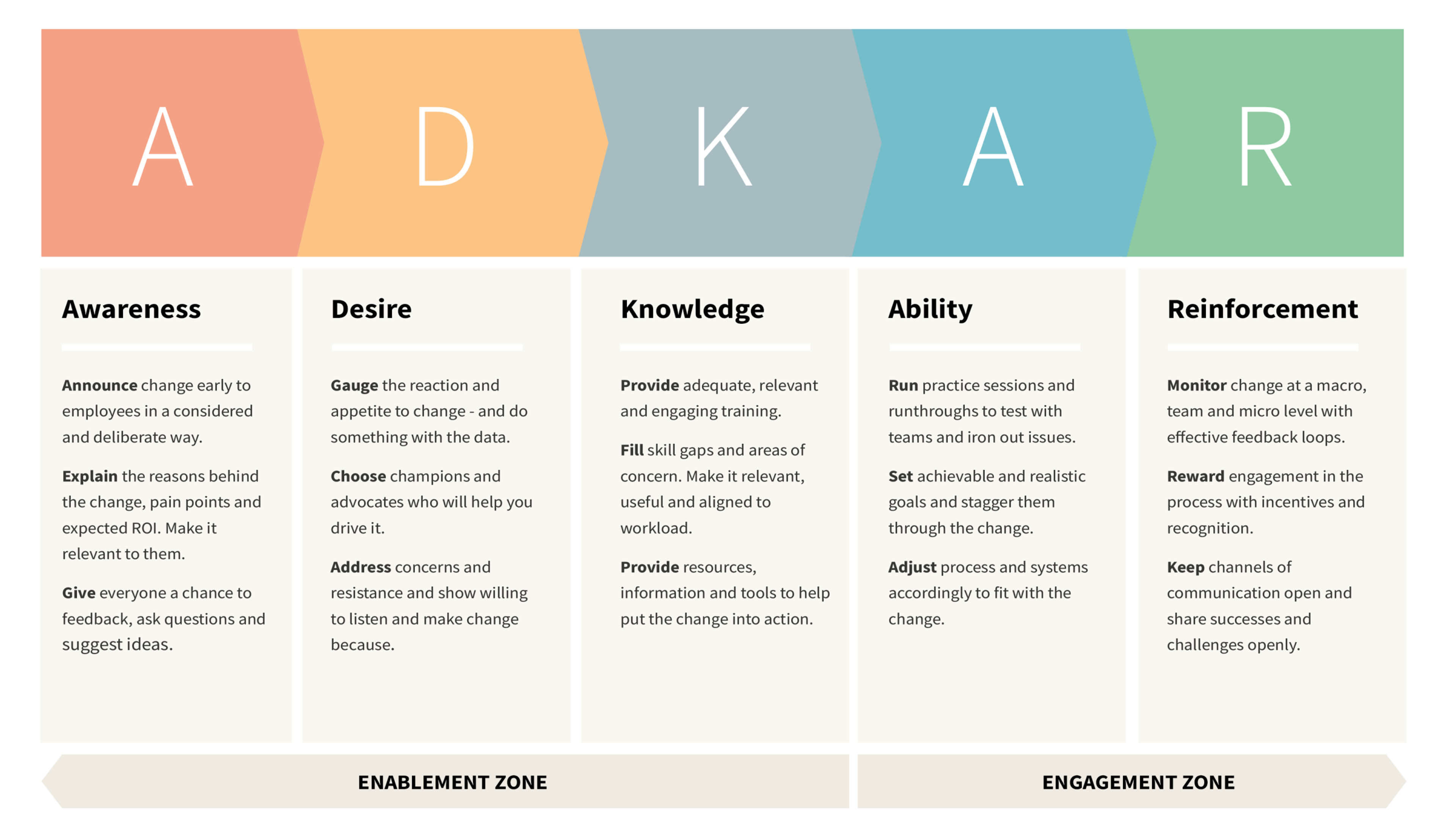
The ADKAR model is a five-stage framework for managing change at an individual level - Awareness, Desire, Knowledge, Ability, and Reinforcement. It helps organisations understand what people need at each point in a change process and where things are getting stuck.
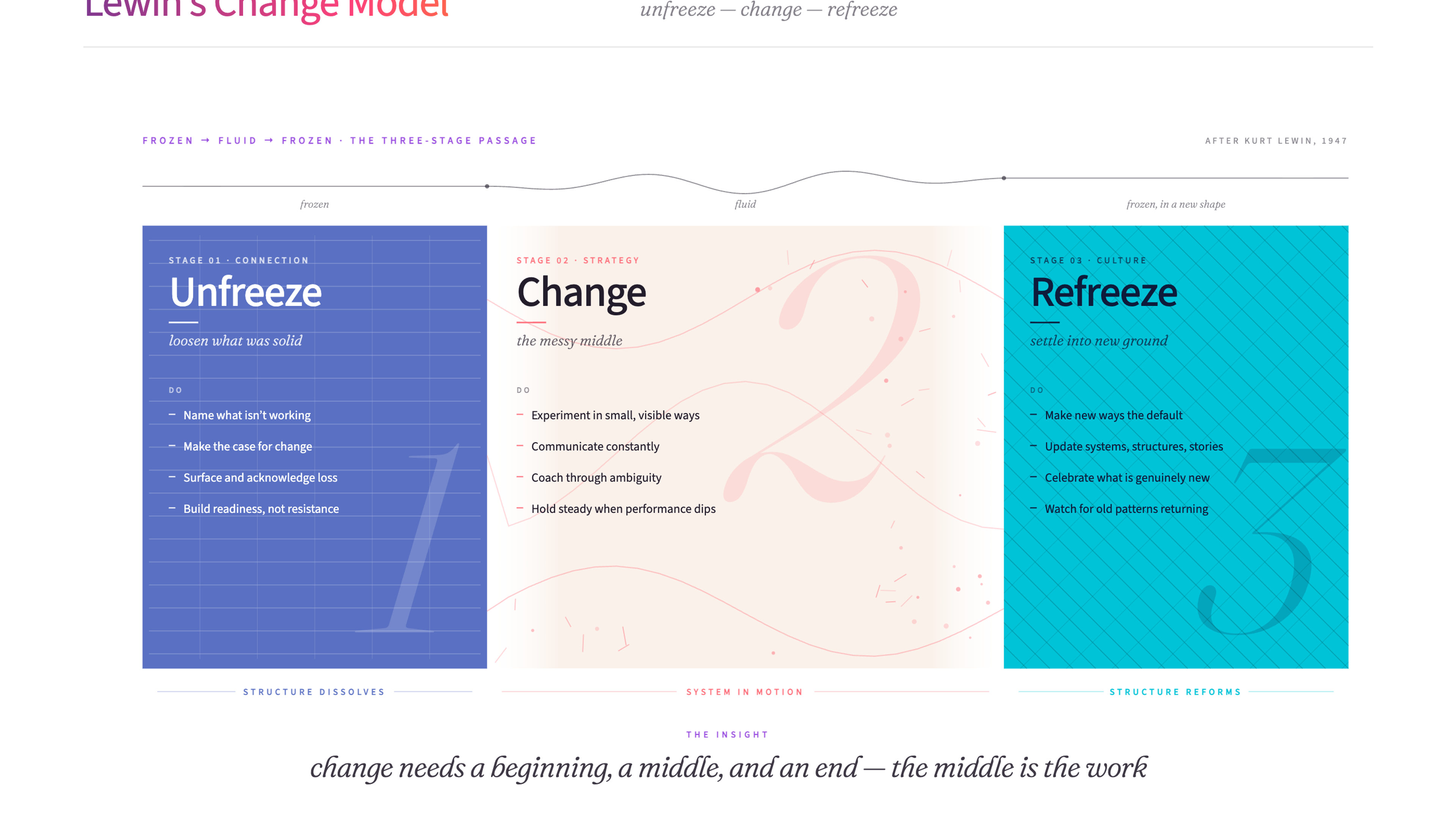
Lewin's Change Model breaks organisational change into three stages - Unfreeze, Change, and Refreeze. Before anything can shift, the conditions holding the current state in place need to soften. Then the change happens. And then the new patterns need to solidify, or the organisation drifts back.
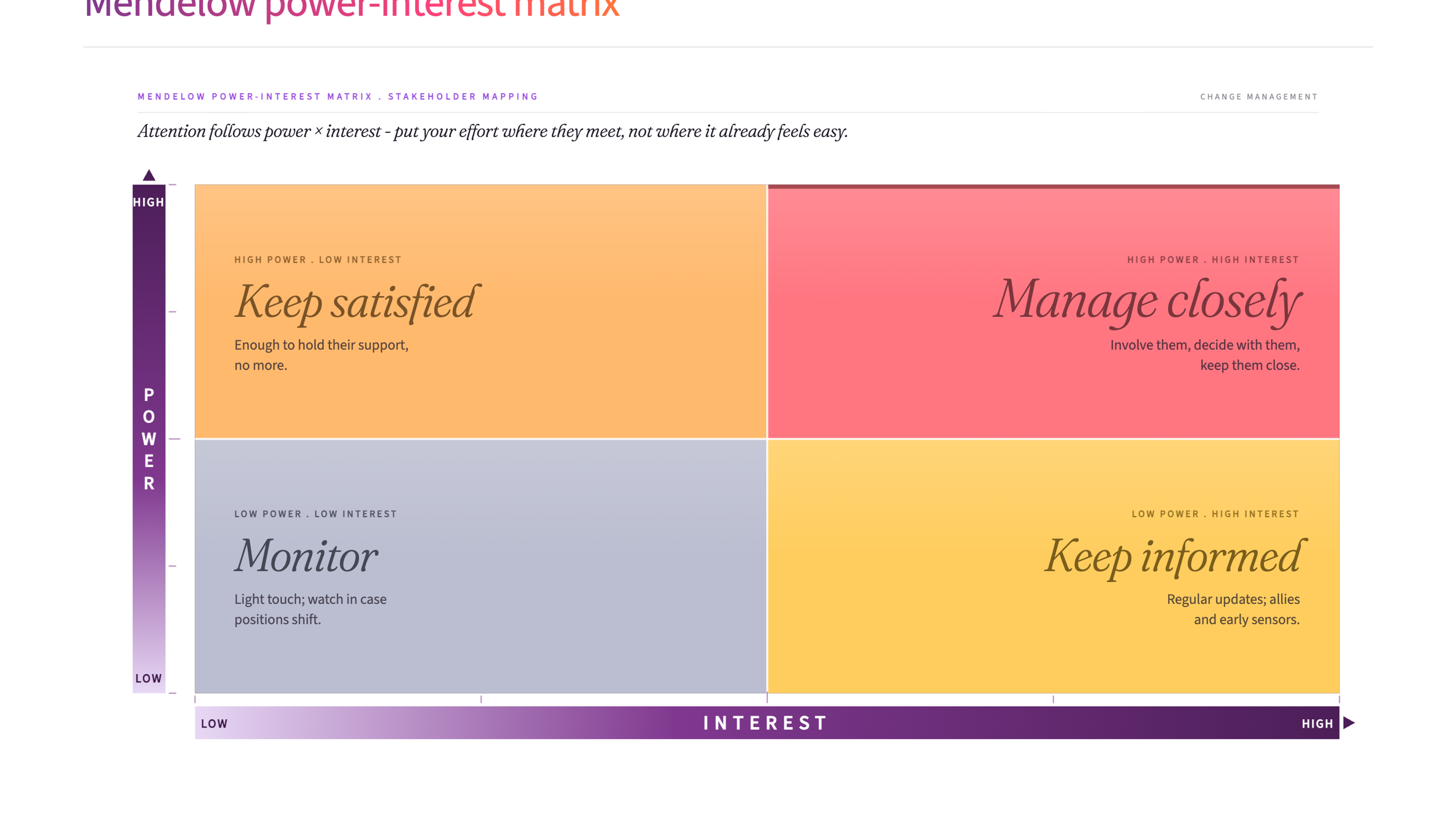
The Mendelow Power-Interest Matrix is a stakeholder mapping tool that helps you work out who matters most during a change or project. It plots stakeholders by their level of power and interest so you can plan how to engage each group.

The traditional approach to building a case for change relies on urgency and burning platforms. But urgency wears off, and fear creates resistance. This article explores a different approach - building a case for change that's rooted in honesty, shared understanding, and a genuine picture of what's possible.

Change management and change leadership are often used interchangeably, but they're fundamentally different. This article explains what each involves, why the distinction matters, and how to develop both capabilities in your organisation.

Your change initiative was well-planned, well-managed, and well-communicated. And it still didn't land. Here's what most change programmes overlook.
Change Management Training
Kotter's eight steps are a useful lens, and one of several we draw on in our Change Management training - built around the change your teams are working through.
James Freeman-Gray is the founder of Mutomorro. He's an organisational development practitioner who has spent over twenty years working with leaders across public, private and nonprofit sectors - helping organisations pull together around a common purpose, joined up in how they work. More about who we are and what it's like to work with us.
I've used Kotter's model in everything from housing association mergers to public sector transformation programmes. What I've found is that organisations often jump straight to step 3 or 4 without building the urgency and coalition first - and that's usually where things start to unravel. It's not a checklist to follow in order, but a map of the things that need to be true for change to stick.
Last reviewed: July 2026
Ready to use Kotter's 8 Step Change Model?
Download the free template - includes practical guidance for workshops and team sessions.
Get the free templateWant to put these ideas into practice?
Whether you're navigating a merger, rethinking how you're structured, or trying to shift a culture that isn't working - underneath, it's the same job: getting the whole organisation pulling in the same direction. Start with a conversation.