Ways of Working Rollout
Ways of Working Rollout takes your Ways of Working design and makes it real across the organisation: standardised processes in daily use, clear roles and decision rights, an installed daily and weekly management system, and performance measures every team acts on. It is the programme that gets the new way of working running, team by team, until it holds without us in the room.

Ways of Working Rollout installs the design across every team in scope, and we run six workstreams: standard work so each process runs the same way whoever is doing it, roles and decision rights so people know what they own, the daily and weekly management system that keeps the new routine live, the performance measures teams see and act on, the training and coaching that transfers the capability, and the phased, wave-by-wave transition that moves the organisation over without stopping the work. You come out with the way of working running in practice, not documented on a shelf.
We deliver the rollout with your people, not around them. Your role and ours are agreed together: depending on your own delivery capability and the size of the work, we co-lead the programme alongside your team, support from the side while your people lead, or run the whole rollout end to end. Every option builds the standard work, the management system and the coaching into the programme, so your leaders and teams run it themselves by the end. For deep technical and systems build we partner with the relevant specialists.
Operating model redesigns that changed seven or more of the twelve elements of an operating model were three times more likely to succeed than isolated structural changes. A broad, multi-workstream rollout beats a single move (McKinsey & Company, 'Operating model transformations: Not all elements are created equal', 2023).
When ways of working rollout helps
Ways of Working Rollout is the step once the design exists and the job is to make it the way the organisation actually runs. These are the situations we are most often asked into. If one sounds like yours, this is a good place to start.
The situation | How it helps |
|---|---|
You have a Ways of Working design and need it running for real | Takes the agreed processes, roles and management system and installs them across the org, so the design becomes daily practice rather than a document |
A previous rollout stalled and the old habits crept back | Installs the daily and weekly management system that holds the new routine in place, so the change stays rather than drifting back to how it was |
You do not have the bandwidth to deliver a rollout of this size alone | We co-lead or run the programme with you, bringing the delivery muscle while building your people up to carry it |
You need to move to the new way of working without breaking the business | Rolls out in waves with a pilot and quick wins first, migrating team by team so the organisation keeps running through the switch-over |
Teams are working differently and performance depends on who is in the room | Turns the design into documented standard work every team runs the same way, so performance no longer hinges on the individual |
Decisions and reviews have no rhythm and things fall through the gaps | Puts a tiered management system into live use - huddles, standard agendas and escalation paths - so problems surface and get acted on daily |
What we design
We run six workstreams, and each one installs a real part of the new way of working:

Standard work and process standardisation
Turn the designed processes into documented standard work each team can run: end-to-end workflows, procedures and handoffs, and the single agreed way a task is done, so performance no longer depends on who happens to be doing it.

Roles, decision rights and accountability
Install the new role definitions and decision rights so people know what they own and where calls get made, and stand up interim roles and dual-running structures to hold accountability steady through the switch-over.

The management system and operating rhythm
Put the daily and weekly routines into live use: tiered huddles, standard review agendas, escalation paths and the leadership cadence that keeps the new way of working running rather than sliding back.

Performance measures and visual management
Get the agreed measures into daily use at the point of work: team KPIs, visual boards and review triggers, so teams see and act on their own performance and progress is tracked wave by wave.

Capability building and standard-work training
Train teams and leaders in the new routines and standards, and coach leaders to run the management system themselves, so the capability lives in the organisation rather than in us.

Phased transition and wave governance
Sequence the switch-over as staged waves with a pilot, quick wins, milestones and dependencies, migrating team by team under a steering rhythm so the organisation moves to the new way of working without disruption.

Why these six
These six are the workstreams that together make a way of working actually run. Documented standard work with no management system to hold it drifts back within weeks; a daily rhythm with no clear decision rights stalls the moment something needs escalating; measures no one reviews change nothing. Each workstream depends on the others, so we run them as one set rather than one at a time.
They follow the established operational-excellence and operating-model frameworks - standard work and leader standard work, a daily management system with tiered reviews, and a wave-by-wave transition roadmap - so the rollout installs the whole system that makes a new way of working stick, not just the parts that are easy to launch. We use the frameworks to make sure nothing load-bearing gets skipped, not as a model to run at you.
How it works
The method produces one thing: the Ways of Working design live and running across every team in scope. It works by delivering the rollout with your people rather than doing it to them, so the capability to run the new way of working is left inside the organisation. It works in four modes.
- We scope our role with you - Before delivery starts, we agree who does what. Depending on your own delivery capability and the size of the rollout, we co-lead the programme alongside your team, support from the side while your people lead, or run it end to end. The posture is set with you and can flex as the programme moves.
- We roll it out in waves - We prove the new processes, roles and management system in one pilot area first, refine them, then migrate team by team in waves. Each wave installs standard work, decision rights and daily management for that team and banks quick wins, so the organisation keeps running while it changes over.
- We deliver it with your people - Your teams run the new processes and your leaders run the new routines from early on, with us alongside coaching. The way of working gets built by the people who will own it, so it fits how the work really goes and is theirs by the time we step back.
- We track it to landed - We measure the rollout against the baseline set at the diagnostic - processes in daily use, the management system running, the target measures moving - and keep correcting until the new way of working holds on its own, not just until it is launched.
The thinking behind the method
We deliver with your people, in waves, and track to landed because of a hard fact about change of this kind: launching it is the easy part and sustaining it is where most of the value is won or lost. In transformation research, around 63% of organisations met most of their objectives at launch, but only about 24% still held the gains later. The difference is whether the new way of working became the default routine or faded once attention moved on.
So the method is built around landing, not launching. Waves let each team switch over cleanly and prove the new way works before the next team follows. Delivering with your people means the routines are run by the people who own them, not performed for an audience that leaves. And the installed management system - the daily huddles, the standard reviews, the visible measures - is what keeps the new way of working running after we step back, so the change holds instead of reverting.
What you get
By the end, you have four things:

- The way of working running across the org - standardised processes in daily use, clear roles and decision rights, and the daily and weekly management system installed and live in every team in scope.
- Progress measured against your baseline - the rollout tracked against the read taken at the diagnostic, so you can see the target measures moving and know the change has actually landed.
- Your people able to run it - leaders trained and coached to run their own operating rhythm, and teams working the new way by default, so it holds without us in the room.
- A working management rhythm handed over - the huddles, reviews, agendas and measures set up and in use, ready to sustain and evolve as the next stage.
A rollout has to move fast enough to build momentum and slow enough not to break the business, and those pull against each other: speed banks quick wins, care protects the work that must keep running. Holding both at once is the craft of the work.
How we hand it over - and what happens next
The point of the work is a way of working your organisation runs itself, so we take care with how we step back. We do not hand over at launch. We hand over once the measures are in daily use, your leaders are running the management system without us, and the capability to keep it going sits inside the org. Because your people delivered it alongside us, the handover confirms a routine they already run rather than passing them something cold.
From there the ongoing work of sustaining, sensing and evolving the way of working belongs to the Adapt stage, which keeps the routines healthy and improves them as the organisation changes. The rollout has done its job when the new way of working is what teams do by default, the leadership team runs its own operating rhythm, and performance holds on its own.
Where this sits
Ways of Working Rollout is the delivery stage in how we approach operational effectiveness. It delivers the Ways of Working Design, follows the Operational Effectiveness Assessment that reads where you stand today, and leads into ongoing Adapt work that sustains and evolves the way of working over time. It also stands on its own - if you already have a design, ours or your own, and need it delivered across the organisation, this is where to start.
Common questions
How is this different from Ways of Working Design?
The design produces the blueprint: the agreed processes, roles, decision rights and measures - how the organisation should work. Ways of Working Rollout delivers that blueprint across the org. It takes the design and installs it, team by team, until the new way of working is running in daily practice. Design answers 'what the new way of working should be'; this answers 'now make it real everywhere'.
How is this different from a change management programme?
Every rollout uses change-delivery mechanics - mobilising leaders, bringing teams with you, reinforcing new habits - and this one does too. The difference is what gets delivered. This programme installs a specific thing: standardised processes, a daily and weekly management system, roles and decision rights, and an operating rhythm, using operational-excellence and operating-model workstreams. It is the rollout of this domain's change, not a generic change template applied to any topic.
How much do you lead, and how much do we?
That is agreed with you, not fixed. Depending on your own delivery capability and the size of the work, we co-lead the programme alongside your team, support from the side while your people lead, or run the whole rollout end to end. The posture can flex as the programme moves. Whichever we choose, it is set up so your leaders and teams are more capable of running the new way of working by the end.
Do you handle the technical and systems build?
We deliver the organisation, people and process side of the rollout - the standard work, the roles and decision rights, the management system and the measures. Where the rollout needs deep technical or systems build, or programme management at large scale, we partner with the specialists who own that and shape it alongside them, rather than claiming to do it ourselves.
What do we walk away with?
The way of working running across every team in scope: standardised processes in daily use, clear roles and decision rights, an installed daily and weekly management system, and performance measures teams act on themselves. You also walk away with a leadership team running its own operating rhythm and progress measured against the baseline, so you can see the change has landed and hold it without us.
What happens after the programme?
The rollout lands and stabilises the new way of working up to the point your teams run it independently. Keeping it healthy and improving it as the organisation changes belongs to the Adapt stage that follows, which sustains and evolves the routines over time. Because we leave the capability behind, much of that ongoing work is something your own leaders can carry, with us alongside where it helps.
Service improvement led by customers and teams, not handed down by consultants
A growing housing association where staff could recite the values but customers experienced something different - and previous improvement efforts kept addressing symptoms rather than causes. Getting every team working to one standard of service, rather than handing customers between them, was the real job.
Read case study →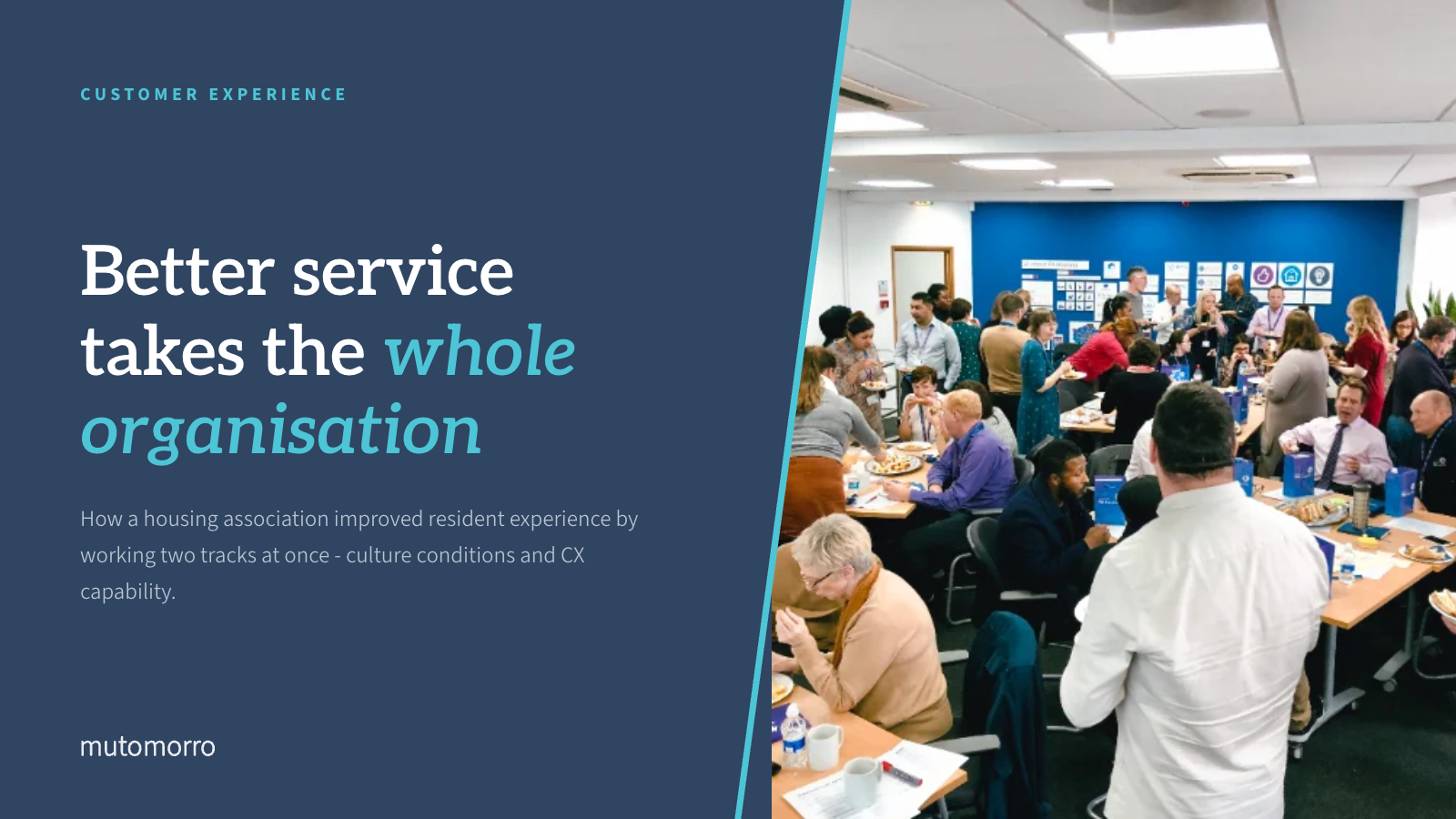
Customer experience shaped by how the whole organisation works, not just the frontline
A housing association with around 9,000 homes had invested in journey mapping, customer profiles and resident research - but the data pointed to something the CX toolkit couldn't fix alone. Culture work without CX capability would produce good intentions and no change. CX capability without the culture shift would produce better-mapped journeys that still fell through the same gaps. They needed both.
Read case study →Most operational improvement focuses on the visible system - processes, workflows, tools. We work with the conditions underneath that determine whether it functions well.
A clear read of how work actually flows from request to done - and where effort leaks between the steps.
Ways of working design gives you a future-state value stream design: a clear picture of how work will flow from request to delivery, with the queues removed, the handoffs redrawn, the decisions assigned and the cadence set - backed by a map of how the work flows today and a plan to get from one to the other. We design it with the people who run the work, so the result is genuinely theirs.
Continuous improvement keeps your new ways of working fit and improving, and builds your own people's ability to run them. Your teams run the improvement cycles and the daily management routines themselves, and you can keep us on a light ongoing rhythm as a critical friend to your improvement work, at a cadence you set.
The PDCA Cycle (Plan, Do, Check, Act) is a continuous improvement framework for testing and refining processes. It creates a repeating loop of planning a change, trying it, checking whether it worked, and adjusting before the next round.
Kaizen is a Japanese continuous improvement philosophy built on the idea that small, ongoing changes add up to significant results over time. The Kaizen Cycle gives teams a structured way to identify improvements, test them, and build them into everyday work.
The RASCI Framework maps five roles in any project or decision - Responsible, Accountable, Supportive, Consulted, and Informed. It helps organisations clarify who does what, reducing confusion and speeding up delivery.
The DACI Framework is a decision-making tool that clarifies who plays what role in a decision - Driver, Approver, Contributors, and Informed. It cuts through ambiguity about who owns what, especially when decisions involve multiple people or teams.
A Gemba Walk is a Lean practice where leaders go to the place where work actually happens to observe, listen, and understand. It bridges the gap between how leaders think work gets done and how it really gets done.
Every organisation has friction - the unnecessary effort, the needless complexity, the things that make simple work harder than it should be. This article explores how to find it, understand where it comes from, and reduce it without creating new problems in the process.
Your change initiative was well-planned, well-managed, and well-communicated. And it still didn't land. Here's what most change programmes overlook.