OODA Loop
The OODA Loop (Observe, Orient, Decide, Act) is a decision-making framework designed for fast-moving, uncertain situations. It helps leaders and teams make quicker, better decisions by cycling through observation and action rather than getting stuck in analysis.
Get the free template
Every decision follows a pattern - even when it doesn't feel like one. You scan the situation, make sense of what you're seeing, choose a direction, and move. The OODA Loop turns that instinctive pattern into a deliberate practice, giving teams a way to make better decisions faster - especially when things are shifting around them.
What is the OODA Loop?
The OODA Loop is a decision-making framework built around four phases: Observe, Orient, Decide, and Act. After acting, you loop back to observing the results - creating a continuous cycle of learning and responding.
Colonel John Boyd developed the model in the 1960s while studying why some fighter pilots consistently won aerial engagements while others didn't. His conclusion: the pilots who won weren't necessarily faster or more skilled. They were better at reading the situation, making sense of it, and adjusting their response before their opponent could do the same. Boyd called this "getting inside the opponent's OODA Loop" - cycling through the process faster than the other side could keep up with.
Boyd originally created the framework for military strategy, but the core idea translates directly into organisational life. Any environment where conditions change, information is incomplete, and decisions need to happen before you have perfect clarity - that's OODA territory. Product launches, crisis response, competitive strategy, operational pivots: all of these benefit from faster, more deliberate decision cycling.
What makes the OODA Loop different from a simple "plan-do-check" cycle is where it places the emphasis. Most decision frameworks treat "thinking about the situation" as a single step. Boyd broke it into two: Observe (gathering information) and Orient (making sense of it). That separation matters, because the biggest decision failures usually happen not because people lacked information, but because they interpreted it through the wrong lens.
How the OODA Loop works
The four phases flow left to right, but the loop isn't a neat circle. Orient sits at the centre of everything - it's the engine that drives how you interpret what you observe, what decisions you consider, and how you evaluate the results of your actions. Understanding that asymmetry is key to using the model well.
Phase | What it is | Watch out for |
|---|---|---|
Observe | Gather raw information on what's happening and changing | Collecting data without noticing what's absent |
Orient | Make sense of it, aware of the filters shaping your reading | The phase most teams rush - it sets decision quality |
Decide | Choose a course of action, ready to be tested | Waiting for perfect information over a workable move |
Act | Execute, then feed the results back into the loop | Treating action as final rather than the next round |
Observe

Observation is the input phase. You're gathering raw information about what's happening - in your market, your team, your operating environment, or whatever context the decision sits within.
Boyd identified several streams that feed observation:
- Unfolding circumstances - what's changing right now, in real time
- Outside information - data from external sources: reports, research, customer feedback, competitor moves
- Unfolding interaction with environment - how your previous actions are affecting the situation (this is where the loop feeds back)
Good observation isn't just collecting data. It means noticing what's changing, what's absent, and what patterns are forming - not just what's obvious. A PESTLE Analysis can provide a structured approach to environmental scanning that strengthens the Observe phase.
Orient

Orient is where the real work happens. This is the phase most people rush through - and the one that determines whether the rest of the loop produces good decisions or poor ones.
Orientation means making sense of what you've observed. Boyd argued that five forces shape how you interpret any situation:
- Cultural traditions - the norms, assumptions, and "how we do things here" that filter what you notice and what you ignore
- Previous experience - what's worked before, and the patterns your brain defaults to when things look familiar
- New information - fresh data from the Observe phase that might challenge your existing mental models
- Genetic heritage - your innate dispositions and cognitive tendencies (the biases you don't choose but carry)
- Analysis and synthesis - the active, deliberate work of breaking information apart and reassembling it into a new understanding
The reason Orient matters so much is that it shapes everything downstream. Two leaders can observe the same situation and reach completely different conclusions - not because one has better data, but because their orientation filters are different. An organisation's culture, its past successes and failures, and the mental models its leaders carry all act as lenses that colour how new information gets interpreted.
This is also where the Competing Values Framework becomes useful. Understanding your organisation's dominant culture type can reveal which orientation filters are strongest - and which blind spots they create.
Boyd's insight was that orientation isn't something you do once. It's a continuous process that updates as new information arrives. The best decision-makers actively challenge their own orientation - asking not just "what am I seeing?" but "what might I be missing because of how I'm looking?"
Decide

With a clear orientation, the Decide phase involves selecting a course of action. This doesn't have to mean a formal decision-making process. In fast-moving situations, the decision might be almost instantaneous - a hypothesis about what will work, ready to be tested through action.
Boyd distinguished between two types of decision-making within the loop:
- Explicit - deliberate, analytical decisions where you weigh options and choose
- Implicit - intuitive decisions guided by experience and orientation, where the "right" response feels obvious without conscious analysis
Speed matters here, but not at the expense of quality. The goal isn't to decide recklessly - it's to avoid the paralysis that comes from waiting for perfect information. In the Cynefin Framework's language, OODA is most powerful in complex and chaotic domains, where waiting for certainty means the situation will have changed before you've finished analysing it.
Act

Act is execution - implementing your decision and feeding the results back into the loop. The action itself generates new information: the market responds, the team reacts, the situation shifts. That new data becomes input for the next Observe phase, and the cycle continues.
The critical point about Act is that it's not the end. Every action is an experiment that generates learning. Teams that treat action as final ("we've decided, now we execute") miss the loop's central insight: acting is also observing. What happened? Did the situation change as expected? What surprised you?
How to use the OODA Loop
The OODA Loop works best as a team operating rhythm rather than a one-off exercise. Here's how to put it into practice:
Start by mapping your current decision cycle. Before trying to speed up, understand how decisions currently move through your team. Where do they stall? Most teams find the bottleneck isn't in deciding or acting - it's in the gap between observing and orienting. People collect information but don't create shared meaning from it.
Build orientation time into your process. The instinct in fast-moving situations is to jump from observation straight to decision. Resist it. Even five minutes of explicit orientation - "what does this mean for us, given what we know?" - improves decision quality significantly. The Embedded Strategy dimension of organisational health depends on exactly this kind of rapid sense-making.
Run shorter loops. The power of OODA isn't in any single cycle - it's in how quickly you can complete multiple cycles. Instead of one long deliberation followed by one big action, break decisions into smaller loops. Observe a narrow slice, orient quickly, decide on a small move, act, and observe the results. Each loop teaches you something the previous one couldn't.
Challenge your orientation filters. Actively ask: what assumptions are we making? What would someone from outside our culture notice that we're missing? What worked last time that might not work this time? The Orient phase only helps if you're willing to let new information change your mental models - not just confirm them.
Use OODA alongside other frameworks. The OODA Loop tells you how to cycle through decisions, but it doesn't tell you what to look at or how to analyse what you find. Pair it with tools that strengthen specific phases: PESTLE Analysis for structured observation, the Competing Values Framework for understanding orientation biases, or the PDCA Cycle when you need a more deliberate improvement rhythm than OODA's rapid cycling.
Example
A technology company notices that a competitor has launched a feature strikingly similar to one they've been developing internally. Here's how the OODA Loop might guide their response:
Observe: The product team gathers information. What exactly has the competitor launched? How are customers responding? What's the pricing? What are early reviews saying? They also note their own development timeline - their version is six weeks from release.
Orient: The leadership team makes sense of what they're seeing. Their instinct (previous experience) says "rush to launch first." But when they examine that impulse, they recognise it's driven by a competitive reflex, not by customer insight. The new information suggests the competitor's version has gaps in enterprise features - exactly where this company is strongest. Their cultural tradition of "shipping complete" actually becomes an advantage, not a handicap.
Decide: Rather than racing to launch an incomplete product, they decide to accelerate the enterprise features, delay by two weeks, and position their release as the version built for serious organisations.
Act: They adjust the roadmap, brief the sales team on the positioning shift, and begin a targeted outreach campaign to enterprise prospects who might be evaluating the competitor's offering.
The results of that outreach become the next Observe phase. Are enterprise buyers responding? Has the competitor adjusted? The loop continues.
Limitations
The OODA Loop is powerful, but it has boundaries worth understanding.
It assumes speed is an advantage. In genuinely complex situations - cultural transformation, long-term strategic alignment, deep structural change - faster cycling isn't always better. Sometimes the right response is to slow down and sit with ambiguity rather than pushing for rapid action.
Orient is hard to do honestly. Boyd's model asks people to examine their own biases, cultural assumptions, and mental models. In practice, most teams skip this and jump from observation to decision. The Orient phase requires psychological safety and intellectual honesty that many organisations haven't built yet.
It's better for responsive decisions than proactive strategy. OODA excels when you're responding to a changing environment. It's less useful for long-range planning where the goal is to shape the environment rather than react to it.
Individual vs collective OODA. Boyd designed the model for individual decision-makers (pilots). Scaling it to teams and organisations introduces coordination overhead that slows the loop. The larger the group that needs to orient together, the harder it becomes to maintain speed.
Getting started
Pick one decision your team is currently navigating - something where the situation is shifting and you don't have all the information you'd like. Run a single, explicit OODA cycle together. Spend ten minutes on each phase: what are we actually observing (not assuming)? What does it mean, given our context and biases? What's our best move right now? And what will we watch for after we act? That single loop will teach you more about the framework than any amount of reading about it.
We share thinking on organisational change and development on LinkedIn - practical ideas for people doing this work inside their own organisations.
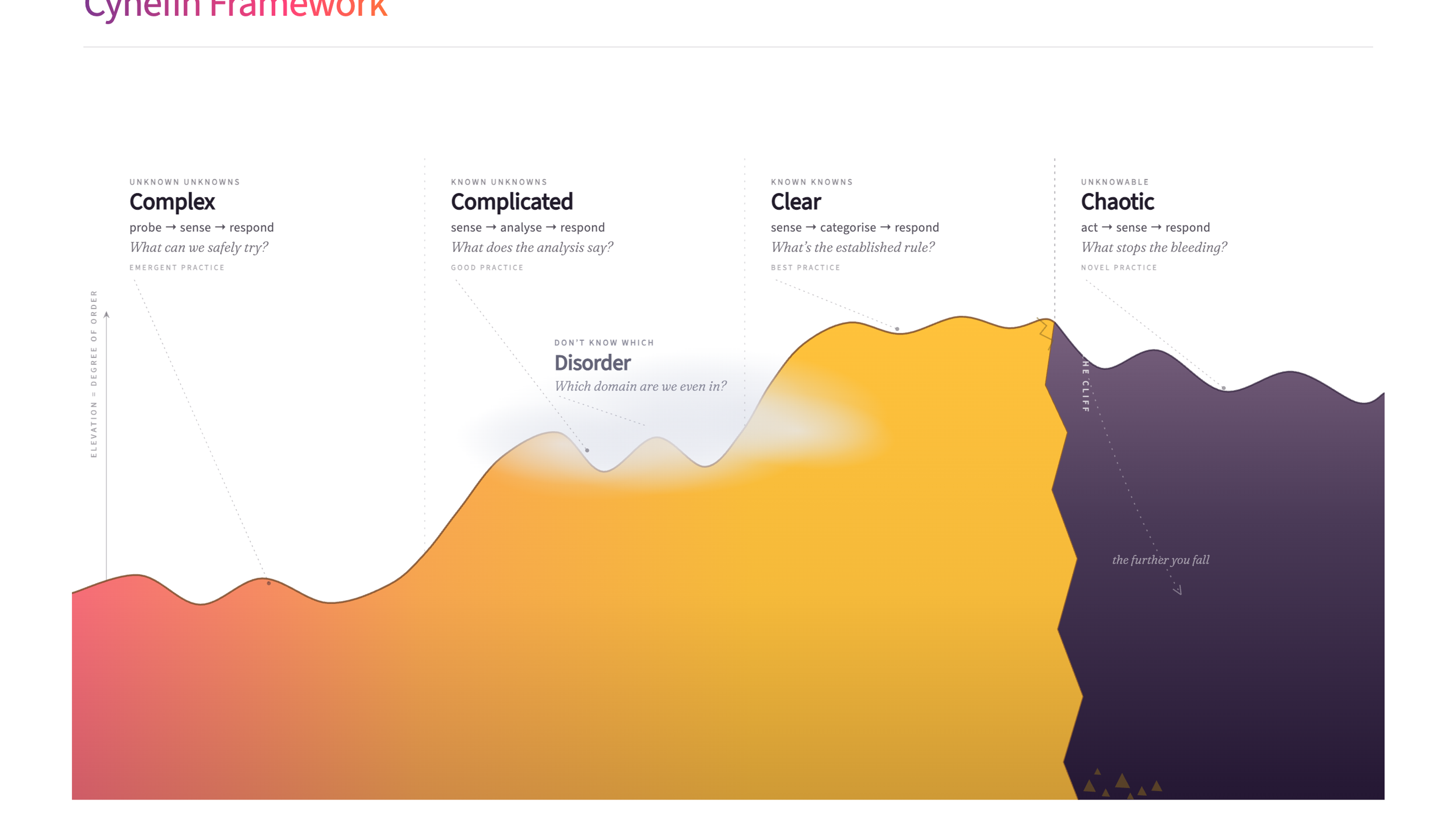
The Cynefin Framework is a decision-making model that helps leaders understand what kind of situation they're dealing with - clear, complicated, complex, chaotic, or confused. The right approach depends on the context, and this framework helps you match the two.
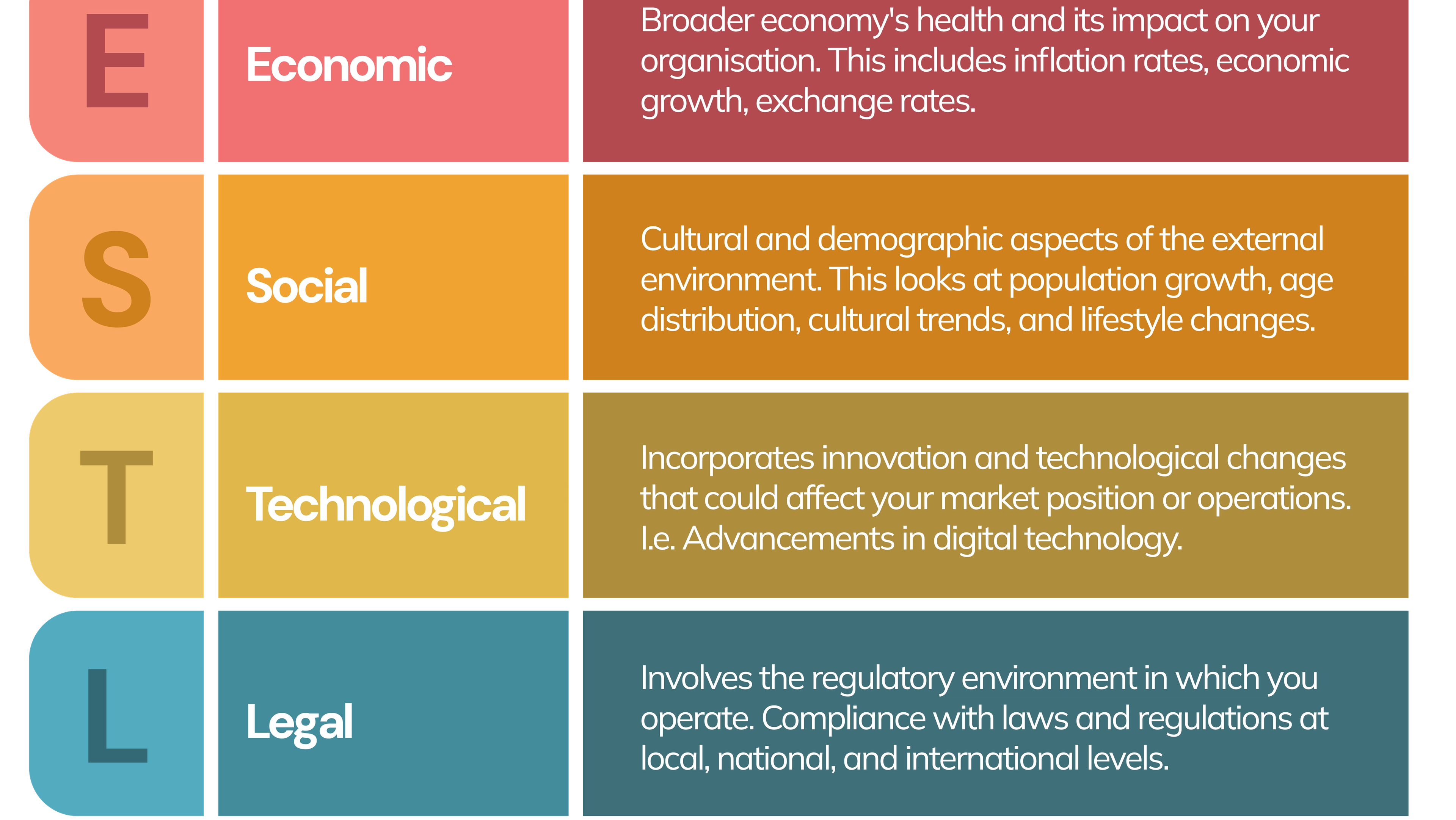
A PESTLE Analysis is a framework for scanning the external environment across six areas - Political, Economic, Social, Technological, Legal, and Environmental. It helps organisations understand the bigger forces that could affect their strategy and planning.
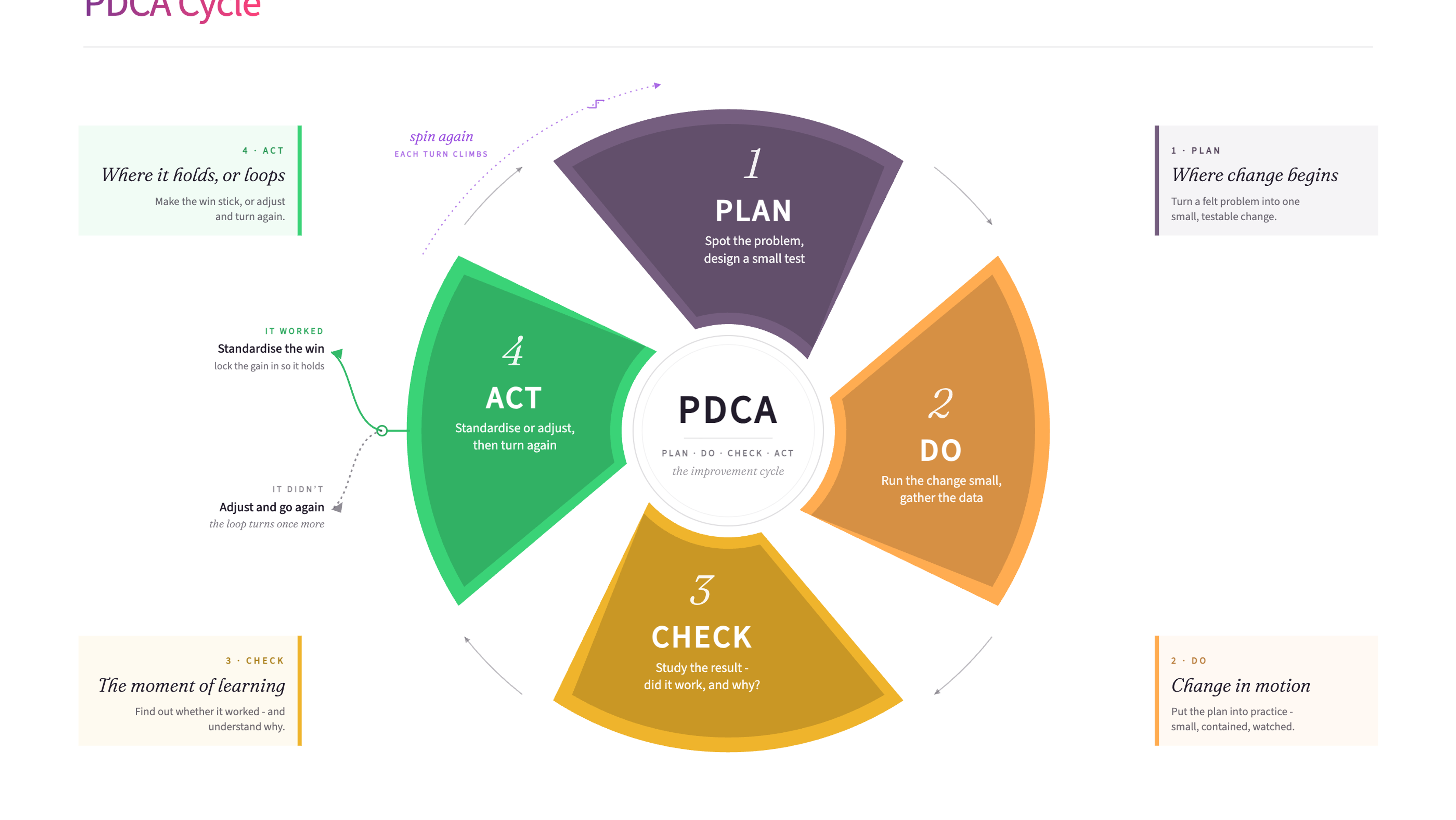
The PDCA Cycle (Plan, Do, Check, Act) is a continuous improvement framework for testing and refining processes. It creates a repeating loop of planning a change, trying it, checking whether it worked, and adjusting before the next round.
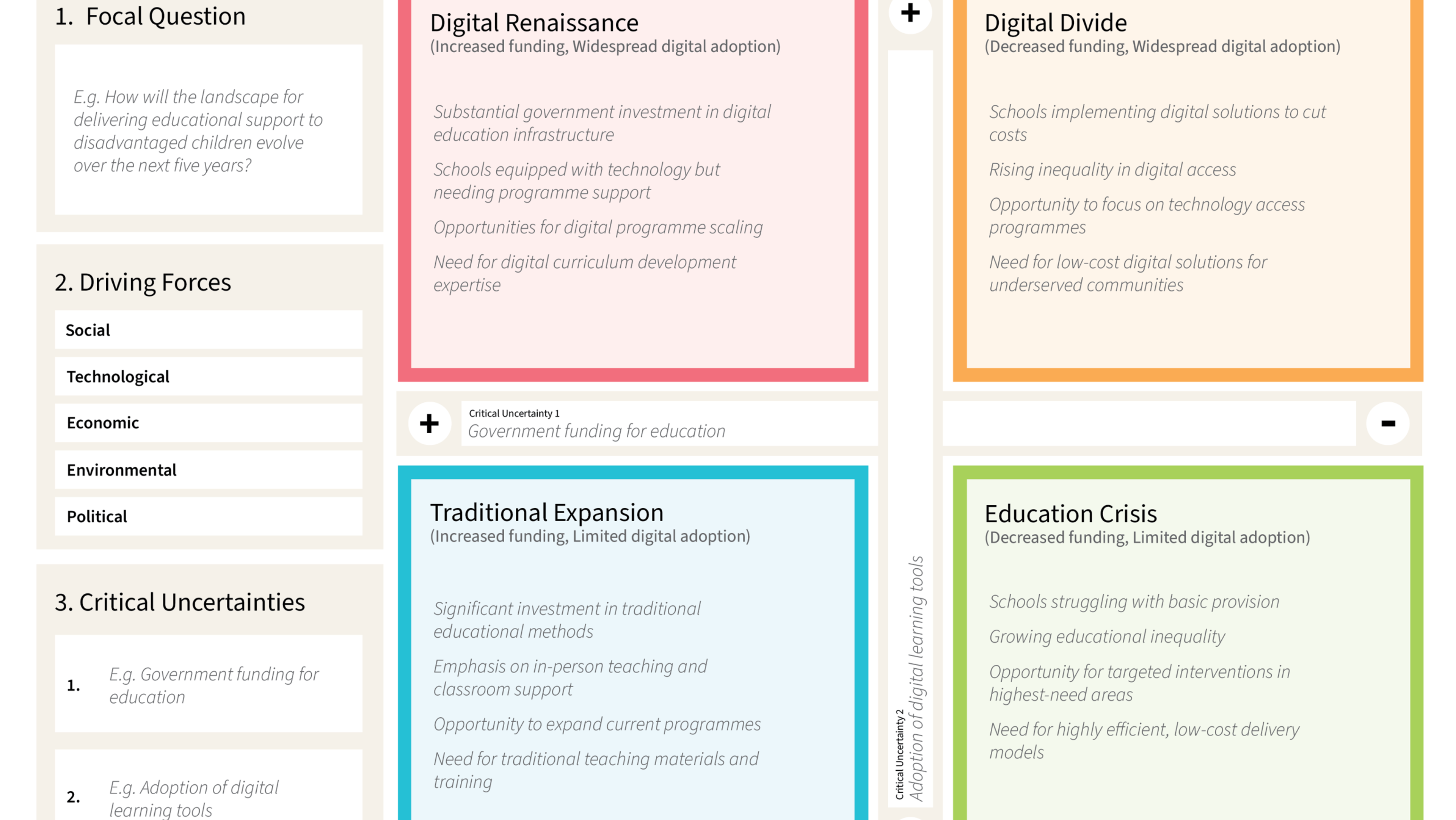
The 2x2 Scenario Matrix is a strategic planning tool that helps organisations explore different possible futures. By mapping two key uncertainties against each other, it creates four distinct scenarios you can plan and prepare for.

Resilience isn't about bouncing back to where you were. It's about developing the capacity to adapt, learn, and come through difficulty stronger than before. This article explores what organisational resilience actually looks like and what leaders can do to build it.
Adaptive leadership is what's needed when the usual approaches stop working - when the problems are complex, the answers aren't obvious, and the organisation needs to learn its way forward rather than execute a plan. This article explores what it means in practice.

Why the most reasonable solutions so often become next year's problem. Drawing on systems thinking, a 1930s sociologist, and MIT research on why the real cure gets abandoned just before it works - this piece traces the two ways a good fix turns on you, and the single habit that catches both.
Systems Thinking Training
The OODA loop is a useful way to think about acting under uncertainty, and one of several we explore in our Systems Thinking training.
James Freeman-Gray is the founder of Mutomorro. He's an organisational development practitioner who has spent over twenty years working with leaders across public, private and nonprofit sectors - helping organisations pull together around a common purpose, joined up in how they work. More about who we are and what it's like to work with us.
The OODA Loop is useful for organisations that need to make decisions faster without sacrificing quality. I use it when teams are stuck in analysis paralysis or when the environment is changing quicker than the organisation can respond. The key insight is that speed of decision-making is itself a competitive advantage.
Last reviewed: June 2026
Ready to use OODA Loop?
Download the free template - includes practical guidance for workshops and team sessions.
Get the free template
Want to put these ideas into practice?
Whether you're navigating a merger, rethinking how you're structured, or trying to shift a culture that isn't working - underneath, it's the same job: getting the whole organisation pulling in the same direction. Start with a conversation.