TESI model
The TESI model (Team Emotional and Social Intelligence) is a framework for understanding how emotions and relationships affect team performance. It helps teams recognise their patterns and build stronger ways of working together.
Get the free template
Most teams talk about trust, communication, or collaboration in broad terms - and most efforts to improve them stay broad too. A team-building session here, a difficult conversation there. The TESI model offers something more specific: a map of the seven emotional and social intelligence skills that shape how teams connect, handle pressure, and sustain their energy over time. It gives you a shared language for things teams rarely discuss directly - and a way to develop them deliberately.
What is the TESI model?
The TESI model - Team Emotional and Social Intelligence - is a framework that identifies seven skills teams need to function well together. It was developed by Marcia Hughes and James Bradford Terrell through their work at Collaborative Growth, and published in 2005. The accompanying assessment tool, the TESI Short, allows teams to measure their collective emotional intelligence and track development over time.
The core premise is straightforward: individual emotional intelligence matters, but team emotional intelligence is something different. A team of people who are each self-aware, empathetic, and good communicators can still struggle as a group. How the team reads the room together, resolves friction, and sustains its energy under pressure - these are collective capabilities, not just the sum of individual ones.
Hughes and Terrell identified seven skills that make up team ESI. They're not a flat list of equally weighted qualities. They layer - some are foundational, some are relational, and some only emerge when the deeper layers are in place. That layering is the key to understanding why some teams with talented people still feel stuck, while others with more ordinary members seem to work with a kind of effortless chemistry.
How the TESI model works
The diagram shows the seven skills as a rainbow - concentric arcs building outward from a foundational core. This isn't decorative. It reflects how the skills relate to each other: inner layers support outer ones. Positive mood - the outermost band - doesn't come from telling people to be more positive. It emerges when the six layers beneath it are working.
Layer (inside → out) | Skill | What it covers |
|---|---|---|
1 - core | Team identity | Belonging and shared purpose - the "we" everything else attaches to |
2 | Emotional awareness | The team's shared ability to read the room and notice unspoken tension |
3 | Communication | Genuine dialogue - listening, saying the difficult thing, making space for difference |
4 | Motivation | The team's collective drive, especially when things get hard |
5 | Conflict resolution | Working through disagreement productively - which rests on the four layers beneath |
6 | Stress tolerance | Holding the team's shape under pressure rather than reverting to old patterns |
7 - outer | Positive mood | The genuine optimism and energy that emerges when the inner layers are strong |
Team identity

The innermost band. Everything else rests on this. Team identity is the sense of belonging, shared purpose, and genuine connection that turns a group of individuals into a team. Without it, the other six skills have nothing to attach to.
This isn't about matching t-shirts or an away day. It's about whether team members feel like they're part of something meaningful - whether they'd describe themselves as "we" rather than "I and the others." Teams with strong identity share a clear sense of what they're trying to achieve together and why their particular combination of people matters.
When team identity is weak, you'll often see people defaulting to individual priorities, low engagement in collective decisions, and a general sense that the team is an administrative grouping rather than a working unit.
Emotional awareness

The second layer outward. Emotional awareness is the team's collective ability to read the room - to notice what's happening emotionally and respond to it with care. Not just individuals being self-aware, but the team developing a shared sensitivity to mood, energy, and unspoken tension.
This is what separates a group that happens to contain emotionally intelligent people from a team that is emotionally intelligent as a unit. It shows up in small moments: someone noticing a colleague has gone quiet and checking in, the team recognising when a discussion is generating heat rather than light, or a leader sensing that the group needs a pause rather than another agenda item.
Teams that develop this skill tend to catch problems earlier, before they become entrenched patterns. Research by Vanessa Druskat and Steven Wolff has shown that group-level emotional awareness is a stronger predictor of team effectiveness than the individual emotional intelligence of team members.
Communication

The third layer. With identity and awareness in place, communication becomes more than information exchange - it becomes genuine dialogue. In the TESI model, communication means listening as much as speaking, being willing to say what's difficult, and making space for different perspectives.
Most teams think their communication is better than it is. They confuse frequency with quality - lots of emails, lots of meetings, but little genuine exchange. The TESI model looks at whether team members feel heard, whether important things get said rather than left unspoken, and whether the team can hold honest conversations without them becoming adversarial.
This connects closely to work on psychological safety. Communication quality and safety reinforce each other: people communicate more openly when they feel safe, and teams become safer as communication improves.
Motivation

The fourth layer. Motivation in the TESI model isn't about individual ambition or external incentives. It's about the team's collective drive - the shared energy that keeps people showing up, contributing, and pushing through when things get difficult.
Hughes and Terrell distinguish between teams that are motivated by external pressure (deadlines, targets, accountability) and teams that are motivated by genuine investment in the work and in each other. Both can produce results, but the second is more sustainable and more resilient when circumstances change.
You can often feel the difference between a motivated team and one that's going through the motions. It shows up in the quality of ideas people bring, the willingness to take on extra effort when it matters, and the energy in the room when the team comes together. Project Aristotle - Google's research on team effectiveness - found similar patterns: the highest-performing teams weren't the ones with the strongest individual contributors, but the ones where people genuinely cared about the team's work.
Conflict resolution

The fifth layer. Notice where this sits - not at the foundation, but in the middle of the stack. The TESI model treats conflict resolution as a relational skill that requires the four layers beneath it. A team can only resolve conflict well when its members feel connected (identity), can read emotional signals (awareness), communicate openly, and care enough to work through disagreements rather than avoiding them (motivation).
This reframes how most teams approach conflict. The problem isn't usually that people lack negotiation skills. It's that the underlying conditions for handling conflict aren't in place. A team that tries to "improve conflict resolution" without attending to identity, awareness, communication, and motivation will keep hitting the same walls.
When this skill is well developed, disagreements become productive rather than destructive. The team can separate the issue from the relationship, hear different perspectives without feeling threatened, and reach resolutions that people genuinely commit to rather than merely accept. Thomas-Kilmann's conflict styles maps the different approaches people bring to disagreement - pairing it with the TESI model helps teams understand not just how they handle conflict, but why.
Stress tolerance

The sixth layer. Stress tolerance is the team's capacity to hold its shape under pressure - to maintain the quality of its communication, emotional awareness, and conflict resolution when things get difficult, rather than reverting to old patterns.
Every team can function well when conditions are good. The question is what happens when deadlines compress, stakes rise, resources shrink, or relationships are tested. Teams with high stress tolerance don't avoid stress - they maintain their collective capabilities in the face of it. The inner layers of the rainbow stay intact.
Teams with low collective stress tolerance often look fine on the surface until pressure hits. Then communication breaks down first, followed by emotional awareness, followed by the team fragmenting into individuals protecting their own position. The layering of the TESI model explains this cascade: stress erodes from the outside in, peeling away the outermost capabilities first.
Positive mood

The outermost band - and the one most often misunderstood. Positive mood in the TESI model doesn't mean forced cheerfulness or ignoring problems. It's the quality of optimism, humour, and generative energy that appears when a team's emotional and social foundations are strong. It's what you notice when you walk into a room with a team that works well together.
This is why positive mood sits at the outer edge of the rainbow rather than at the core. You can't build it directly. You can't mandate it. It emerges - a visible radiance that tells you something is working beneath the surface. Teams that try to cultivate positive mood without attending to the six layers beneath it end up with surface-level positivity that feels hollow.
When positive mood is genuine, it acts as a multiplier. Research suggests that teams with authentically positive emotional climates are more creative, more resilient to setbacks, and more effective at problem-solving. But the emphasis is on "authentically" - it has to grow from the inside out.
How to use the TESI model
Start with the layers, not the whole model. Don't try to assess all seven skills at once. Begin with the innermost band - team identity. Ask the team: do we have a clear, shared sense of what we're here to do? Would everyone describe our purpose in roughly the same way? If the answer is uncertain, that's your starting point. Everything else builds from there.
Use the TESI Short assessment. The formal assessment tool developed by Hughes and Terrell gives teams a quantified view of their collective ESI across all seven skills. It's designed for team self-assessment - the team completes it together and discusses the results. The value is less in the scores themselves and more in the conversation they generate. The Collaborative Growth website has information on accessing the assessment.
Read the rainbow from the inside out. If you identify a problem in an outer layer (say, poor conflict resolution), look to the layers beneath it before trying to fix the surface issue. Is emotional awareness strong enough for people to read the signals? Is communication open enough for disagreements to be raised? Is team identity strong enough that people want to resolve conflict rather than avoid it? The fix is often one or two layers deeper than where the problem shows up.
Make it a regular practice, not a one-off. Team emotional intelligence isn't static. It shifts with changes in membership, leadership, workload, and context. Revisit the model periodically - not as a formal assessment every time, but as a lens for checking in on how the team is functioning. A monthly five-minute conversation about "which layer feels strong right now, and which feels stretched?" can be more useful than an annual team development day.
Example
A product team in a growing technology company has started to struggle. They've doubled in size over the past year, and what used to be a tight, high-performing group now feels fragmented. Meetings are longer but less productive. Decisions that used to happen quickly now stall. Two senior members have a simmering tension that everyone can feel but nobody addresses.
The team leader introduces the TESI model using the rainbow framework. They begin with team identity - and this is where the first insight lands. The original team members share a strong identity built on years of working together. The newer members don't feel part of it. There's an unspoken "old guard" and "newcomers" dynamic that nobody has named.
With this visible, the team works on rebuilding identity around the team as it is now, not as it was. They redefine their shared purpose, create space for newer members to contribute to the team's direction, and acknowledge that growth has changed the group's character.
As identity strengthens, the simmering conflict between the two senior members becomes easier to address. The team's emotional awareness has improved enough to hold the conversation, and both people feel invested enough in the team to work through it rather than continuing to avoid it. The fix wasn't a conflict resolution workshop - it was strengthening the layers that made resolution possible.
Limitations
It's a team-level model, not an individual one. The TESI model is designed for intact teams that work together regularly. It's less useful for temporary project groups, cross-functional committees, or loose networks of people who share a reporting line but don't collaborate day to day. Belbin's Team Roles or DiSC Styles may be more appropriate for understanding individual contributions.
It requires honest self-assessment. The model relies on team members being willing to reflect on emotional dynamics openly. In teams where trust is very low or where there's a strong culture of avoiding emotional topics, introducing the TESI model can feel exposing. It may need groundwork on psychological safety before the model can do its best work.
The layering is a guide, not a rigid hierarchy. The inside-out logic of the rainbow is useful for diagnosis and prioritisation, but real teams are messier than the model. A team might have strong communication but weak identity, or excellent stress tolerance that compensates for gaps elsewhere. Use the layers as a thinking tool, not a prescription.
It doesn't replace structural conditions. Team emotional intelligence matters, but it doesn't overcome poor team design, unclear mandates, or impossible workloads. Hackman's 6 Team Conditions addresses the structural side of team effectiveness - the two models complement each other well.
Getting started
Start with one question in your next team meeting: "When we're at our best as a team, what's happening?" Listen to the answers and notice which of the seven TESI skills they describe - you'll likely hear people talking about connection, communication, energy, or the ability to handle difficulty together. Then ask: "And when we're struggling, what's the first thing that slips?" That question usually points to the layer where development would make the most difference.
For teams looking to develop their collective emotional intelligence as a deliberate capability rather than leaving it to chance, our organisational development consultancy works with intact teams to build the conditions where these skills can grow. The Enacted Culture dimension of the EMERGENT framework explores how the emotional and relational patterns within teams become the lived culture of the organisation - the culture people experience every day, not the one written on the wall.
We share thinking on organisational change and development on LinkedIn - practical ideas for people doing this work inside their own organisations.
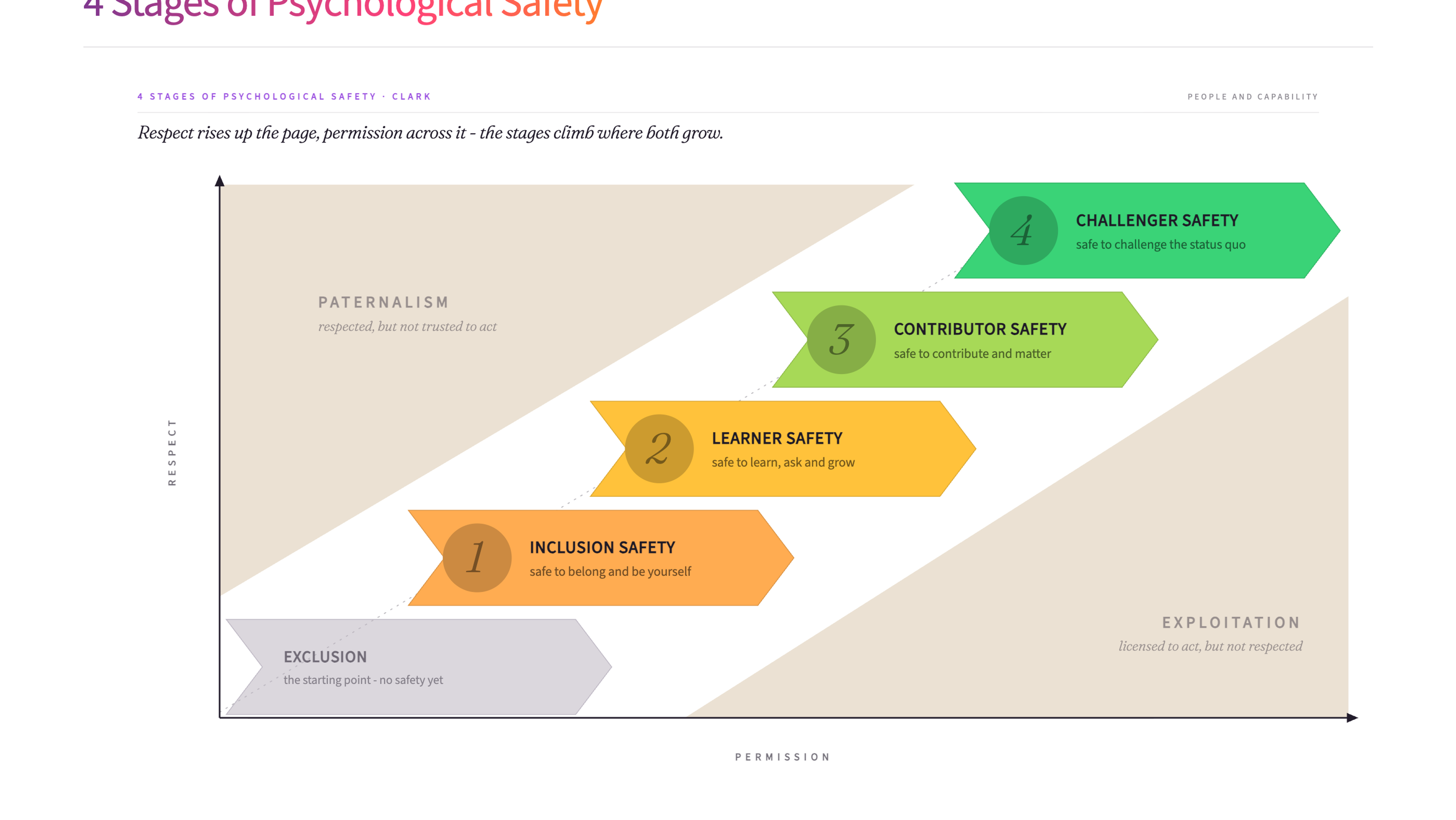
The 4 Stages of Psychological Safety is a framework that maps how safe people feel to be themselves, learn, contribute, and challenge the status quo. It helps leaders understand what conditions people need before they'll speak up and take risks.
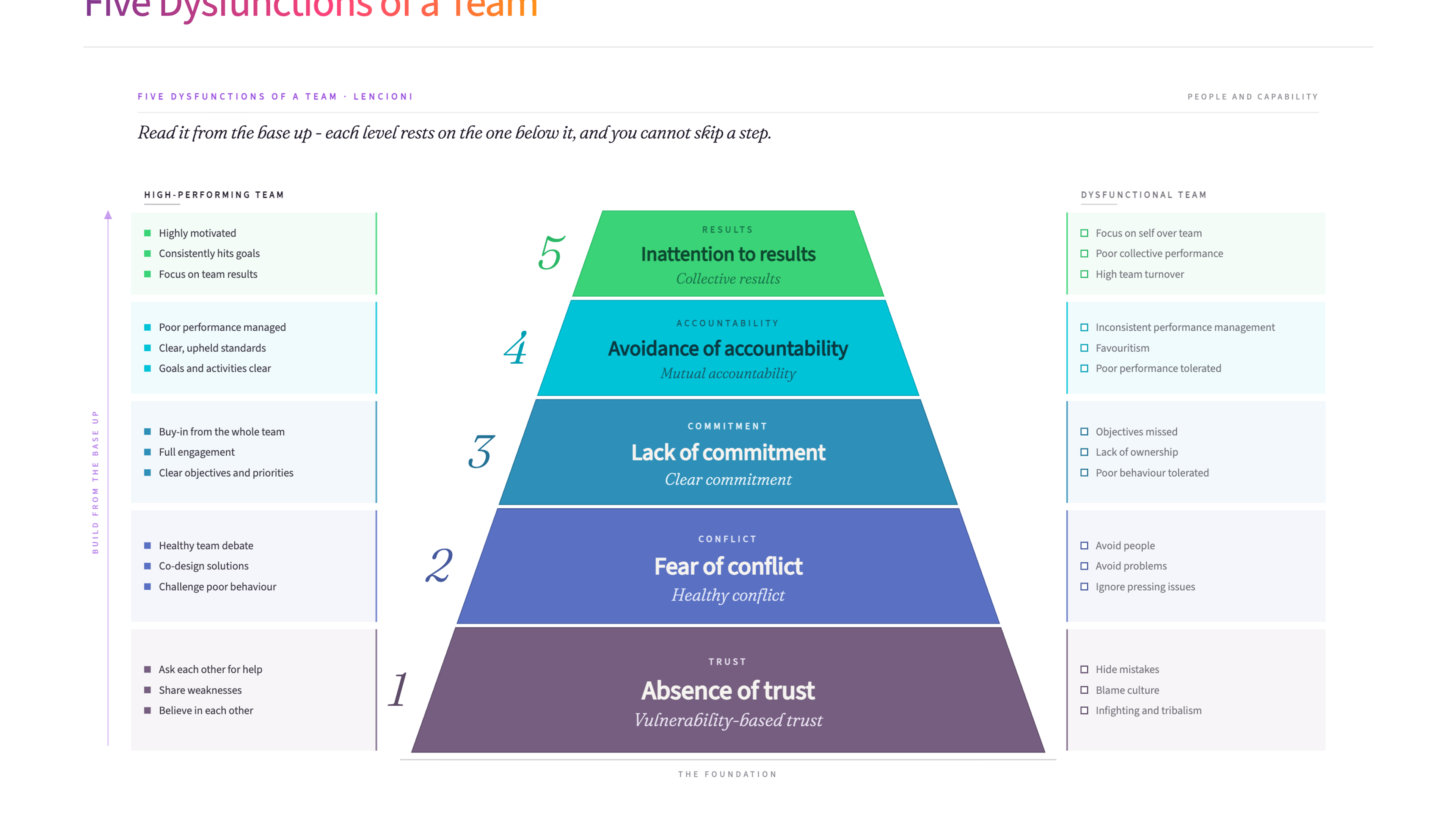
The Five Dysfunctions of a Team is Patrick Lencioni's framework for understanding why teams struggle. It maps five connected problems - from absence of trust to inattention to results - that build on each other when left unaddressed.
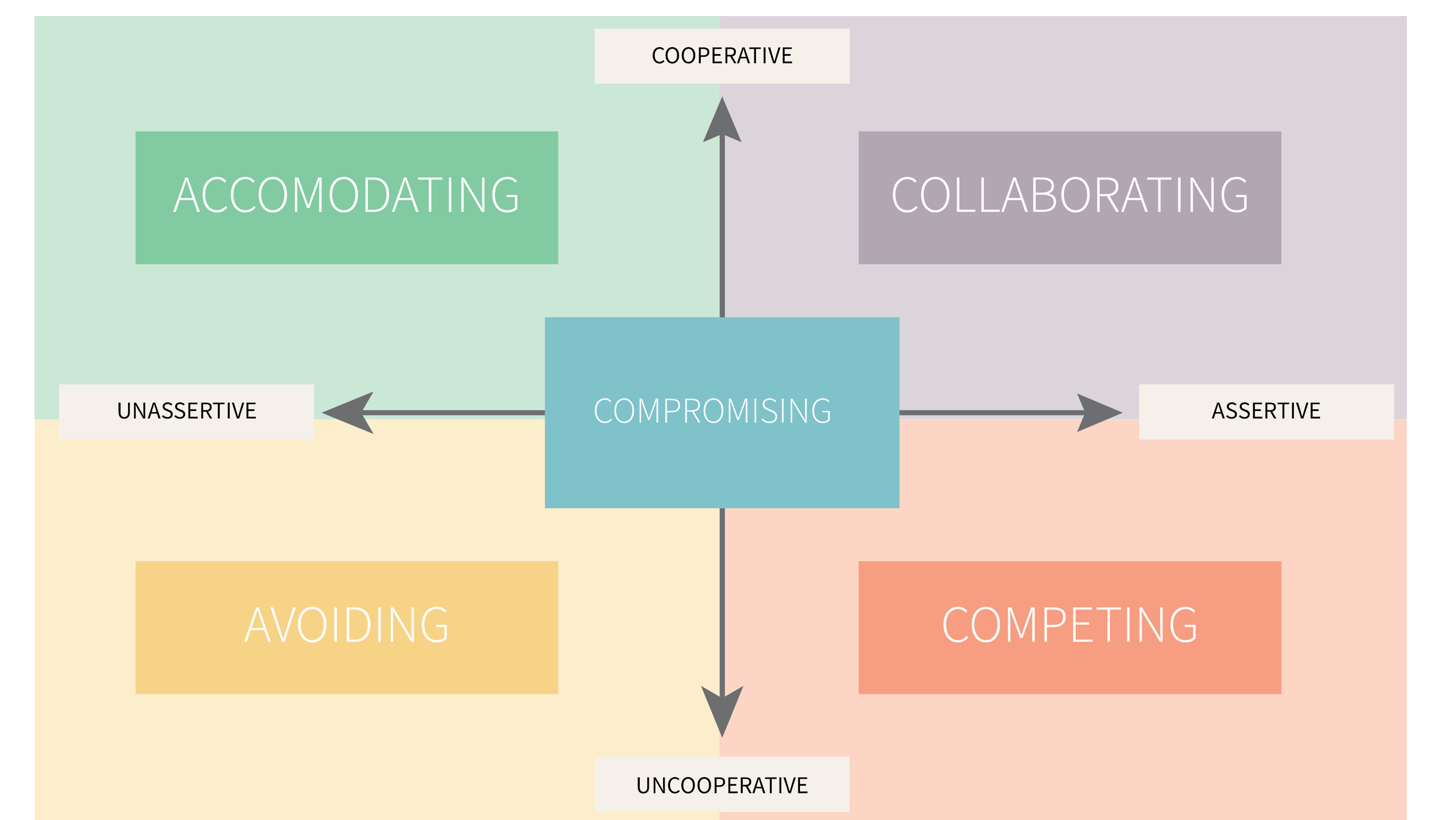
The 5 Conflict Styles model (Thomas-Kilmann) maps five different ways people approach conflict - from avoiding it to collaborating through it. It helps teams understand their default patterns and choose more effective approaches.
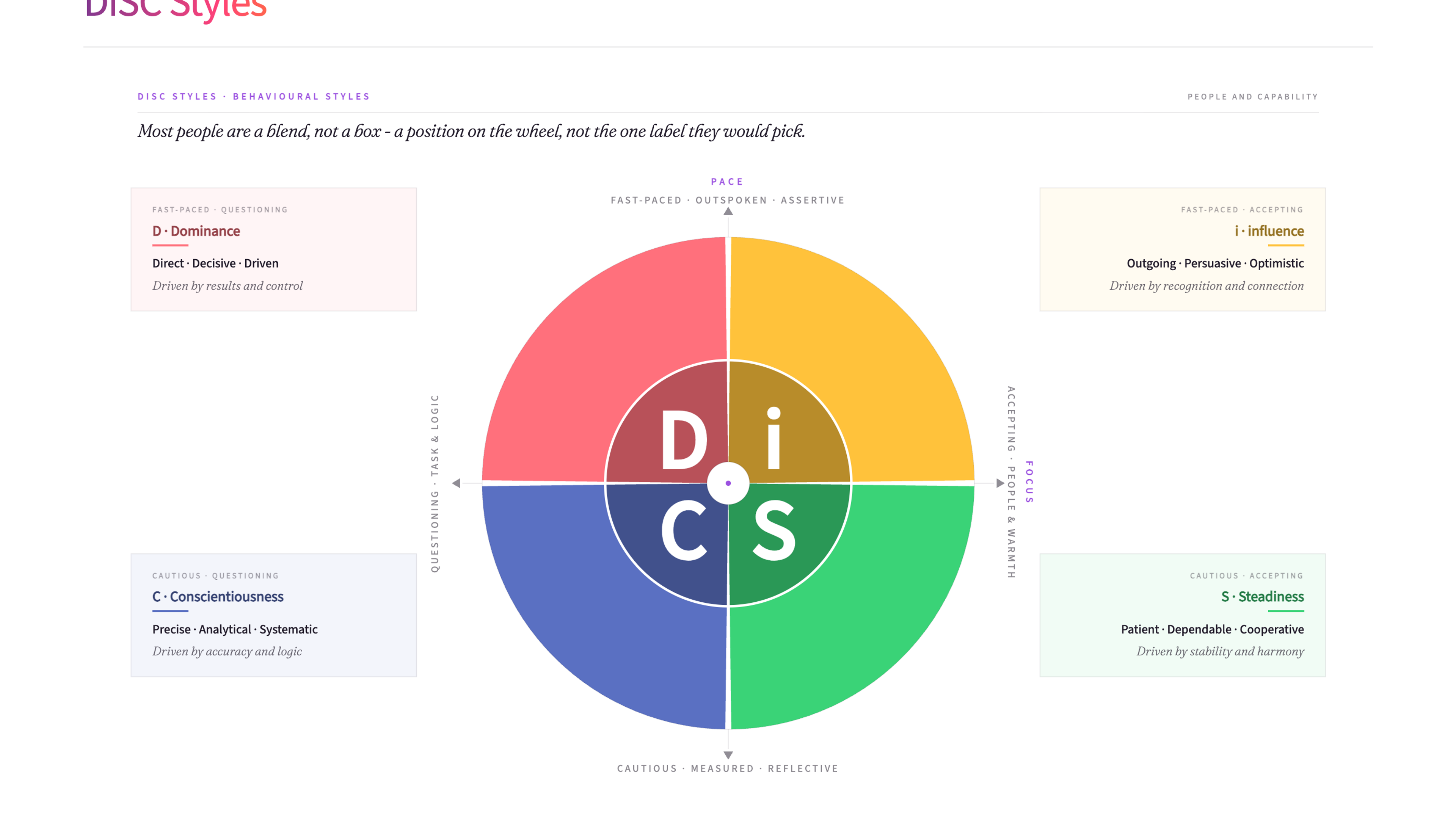
The DiSC model is a behavioural profiling tool that maps four personality styles - Dominance, Influence, Steadiness, and Conscientiousness. It helps teams understand how different people communicate, make decisions, and approach work.
Emotional intelligence in leadership isn't about being nice or reading a room. It's about the quality of attention you bring to how people are experiencing your leadership - and the willingness to adjust what you do based on what you notice.
Psychological safety is one of the strongest predictors of team performance - but it's often misunderstood. This article explores what it actually looks like in practice, why it matters beyond the research headlines, and what leaders can do to build the conditions where honesty, learning, and real collaboration become possible.
Team Effectiveness Training
The TESI model is one of several frameworks we use in our Team Effectiveness training to think about how teams function and grow.
James Freeman-Gray is the founder of Mutomorro. He's an organisational development practitioner who has spent over twenty years working with leaders across public, private and nonprofit sectors - helping organisations pull together around a common purpose, joined up in how they work. More about who we are and what it's like to work with us.
I reach for the TESI model when working with teams where emotional dynamics are clearly affecting performance. It names seven areas of team emotional intelligence that teams rarely explicitly discuss - things like team identity, motivation, and how the team handles stress.
Last reviewed: June 2026
Ready to use TESI model?
Download the free template - includes practical guidance for workshops and team sessions.
Get the free template
Want to put these ideas into practice?
Whether you're navigating a merger, rethinking how you're structured, or trying to shift a culture that isn't working - underneath, it's the same job: getting the whole organisation pulling in the same direction. Start with a conversation.